SOCKET-A
AMD Athlon-XP CPU's.
To the best of my knowledge there are currently FOUR models of AMD XP+ proccessors available today.
These are:
The Model 6 Palomino chip is available under 7 performance related flavours. These range from the AMD 1500+ which has a core speed of 1,333MHz, up to the highest Palomino AMD 2100+ chip which runs at 1,733MHz.
The Thoroughbred AMD cpu was initially released as Model 8, although after the release of a more intense range of thoroughbreds (labelled Model 8B), the initial thoroughbreds are now known as Thoroughbred Model 8A.
Model 8A Thoroughbred cpu's begin their performance at 1,467MHz known as Model AMD 1700+. The highest performance Model 8A has to offer is the AMD 2200+ which has a core speed of 1,800MHz. There are 6 available chips within this range.
Model 8B Thoroughbred AMD processors begin life at 1400MHz for the AMD 1600+, and range through 10 retail versions with the highest performance being a 2700+ with a core speed of 2,167MHz.
Model 8B also had a Thoroughbred chip on offer called the AMD 2800+, it promised a performance of 2,250MHz although it does appear to have vanished from production, so therefore is widely ignored. The decision from AMD to cease production of the 2800+ model 8B is unclear, but after researching the performance speeds of the latest Model 10 BARTON core cpu's, a calculated assumption can be made.
Model 10 BARTON core processors are the latest technology that AMD has to offer. They begin with the 2500+ version which clocks in at 1,833MHz and spanning 6 actual versions, the highest most expensive Barton cpu is the Model 10 AMD 3200+ which serves a core speed of 2,200MHz.
Although many other factors display the performance of AMDs individual releases, it could be considered that many end users are attracted mainly to the eventual performance speed alone. Despite the highest 3200+ Barton processor sporting a 512Kb Level2 Cache (which is double what all pre-Barton AMDs had to offer) and being based on a Double Data Rate 400MHz Front Side Bus, it still only offers a core speed of 2,200MHz. Any eager consumers would today recognise this as being the fastest processor that AMD has to offer, after all based on core speed alone the nearest competitor is the Thoroughbred Model 8B AMD 2700+ CPU which runs at 2,167MHz. These figures should portray the Barton 3200+ as the most desirable processor, and via market forces, would enhance its selling power, to anyone who was fortuneate enough to be able to afford one.
However, if the lost Thoroughbred 8B 2800+ AMD chip was still widely available, at a promised core speed of 2,250MHz it would at face value outshine the latest technology that AMD are attempting to promote. Perhaps this is why AMD have suspended production of the high performance Model 8B 2800+.
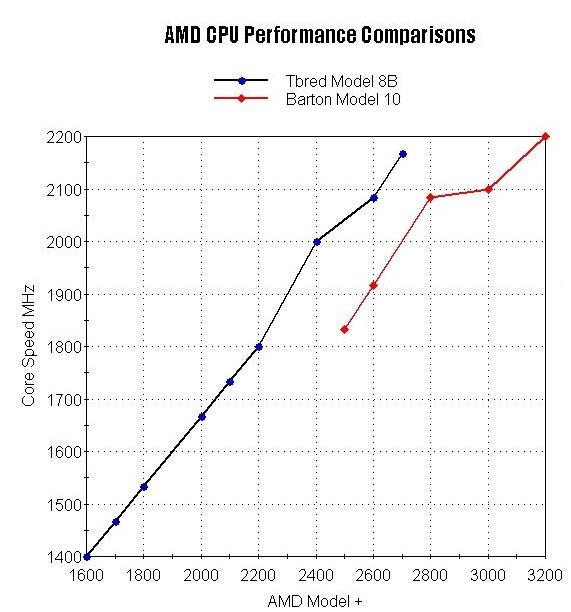
The following graph indicates the performance levels of all currently available Throughbred Model 8B and Barton core Model 10 AMD Processors.
Since it is assumed that as the Model number increases, as does the retail cost, then the steepness of the line graphs can illustrate a Ratio between performance speed and end user cost.
For Thoroughbred 8B processors, which is represented by the black line, there is a steady increase for performance levels relating to processor models AMD 1600+ to 2200+, since this gradient is constant within this range, then it can be assumed that you will recieve the same marginal performance for each unit of currency spent.
However as we reach the marginal performance of the 2400+ chip over the preceeding 2200+ chip, the steepness of the gradient is stronger, this implies that for the additional cost of a 2400+ over a 2200+ cpu, the benefits reaped are dramatically increased. The increase in core speed is actually an extra 200MHz, and this ratio is never matched anywhere else on the graph.
I was hoping to create a similar graph which plots processor core speed against cost of cpu, but since such retail costs can differ day to day, then the eventual results would soon become redundant. Therefore assuming that the cost difference between models maintains some form of regularity, then the processor which currently offers the best bang-for-buck or pizzazz-per-pound is the AMD Thoroughbred Model 8B 2400+ CPU.
CPU OEM prices including VAT - as of 4th August 2003
| All stores are UK based | 1600+ | 1700+ | 1800+ | 2000+ | 2100+ | 2200+ | 2400+ | 2600+ | 2700+|
E-buyer |
�35 | �37 | �39 | �49 | �68 | �49 | �60 | �75 | �99 |
hardwareoptions.com
| - | - | �41 | �47 | - | �52 | �59 | �73 | - |
E to Q | - | �41 | �44 | �49 | - | �51 | �60 | �72 | �105 |
Stak.com
| - | - | - | - | - | - | - | - | - |
Komplett |
- | - | �40 | �49 | - | �50 | �61 | �80 | �105 |
Ronal | - | �39 | - | �49 | - | - | �65 | - | - |
Dabs.com | - | �37 | �39 | �46 | - | �51 | �60 | �73 | �99 |
Microdirect |
- | - | �51 | �50 | �64 | �52 | �64 | �77 | �104 | |
Palomino refers to the original AMD Athlon XP processor (Model 6)
The Palomino was manufactured using AMD�s .18-micron copper process technology in model numbers ranging from 1500+ to 2100+, while the Thoroughbred is manufactured using AMD�s .13-micron copper process technology in model numbers ranging from 1700+ to 2800+.
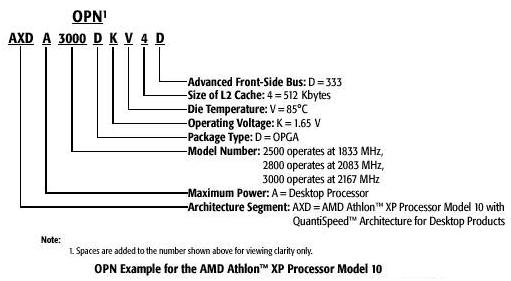
The Palomino and Thoroughbred processors may be differentiated by their ordering part numbers (OPN). How to Indicate each AMD CPU.
Difference Between "Palomino" and "Thoroughbred" Processors
Thoroughbred refers to a subsequent revision of the AMD Athlon XP processor (Model 8).
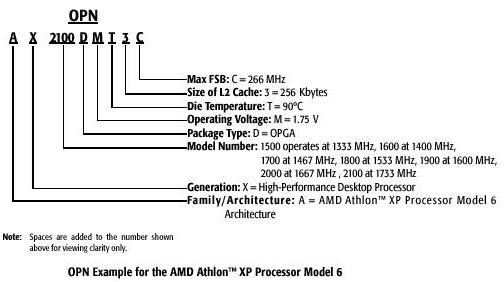
The Palomino's OPN is located on the processor die, and begins with the letters "AX" (e.g., "AX2100DMT3C").
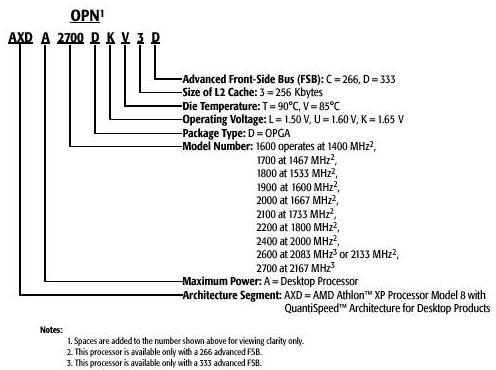
The Thoroughbred's OPN is located on a black label on the processor package (not on the die)
and begins with the letters "AXDA" (e.g., "AXDA2800DKV3D").
The following charts are taken directly from the OPN PDF files available from the official AMD website,
and help shed some light on the specification of each AMD processor.
If you are currently deciding to upgrade your AMD cpu, but are unsure which models your motherboard can support, then AMD offer a very handy tool.
To discover what range of AMD processors your current motherboard can handle, just follow these tips:
This information is displayed to you in a handy webpage format, so once you have run Belarc, you can save the specifications of your PC onto you hard drive as a simple webpage. Be careful who you share this information with though, since if you are running a retail version of Windows, belarc can even recover your WINDOWS SERIAL PRODUCT KEY, which is highly useful for yourself, but not very wise to let others know.
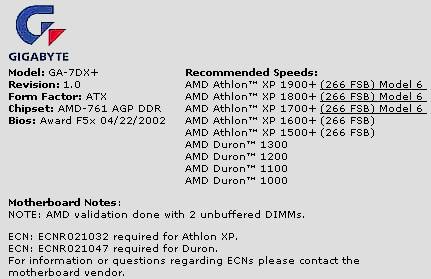
For example, for the Gigabyte GA-7DX+ motherboard, the following processors apply,
as approved by the official AMD.com website.