Mike's rough Time Dilation sketch.
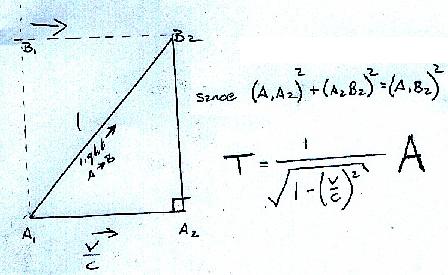
Ok.
You are stationary on Earth.
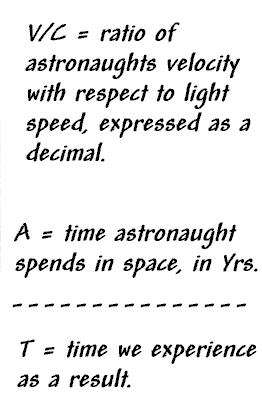
An astronaught travels at a velocity which can be expressed as a ratio of the speed of light.
Velocity of astronaught (with respect to a stationary observer) = V
The speed of light (300,000 KM/s) = C
Therefore the ratio between the two is V/C
Example
If V=150,000 KM/s
and C=Constant value of 300,000 KM/s
Then the ratio between the two is V/C = 150,000 / 300,000 KM/s
Or to simplify : ratio V/C = 0.5 , a half , 50% (call it what you like).
So, if an astronaught travels at V/C = 0.5,
then place this figure into the equation from above 
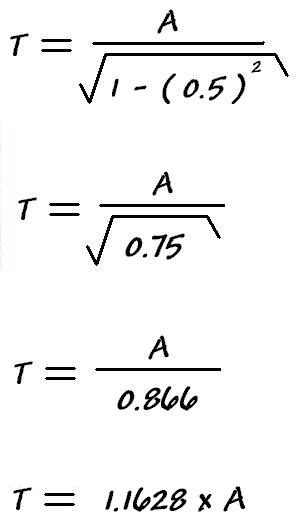
This means that if an astronaught travelled at 50% C for a duration of 25yrs,
then the time he ages is A=25 yrs.
However upon his return, he would discover that the innocent stationary bystander on Earth,
would have actually Aged at a rate of T=1.1628 x A
Which is 29 years.
This is quite an impressive time lapse, but not as impressive as if you increase the Velocity to a greater ratio of C.
Have a play with the equation, enter some new values
Remember apart from the calculations, all you have to manipulate is :
For instance, at a velocity ratio of V/C = 98% (0.98)
Where the astronaught travels for only 10 years in space, A = 10 yrs
The time elapsed on our "stationary" planet
during his 10 year journey is actually = 50 yrs and 3 months.
For the cynics out there, who may wish to argue that this is all just mere speculation,
these speeds have been achieved to date using particle accelerators.
Infact, at Fermilab, Protons have reached a top speed to date of 99.999946 % of C.
I have been thinking about this, and it actually presents a slight Contradiction within my mere mushy head.
What troubles ya Mike

