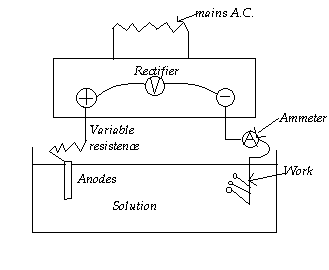
The electroplating of metals is generally carried out in order to improve the appearance or corrosion resistance of a surface by electrodepositing a thin layer of some desired metal on it.
Electroplating
In electroplating, the plating metal is generally the anode, and the object to be plated is the cathode. A solution of a salt of the plating metal is the electrolyte. The plating metal is deposited on the cathode, and the anode replenishes the supply of positive ions, thus gradually being dissolved. Electrotype printing plates, silverware, and chrome automobile trim are plated by electrolysis.
at the anode:
The metal to be electroplated to the surface is oxidized to cations which enters the plating solution.
M(s) ® Mn+(aq) + ne-
at the cathode:
The cations in the plating solution migrates to the cathode, where they are reduced to metal and deposited onto the surface of the metal being plated.
Mn+(aq) +ne- ® M(s)
Metals are finished for many reasons. A finish may be defined as any final operation applied to the surface of a metal article in order to lend it properties not possessed by the article in its "unfinished" form.
Electroplating is a kind of metal finishing. The purposes of electroplating an article are for:
3) Special Surface Properties, or
4) Engineering or mechanical properties
Many metal products such as Zinc die castings and ordinary steels, which are the least expensive metals available, are dull and not attractive. A thin coating of a metal such as chromium enhances their appearance and adds to their sales value. Chromium can be plated in a bright condition, and when properly applied, it maintains its brightness over long periods. For this reason chromium is the most common electroplate for decoratve purposes. But since coatings of chromium thick enough to retain some measure of their original appearance are difficult to apply and very expensive, docorative chromium depoits are almost universally applied over undercoats of copper and nickel or nickel alone, and the final chromium coating is very thin.
Other electroplated metals used for decorative effects include gold, silver, brass, bronze, nickel, copper and rhodium. Lead and tin are sometimes used for special effects.
The function of protecting the basis material from degradation overlaps that of improving its appearance. The common Copper/Nickel/Chromium applied also protects the substrate from corrosion. However, when corrosion prevention is the principle aim of the coating, zinc is the most economical and most effective metal available.
The cell used in electroplating contains an electrolyte which is usually but not always an aqueous solution containing a reasonably high concentration of an ion of the metal which is to be electroplated on to the surface. This elevtrolyte is called by platers the "Bath".
The plating bath is practically always an aqueous solution containing a compound of the metal to be deposited (to be electroplated on the surface). The object to be plated is made the cathode of the plating cell. The cell anode is often a bar of the metal to be plated from solution, so that the anode reaction of metal dissolution replaces the metal ion lost from solution by cathodic deposition.
Ingredients of a Plating Bath serve one or more of the following functions:
to provide a source of the metal or metals being deposited.
to form complexes with ions of the deposition metal
to provide conductivity
to stabilize th solution, eg, against hydrolysis
to act as a buffer, ie, to stabilyze the pH
to modify or regulate the physical form of the deposit
to aid in dissolving the anodes
to modify other properties, either of the solution orof the deposit, peculiar to the specific case.
To ensure a strong and close bond between the object to be plated and the plating material, the object must be cleaned thoroughly by dipping it into an acid or caustic solution, or by making it the anode in a cleaning bath for an instant. To eliminate irregularity in the depth of the plate, and to ensure that the grain at the surface of the plate is of good quality and conducive to polishing, the current density (amperes per square foot of cathode surface) and temperature must be carefully controlled. Colloids (see COLLOID) or special compounds are often added to the bath to improve the surface uniformity of the plate.
Definition of Electrolysis--Back Menu Next--Definition of Electroplating Page written and maintained by 5E Wong Mei Chi Michi