 |
| @ |
|
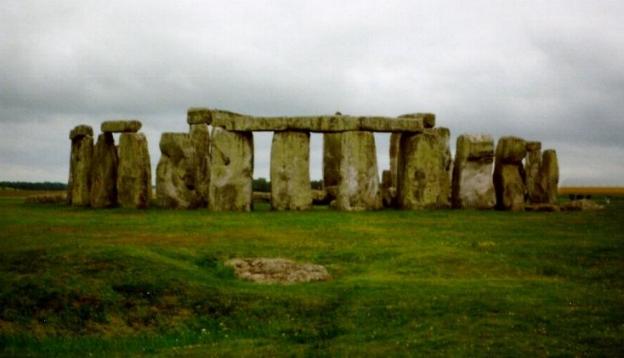
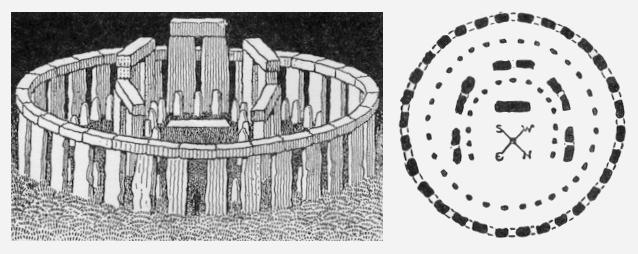
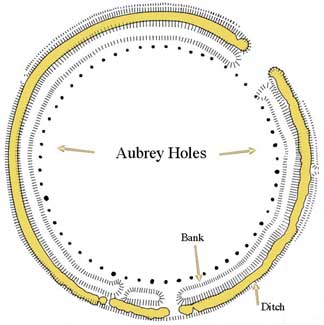
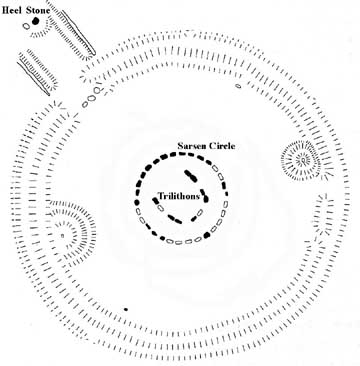
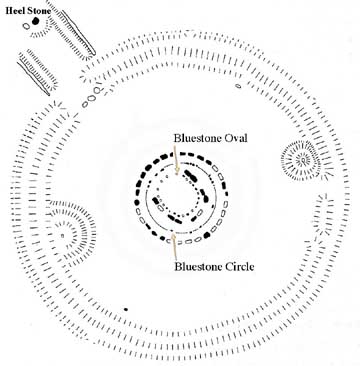
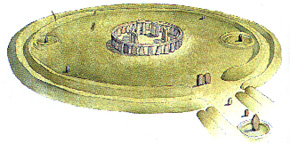
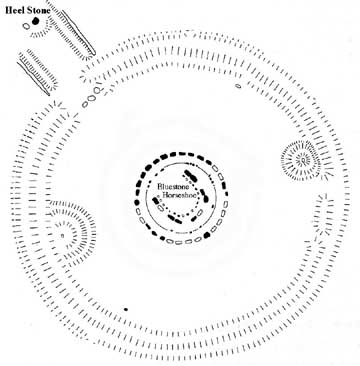
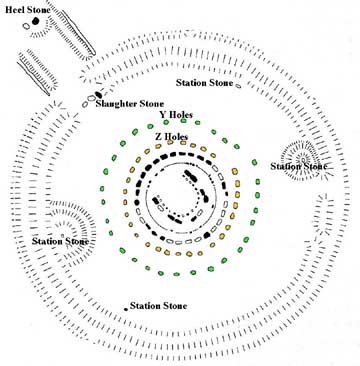
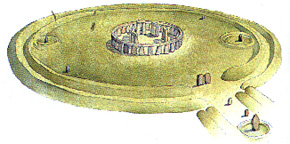
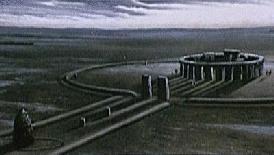
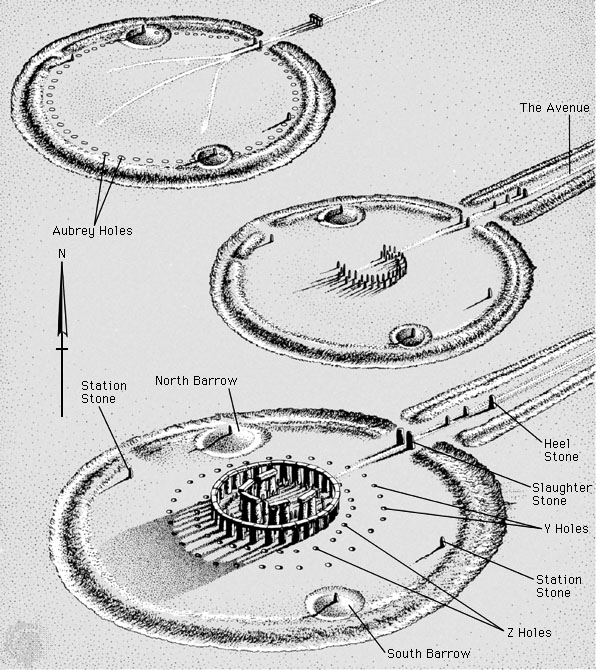
| Stonehenge is a world famous prehistoric monument, dating back thousands of years (approximately 3100BC). The megalithic ruin is situated on the Salisbury Plain approximately three kilometres (2 miles) west of the town Amesbury, Wiltshire, in Southern England. It is not a single structure but consists of a series of earth, timber, and stone structures that were revised and re-modelled over a period of more than 1500 years. It is a site of great interest since no one is entirely sure why it was built. There are many theories, ranging from an astronomical observatory (aligned in such a way that it can be used to predict eclipses etc), to religious temples, to a calendar. Stonehenge itself consists of two nested circles around two nested semi-circles. There is a large outer circle of thirty sandstone blocks called the sarsen stones. The tall sarsen stones are almost 14 feet high. A continuous circle of thirty stones called Lentils run across the top of the Sarsen stones. The circle of lentils is held on top of the sarsens by mortices, tenons, and tongue-and-groove joints. The outer circle is approximately 108 feet in diameter. Inside the sarsen stones is a circle of thirty much smaller bluestones. Inside the sarsens and bluestone circles are two smaller semicircles. The first is of tall sandstone (called Trilithons), the second shorter bluestone. Inside the semicircles is a large sandstone block called the Altar Stone. A final stone called the Heel Stone lies eighty yards east of the Altar Stone. Stonehenge is oriented to mark the sunrise and moonrise at the summer and winter solstices. At sunset of the Summer Solstice the Heel Stone will cast a shadow on the Altar Stone. The exact usage beyond that is uncertain. As different groups have altered the site the uses have most certainly changed somewhat. Stonehenge was constructed in three or four stages between 3100 BC and 1100 BC. Stage I (3100 - 2300 BC) - Neolithic Age The earliest portion of the complex, which dates to approximately 3100-2300 BC, comprised a circular ditch of about 330 feet (100 metres) in diameter with an internal bank, and a northeastern entrance. Just inside the earth bank is a circle of 56 Aubrey holes (named Aubrey holes for their 17th-century discoverer, John Aubrey) that held wooden posts. Probably also dating to this time are the four Station Stones (only two of which survive). These sarsens stood just inside the Bank on more or less the same line as the Aubrey Holes. Circular ditches 10 to 12 metres in diameter surrounded two of the Station Stones. These have caused the area enclosed by the ditch to appear mound-like and have lead to the erroneous identification of each mound as a burial barrow. The now fallen Slaughter Stone, located at the break in the bank and ditch, may date from this period, as well as the Heel Stone, located further out along the Avenue. After 2900 BC and for approximately the next 500 years, postholes indicate timber settings in the center of the monument and at the northeastern entrance. The Aubrey Holes no longer held posts but were partially filled, (some with cremation deposits). The numerous postholes indicate timber structures, but no clear patterns or configurations are evident that would suggest their shape, form, or function. Stage II (2100 - 2000 BC) People of the Beaker Culture built an earthwork approach road to the entrance of the bank and ditch, called the Avenue. The Beaker Culture used bluestone from the Preseli Mountains in southwestern Wales, to set up the double concentric circle of Menhirs (large, rough-hewn standing stones) within the earlier ring. Both the Avenue and the double circle were orientated toward the summer solstice sunrise. The double circle was never completed and was dismantled during the following period. The Trilithons are ten upright stones arranged as five freestanding pairs each with a single horizontal lintel. They were erected within the Sarsen Circle in the form of a horseshoe with the open side facing northeast towards the main entrance of the monument. They were arranged symmetrically and graded in height, the tallest is in the central position. Only three of the five trilithons are now complete with their lintels. The other two have only one standing stone with the second stone and lintel lying on the ground. The Sarsen Circle, of about 108 feet (33 metres) in diameter comprised originally of 30 neatly trimmed upright sandstone blocks (Sarsens) of which only 17 are now standing. These stones, which stand on average 13 feet (4 metres) above the ground, are about 6.5 feet (2 metres) wide, and 3 feet (1 metre) thick, supported a continuous ring of sarsen lintels (held in place by tongue-and-groove joints). Each lintel block has been shaped to the curve of the circle. The average length of the rectangular lintels is 3.2 metres (10' 6"). The 35-ton heel stone was possibly placed during the second period. Its placement was one of the most sophisticated accomplishments of that age and provides the best evidence that early people used astronomy. The sarsen Heel Stone is approximately 4.88 metres (16 ft) high, with another 1.22 metres (4 ft) buried below ground. A circular ditch of approximately the same dimensions as the ditch surrounding each of the two Station Stones surrounds the Heel Stone. The stone now leans out, but most likely would have once stood vertically upright. Originally, the Heel Stone may have been paired with another stone now missing. On Midsummer Day (June 24 then, now June 21) a person standing in the center of the circle can see the sun rise directly above the heel stone. Stage III (2000 - 1550 BC) During Stage III the monument underwent a complicated sequence of large stone settings. The first stone setting consisted of a series of Bluestones placed in what are known as the Q and R Holes. These were subsequently dismantled and a circle of sarsens and a horseshoe-shaped arrangement of trilithons erected. A circle of 30 sarsen stone (weighing up to 50 tons each) uprights 30.5 m (100 ft) in diameter and capped by a continuous ring of sarsen lintels was erected in the center of the site. The Sarsen Circle with its lintels is perhaps the most remarkable feature of Stonehenge in terms of design, precision stonework, and engineering. This circle surrounds a horseshoe-shaped setting of five trilithons (formations in which two uprights support a lintel). After transporting the sarsen stones from Marlborough Downs, 30 km(20 miles), the stones were shaped and jointed together with stone hammers. Other changes involved adding, moving, and rearranging stones that had been used during the second period. No other megalithic structure in northwestern Europe displays the precision and architectural refinement that Stonehenge does. Some of the bluestones were later re-erected in the center in an oval structure that contained at least two miniature trilithons, and holes were dug for the rest to be set in two concentric circles (Y and Z holes) outside the sarsen circle. The Y and Z Holes were dug for the placement of stones but were never filled. This plan was abandoned, and the bluestones were finally rearranged (1550 BC) in the circle and horseshoe that still remains today. Assigned to Stage III are also Stone holes D and E and the recumbent sarsen known as the Slaughter Stone located on the northeast side in a break in the bank and ditch in what is regarded as the main entrance to the monument. The term "Bluestone" refers to various types of mostly igneous rocks including dolerites, rhyolites, and volcanic ash. It also includes some sandstone. The Bluestones at Stonehenge are believed to have originated from various outcrops in the Preseli Hills in Pembroke shire in Wales. How they were transported to the site at Stonehenge has been the subject of much speculation. Stage IV (1550 - 1100 BC) The Avenue was extended a further 2 km (1.25 miles) from Stonehenge to the River Avon. Finally, mention should be made of the so-called Altar Stone, a large dressed block of sandstone that lies embedded in the ground within the Trilithon Horseshoe and 'in front of' the central and largest trilithon pair. Two fallen stones now lie across it. The stone is believed to be Cosheston Beds Sandstone from south Wales, and is the only example of this type of stone at Stonehenge. It is 4.9 metres (16 ft) long, 1 metre (3� 6�) wide, and 0.5 metres (1� 9�) thick. |
 |
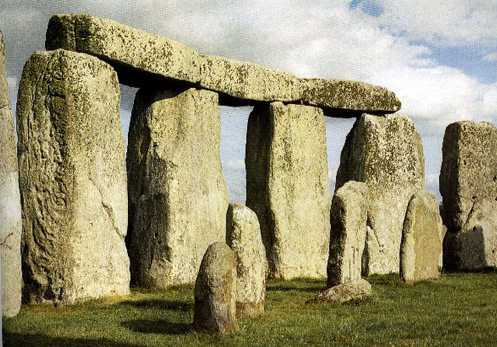 |
| Part of the outer Sarsen Circle with lintels in place. Bluestone Horseshoe In front. |
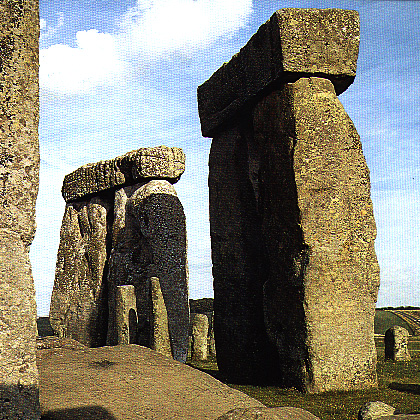 |
| Two of the Trilithons In front of them stand two of the upright bluestones that originally formed an oval inside the horseshoe of Trilithons. |
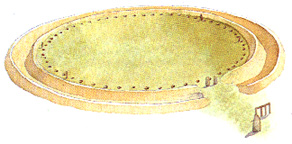 |
| Stonehenge Stage I. (3100-2300 BC) (image from Mohen, pg. 130) |
 |
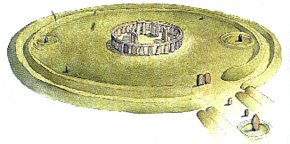 |
| Stonehenge Stage II. (2100-2000 BC) (image from Mohen, pg. 130) |
 |
 |
 |
| Stonehenge Stage III. (2000-1550 BC) (image from Mohen, pg. 130) |
 |
 |
 |
| Stonehenge Stage IV. (1550-1100 BC) (image from Mohen, pg. 130) |
 |
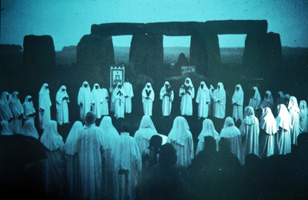
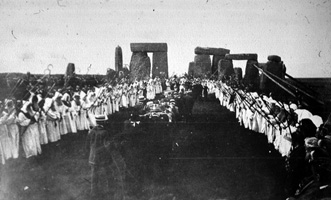
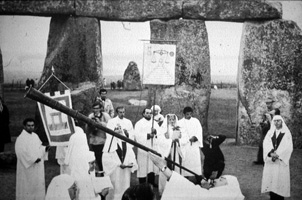
| An interesting fact most people know is that Stonehenge is angled such that on the equinoxes and the solstices, the sun rising over the horizon appears to be perfectly placed between gaps in the megaliths. Most people don't realise however, that this is purely coincidental - the Earth's orbit has shifted several times in the 5000 years since it was built, and at the time of it's construction, the sun would not have lined up with the gaps at all! Stonehenge's axis is pointed roughly in the direction of the sunrise at the summer and winter solstices. Some scientists believe that early peoples were able to foretell eclipses of the sun and the moon by the positions of these celestial bodies in relation to the stone monument. The site may have served as an observatory where early rituals or religious ceremonies took place on specific days of the year. The early belief that the monument was built as a temple for sky worship has never been definitively proven. A common misconception is that Stonehenge was built by Druids (a caste of Celtic priests). Druids were not around until a few hundred years before the Christian era - long after Stonehenge was constructed, making their involvement in its construction very unlikely. |
 |
 |
 |
 |