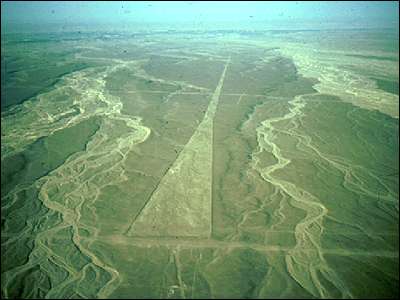
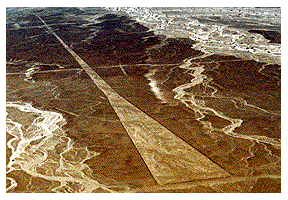
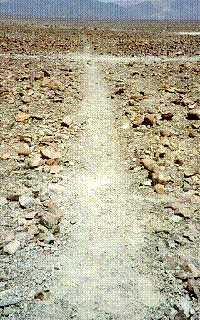
In the Peruvian desert, about 200 miles south of Lima, there lies a plain (Pampa) between the Inca and Nazca valleys. Across this plain, (in an area measuring 37 miles long and 1 mile wide) is an assortment of perfectly straight lines, some running parallel and others intersecting to form a grand geometric form.
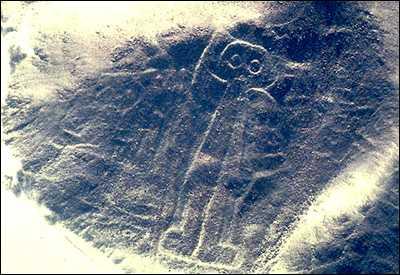
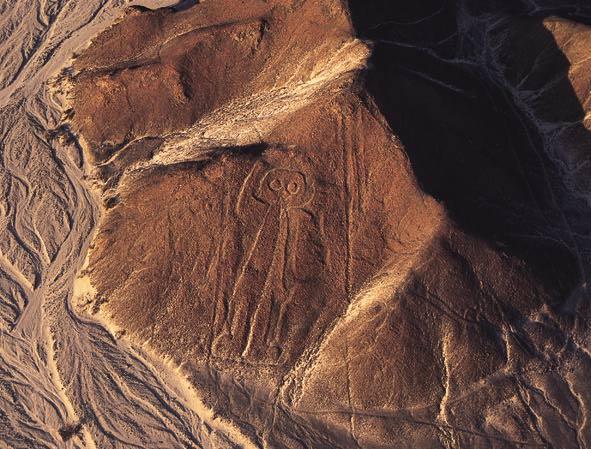
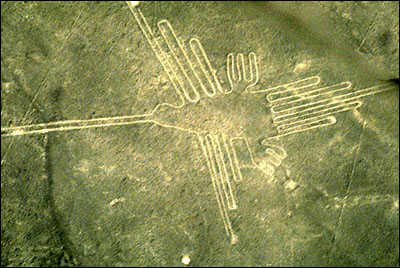
With in this area there are trapezoidal zones, strange symbols, and pictures of birds and beasts all imprinted in large scale. The figures come in two types, Biomorphs and Geoglyphs. The Biomorphs are some 70 animal and plant figures that include a spider, hummingbird, monkey and a 1,000-foot-long pelican. The Biomorphs are grouped together in one area on the plain, �some archaeologists believe they were constructed around 200 B.C., about 500 years before the Geoglyphs�.
There are about 900 Geoglyphs on the plain. Geoglyphs are geometric forms that include straight lines, triangles, spirals, circles and trapezoids. They are enormous in size.
Although the recognisable animal Biomorphs draws most of the attention at Nazca, they are in fact dwarfed by the huge trapezoidal (wedge-like) designs. Some of these wedges have sides more than 2,500 feet long. The wedges, in turn, are outdone by the lines themselves, which run perfectly straight for up to 5 miles. Many of the images are so big that they can only be viewed from the air at a height of 1,000 feet. So for whom were these lines and figures created.
The Nazca plain is virtually unique for its ability to preserve the markings upon it, due to the combination of the climate (one of the driest on Earth, with only twenty minutes of rainfall per year) and the flat, stony ground which minimises the effect of the wind at ground level. With no dust or sand to cover the plain, and little rain or wind to erode it, lines drawn here tend to stay drawn. These factors, combined with the existence of lighter coloured subsoil beneath the desert crust, provide a vast writing pad that is ideally suited to the artist who wants to leave his mark for eternity.
Since the Nazca Lines were discovered in the 1930s, not one single theory has been put forward to explain all of the marks on the desert plain. A prominent scientist has called it 'one of the most baffling enigmas of archaeology'.
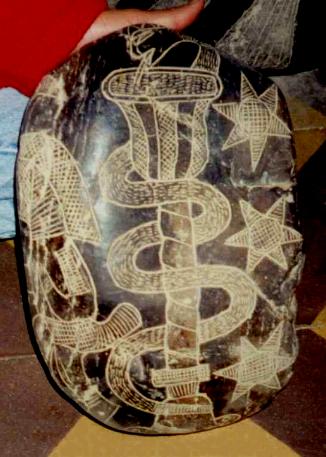
One theory is, that the lines of the Pampa were originally made on a lower sub-surface layer below the present surface, what we see today is actually a "shadow effect" of the original template. The theory is that the symbols of the Pampa were magnetically stamped into the surface creating a force that could both conserve and protect them from natural disaster. This magnetic puzzle would continue to function forever attracting odds and ends of ferrous surface materials into the design, holding the surface layer as a shadow of it's former self. Several etchings on the Ica Stones show ships suspended in an electromagnetic cushion whose energetic field is controlled by both the surface of the planet itself, and the craft.
As for the mystery of how the Nazcans managed to raise mountaintops and draw perfectly straight lines over ravines, it must be said that these achievements, are no more significant than the achievements of other ancient peoples elsewhere in the world, the Great Pyramid of Giza for example.
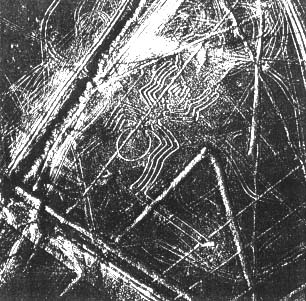
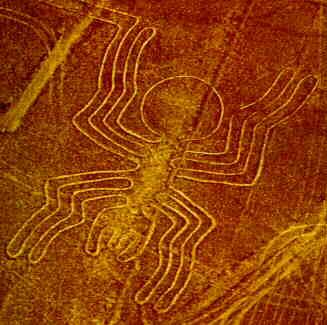
One remarkable drawing, a Nazcan spider, measures some 150 feet in length formed by one continuous line. What is remarkable about this drawing is that it depicts a unique spider, a member of a spider genus known as Ricinulei which is of such rarity measuring less than an eighth inch in size and is found only living beyond the reach of sunlight in the Amazon rainforest nearly 1,000 miles from these Nazcan drawings. In other words, the drawing is Nazcan, the spider isn't.
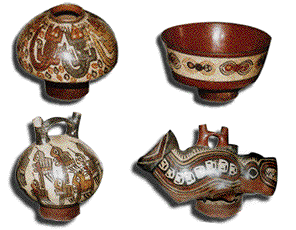
An astonishing piece of evidence is the resemblance of the Nazca Biomorphs to certain features found on Nazcan pottery. This is an important issue because it potentially offers proof that the Nazcans had either designed the images or at least viewed them from the air.
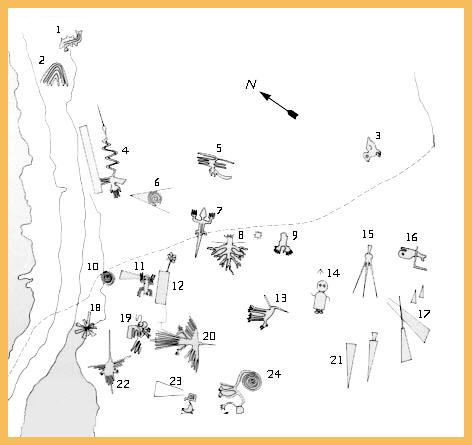
1) Killer whale 2) Wing 3) Condor 4) Bird 5) Animal 6) Spiral 7) Lizard 8) Tree 9) Hands
10) Spiral 11) Spider 12) Flower 13) Dog 14) Astronaut 15) Triangle 16) Whale 17) Trapezoids
18) Star 19) Pelican 20) Bird 21) Trapezoid 22) Hummingbird 23) Trapezoid 24) Monkey
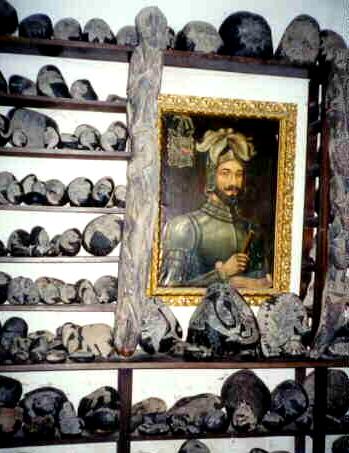
Ancient carved Stones called Ica or Gliptoliths. The Stones comprise a sophisticated library left behind by an ancient lost civilization including images of medical transplants and blood transfusions, men with dinosaurs, and advanced technology such as telescopes and surgical equipment. The library is organized by subject matter including the races of man, ancient animals, lost continents, and the knowledge of a global catastrophe.
|