| @ |
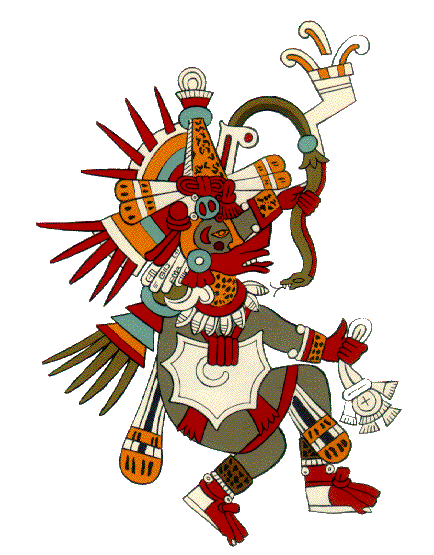
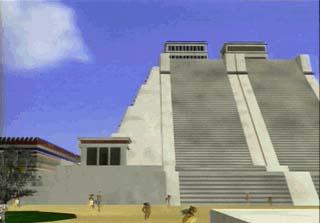
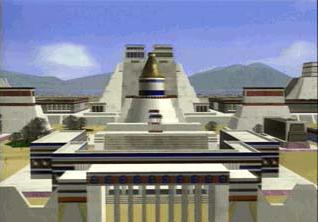
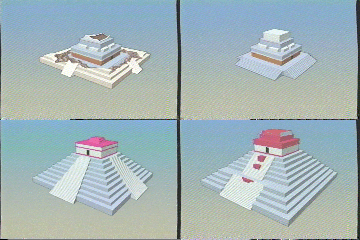
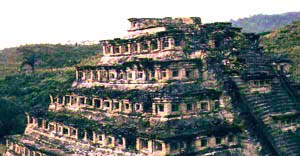
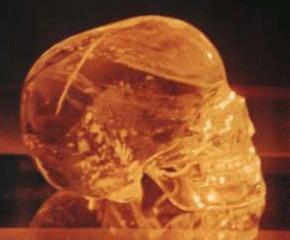
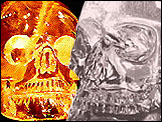
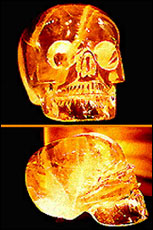
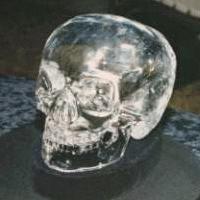
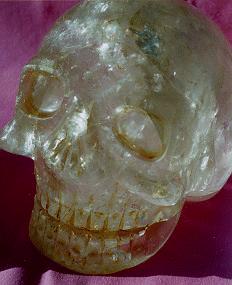
Tenochtitlan, the capital of the Aztec Empire, flourished around 1300 A.D. as the last ancient civilization on earth. This town was a city built on small islands. A pyramid 45 meters in height towered above all in the centre of the city. This was used for ceremonies in which sacrifices to the gods were performed. The Aztecs were a very religious race and strongly believed in the practice of sacrificing people to please the gods. They sacrificed over 20,000 people a year. The emperor thought that a special temple should be built for the deadly ritual, so, the Aztecs built the Sacrificial Temple. One example of such a temple would be the Great Temple of Tenochtitlan. The cities of the Aztec empire always wanted to make their sacrificial temple better than any other cities. They decided not to destroy the old temple, but to build over it! They made temples larger, more extravagant, and more pleasing to the eye with each new layer. In addition, the temples had more steps, more decorations, and a larger sacrificial area. (These temples look a lot like the great Egyptian pyramids except they do not have a pointed top. Instead, they have a flat top with two small compartments where the sacrifices were held.) In a rare find, archaeologists found a temple that was built over six times! Each new temple was more magnificent than the others. The Aztec (Mexica) Empire 1300-1519 The mighty Aztec Empire was a group of American Indian people who ruled in Mexico in the 15th and 16th centuries. The ancestors of the Aztecs migrated for many years before settling in the 13th century in the valley where the empire later existed. By 1325 the Aztec had established the city of Tenochtitlan that became the capital. This very advanced and religious civilization built large cities, as big as any in Europe. Much of the architecture was made up of huge towering temples that they used to worship their gods. They also built large sculptures and held very intricate ceremonies where bloody human sacrifices would sometimes take place. Shortly into their second century as a great empire, the Aztecs were conquered and destroyed by the Spaniards in 1521. Although the Aztec empire was destroyed, the Aztec people and their culture continue to shape the culture of modern Mexico. The centre for the Aztec civilization was in the Valley of Mexico that placed them at about 7.5 thousand feet above sea level, which provided a very mild climate in spite of being in the tropics. The largest city and capital of the Empire, Tenochtitlan, present day Mexico City, was located on an island in Lake Texcoco and connected to the mainland by raised earthen roads. The emperor of the Aztec people was called the Huey tlatoani, which means great speaker. Chosen by a council of Nobles, the emperor had great power, but still needed to consult with his council before making the more important decisions. The cities were protected by strategically placed military units that were run by a "great noble," who also served as a governor. Government offices were inherited, but the highest positions were received only through loyalty and service to the emperor. The civilization was divided into four classes like many of its time. The classes were: nobles, commoners, serfs, and on the bottom, slaves. Commoners made up the majority of the population and made their living farming for others. Serfs worked for the nobles, farming and living on the land. Slaves were treated as property, but their children were considered free. Slaves were usually prisoners of war, criminals, or people not able to pay off certain debts. The Aztecs, who worshiped hundreds of divinities, used religion as a focal point in all of their lives. Many times they would wage war just to capture prisoners to sacrifice to their gods. All of the gods ruled over at least one human activity or some aspect found in nature. Many of the ceremonies were held to ensure good crops and win favours with the gods. Human sacrifices were made to give strength to the gods and pass bravery down to anyone who ate the flesh of the victims. Most, but not all ceremonies; were held inside ceremonial centres on top of a large, pyramid-shaped structure called a Teocallis. The Aztecs also developed a 260 day calendar to represent the lucky days which they would sow crops, build houses, or go to war on. The Aztec Calendar In the Aztec civilization households usually consisted of a husband, wife, unmarried children, and other relatives. Each member of the family; as well as extended, helped each other with the workload. While the husband's main job was to support the family by farming or craftwork, the wives did household chores like making clothing and cooking meals. Boys stayed home learning from their fathers until they were ten, then they would go to school and receive a general education along with some military training. Some girls attended schools, but they generally learned skills from home. The main food consisted of a thin cornmeal pancake, along with Tlaxcallis used to scoop up other foods forming a kind of taco. Much of the meat came from hunting. They produced an alcoholic beverage from the Maguey plant. The lower class also used the maguey fibres for their clothing. The upper class used cotton material along with highly decorated cloaks for their clothes. Houses were small and built more for utility than beauty. Houses made of thatched roofs and branch walls covered in clay covered the cities along with a few stone houses surrounding patios for the rich. Temples were elaborately decorated with colourfully painted sculpture. They also decorated their round stone calendars. They also had forms of oral literature or poetry, along with traditional accounts of their history. Music was used in religious practices and even for some personal enjoyment. Other crafts included pottery, weaving, metalworking, and woodcarving. War played an important role in Aztec culture. Men, in return for rewards, would try to take many men captive without killing them for religious sacrifice and slavery. The men wore padded cotton armour and used wooden clubs, arrows, spears, and shields during battle. Agriculture was the biggest part of the Aztec economy with corn being the principle crop. Farmers, using a pointed stick for digging, also grew beans, avocados, sweet potatoes, squash and tomatoes. Another thriving part to the Aztec economy was the market place. With government officials supervising the trading, over 60,000 people visited the markets daily. Without having a money system, as we know it, the Aztecs were believed to have bartered goods and services in return for other goods. Today many of the ruins and objects found from the Aztec's civilization can be found in present day Mexico City. Many people in Mexico have ancestors from the Aztec Empire and still speak, although in a modernized form, the ancient Nahuatl language. Origin Theories: Celestial Gifts or Skulduggery? Regardless of any unearthly properties the crystal skulls may or may not possess, the question remains: where did they come from? There are countless hypotheses that they are the legacy of some higher intelligence. Many believe they were created by extraterrestrials or beings in Atlantis or Lemuria. One elaborate theory maintains that the skulls were left behind by a sophisticated Inner Earth society that lives at the hollow centre of our planet, and there are thirteen "master skulls" which contain the history of these people. The most obvious answer to the mystery is that native artisans in Latin America or elsewhere crafted the skulls themselves. The Mayans are most often associated with them, although some doubt that they could have made the skulls, and not simply because of the technical conundrum the job poses. One theory holds the Aztecs as a more likely candidate to have created them. Skull imagery figures prominently in Aztec art and religious symbols, and not in that of the Mayans. The Aztecs were also more highly skilled in sculpting with crystal. It could be that the skulls found in Mayan ruins are actually displaced Aztec relics... or, as some suspect, this incongruity may indicate that some accounts of the skulls' origins are phoney. Many sceptics feel that the crystal skulls are probably of a much more recent vintage than their accompanying stories suggest. This, they believe, is the best way to explain their existence, since no one could have created them without technologies available only within the past century. Since carbon dating only works on organic substances, it is impossible to determine just how old a crystal skull is. But one recent study found reasonable signs of some skulls' relative youth. A May broadcast of the BBC documentary series "Everyman" reported on studies of a number of crystal skulls and other artefacts of supposedly ancient origin conducted at the British Museum. Using electron microscopes, the researchers found that two of the skulls possessed straight, perfectly spaced surface markings, indicating the use of a modern polishing wheel. Genuine ancient objects would show haphazard tiny scratches from the hand-polishing process. The report speculated that these skulls were actually made in Germany within the past 150 years. Even the regal Mitchell-Hedges skull is not without scandalous accusations of fraud. Some believe that F.A. Mitchell-Hedges had the piece commissioned by a sculptor, and planted it in the Lubaantun ruins for his daughter to find as a spectacular birthday present. The validity of this charge is uncertain, but even if the Mitchell-Hedges skull is of modern origin, its structure is no less extraordinary. In all likelihood, every crystal skull in the world was fashioned by plain old human beings of some sort, and regardless of whether the work was carried out five years ago or five hundred years ago, we still don't have any idea how they did it. |
| Aztec Culture |
 |
 |
 |
 |
 |
 |
 |
 |
 |
 |