ZINES AND E-ZINES ROCK MISSION HIGH SCHOOLVolume 1 Number 1 Spring 2001 CAN SCHOOL EVER BE REAL?
Mission Statement | Hotlist | Book Reviews | Zine Process | Zines I Like | Student Zines 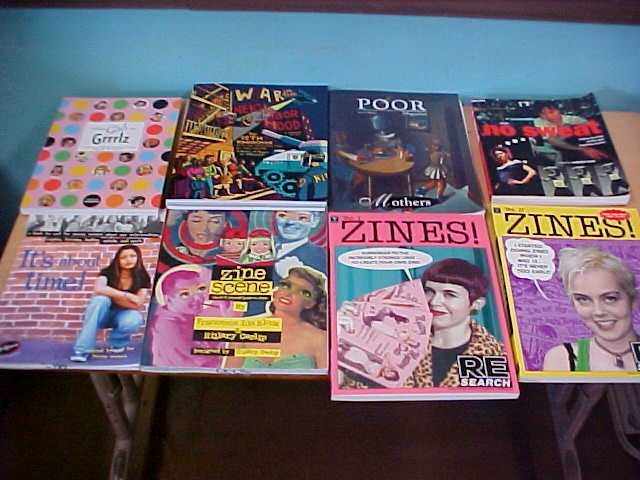 |
ZINES AND E-ZINES ROCK MISSION HIGH SCHOOLVolume 1 Number 1 Spring 2001 CAN SCHOOL EVER BE REAL?
Mission Statement | Hotlist | Book Reviews | Zine Process | Zines I Like | Student Zines |
| ZINES CAN…
· Break the silence · give you a voice · express feelings · say what matters · right wrongs · show what you can do · let you be counted · help you take a stand · make you visible
A small handmade amateur publication
|
MISSION STATEMENTThis is a zine which will detail the fun and excitement of doing a zine project in an American Lit classroom at Mission High School. It all started with the idea that instead of writing nothing but essays all year we could do shorter, tighter writing pieces which would lend themselves to more concentrated revisions and so better move along the writing process. Students who were ESL or had special needs or who maybe missed class frequently would be able to plug into a project that was made up of many small pieces. This would insure a greater chance for success and make the best use of whatever time was invested in class. There was also the remote possibility that by focusing on shorter, tighter pieces, we could take care of some of those pesky grammatical issues that kept recurring in essay after essay.So with high hopes we plowed through the first semester doing essays and reading a variety of texts whose themes would be used for the second semester independent reading. When second semester arrived, students had a choice of thirteen titles that reprised many of the themes we had discussed first semester. For the first title, book groups were formed, and for the second title, students worked independently. All of the year’s reading moved towards production of a zine on a topic that interested the student. Students were then grouped for zine production by the issues they chose to explore. Resources were provided and students were encouraged to do outside exploration. So the race is on to see who found out the most information, who designed the most readable zine and who knows more now than when they started. We’re off! |
First we looked at what others had done.BOOK REVIEWSRESearch, from V.Vale 1996, 180 pp , $18.99 Volume 1 starts out with many definitions of exactly what a zine is,
according to publications from “S.F. Examiner” to “Homegrown”. There
is a history of zines and examples from many different kinds of zines.
There is a zine directory and interviews with lots of people who have done
zines. Many of the pages look like cut and paste collages, with examples
from various zines laid out next to interviews and photographs and art.
Volume 2 picks up where the first vplume leves off, providing zine reviews
and profiles on additional zines and their creators. This volume
is slightly smaller but has the same cut and paste format that so many
zines use. The two volumes together give a good overview of the subject
matter of zines and a clear picture that a lot of zines contain material
that might be considered offensive to a mainstream audience. Not
all zines are well written or have decent art, but all zines have something
their creators want to say. These two volumes together give a good
idea about what’s out there in the zine world and are good resources for
anyone who wants to know what zines are all about.
Zine Scene
This book, put together by the popular novelist Francesca Lia Block is subtitled “The Do It Yourself Guide to Zines”. This book not only explains what zines are but gives you resources and ideas for producing your own zine. Early chapters include information on what zines are, how to find them, profiles of zine creators and a short history of zines. The second half of the book focuses on how to produce your own zine, providing information like how to make design decisions, some possible elements to include, how to pick a name, whether to work as an individual or group, where to do it and how to get the look you want. The final section includes information on how to raise money, how to distribute your zine and a special chapter on web and e-zines. The book ends up with some advice and resources. This is a good introduction to the whole process. There are a lot of graphics and samples and it’s laid out to be easily read and used.
|
From Girls to Grrrlz
By Trina Robbins Chronicle Books 1999, 144 pp., $17.95 This book by the well known cartoon artist provides a history of women’s
comics from teens to zines. This is a tribute to the “artists, authors,
and characters who have been entertaining women of all ages for years.”
The first chapter deals with the comics from 1941-1957 and subsequent chapters
take the history up through the 90’s covering those publications aimed
at girls, and later those aimed at women, then womyn and finally grrrlz.
She dates the comics business from 1938 and the creation of Superman, which
gave a superhero cast to all that followed in the comic world. Ms.
Robbins covers teen magazines geared to teen girls as well as to comic
books, detailing the letters and advice features which we take for granted
now, as well as the star profiles, and fashion tips. All of these publications
aimed at teen girls reflected the attitudes of their times if not what
was going on in the “real” world. Superheroines came in fairly early
historically but were not as popular as the girl romance comics or the
comics about teen life. Even with the feminist movement of the 60’s, comics
remained male terrain and very little of what was going on in the women’s
movement made it into the comics. Underground comics featured graphic
violence and the same retro attitudes towards women. But underground
newspapers were beginning to sprout everywhere, created by women, illustrated
and written by women. Here women’s issues finally got some expression.
Abortion and reproductive health, sex, dysfunctional families, weight issues
and coming out were dealt with. Today, when comic books are often
the first line of defense when it comes to censorship, it is exhilarating
to see so many women doing zines and comics, getting the word out about
what interests them. In the process they’re providing stimulation
for the younger grrrlz coming up who we all know have something big to
say.
|
| Then
we decided what we wanted to do.
WORDS CAN HAVE MEANING! Zines will exist in hard copy as well as on a website. Writing and a good portion of research will be done in class. Two websites exist to help people navigate the process. The first site is provided by our Zeum collaborator and instructor, Susan Mahony. That site can be reached at: userwww.sfsu.edu/~scmahony/mhs/mhs.html This site contains a basic overview of the project,as well as tutorials in various technical aspects of the project, everything from doing research, using search engines, importing graphics and designing pages using templates. The other site can be reached from the mission homepage, on-campus version
only and is located at:
This site contains hotlists on some of the selected topics and a sheet detailing the format for reporting information from various sources. Once research and writing is complete and “blocks” of writing are available, students will type and save material in a file. One file for all material for a particular zine is best. This material will then be basically cut and pasted into templates. Refinements on design and format can then be done on the templates. Zines can then be printed out for hard copy and saved as well as posted as web zines. 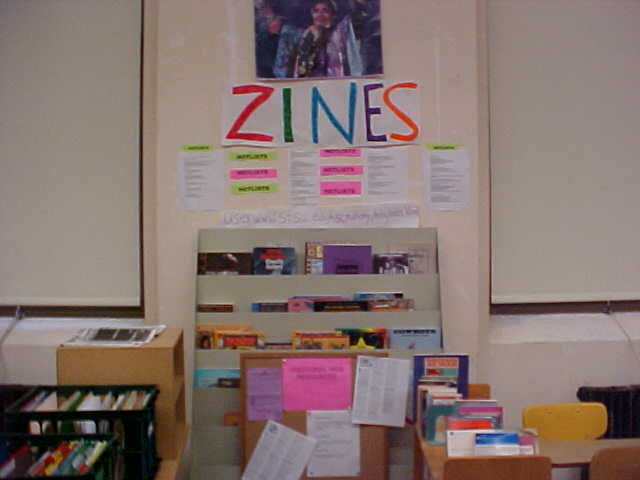 |
The name ’zine,’ short for ‘fanzine’, a science fiction fan magazine, may be new, but small, self-published pamplets and newsletters date all the way back to Ben Franklin’s Poor Richard’s Almanac, which was launched in 1757. Dadaist manifestos of the early 1900’s continued the trend and started a design style adopted by many of today’s zine editors. Science fiction zines proliferated in the 1920’s and ‘30’s, followed by punk rock zines in the 1970’s. Today’s zines cover political rantings, sex and sexual politics, hobbies, music, movies and just about every other topic that’s conceivable—and many that aren’t.San Francisco Examiner
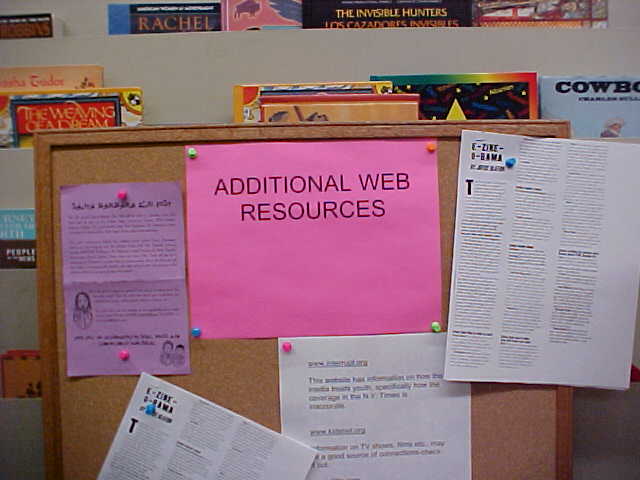
We researched zines and our topics. HOTLIST OF ZINE SITES www.gellyroll.com/teen/zines/zines.html http://www.fort.lib.wi.us/zines.html http://jayna.iturfpages.com/teenzines/html http://education.indiana.edu/cas/adol/teen.html www.ala.org/teenhoopla/comicszines.html www.pilot-search.com/links/zines/teen_literature/ Take a look at Lowell's Online Newspaper
|
| We met the challenges.
· I don’t have enough to write about on my topic Find topics which are related to your topic. For example, if your
topic is domestic violence, you can write about physical abuse, verbal
abuse, emotional abuse, neglect, shelters for battered women, restraining
orders, laws and penalties for abuse, sports figures and abuse, anything
that is related. Ask other people for related topics or see me.
Websites and articles will give you ideas for related topics. Think
big picture.
· I can’t find sources for my topic Try key words on www.google.com, look in topic folders and zine folders.
See books on table and on shelves. Look at tables of content for books
for your topic. See magazines etc. on shelves. Go to the library
and tell them your topic and ask for help.
· No one can proof my written work. See me for comments and/or proofing, 5th period can ask Felicia
for help. Other adults can help, older siblings, parents, tutors in library,
other teachers.
· I am behind on my writing and my group wants to design the zine. Focus attention on catching up on writing. Ask group for help in proofing. Ask them to reserve you space, give input on design. · I can’t find art or graphics for my zine Try www.ditto.com, or clipart sites. See if there are photos or
graphics on the websites you visit that you can modify for use in your
own zine. If you have access to a scanner you can scan art onto disk to
use. Make a friend in the digital art club who can give you tips.
· I can’t work with my group Focus attention on your own writing and individual work. Once that is complete meet with group about placement of pieces in zine. If there are problems, see me at that point, when all writing is done. · I can’t expand my topic See websites and articles on your topic and see what categories they include. Does your topic fit under a broad topic like discrimination or violence or women’s issues. If it’s a teen topic, look at the books on teen topics and see what resources are listed. Try the index in the back of books and see where your topic turns up. Ask people. Ask for help in the library. · My topic is boring and everything I’m reading sounds the same. What can I do besides read? Are there any movies or TV shows that relate to your topic? Have you seen an art exhibit or performance you could write up? Do additional interviews. Ask people you know if they’ve had any experience with your topic or know someone else who might be an interview subject. Have you had any direct personal experience with your topic you could write up? Don’t forget other novels or short stories you’ve read that might tie in. · All my rough drafts of ‘blocks’ say format at the top. Please check out the site www.bearnet.org/~kcecil
· My blocks are very short. Length is not the most important thing. Focus on providing solid
information, facts, statistics etc. You are educating others about
your topic. A lot of short blocks can work very well as long as you
concentrate on making them strong.
Weird Flower #6 "Alternative Culture" San Francisco Examiner
None of this excitement would have
been possible without the help of the San Francisco Education Fund. They
provided not only the initial grant to get books into the classroom but
a digital camera to document the process and for use in zine publication,
endless opportunities to network with other teachers and compare classroom
experiences, tech workshops and a collaborator from Zeum to train us in
desktop publishing
|
We gathered more information
about zines.
http://scout18cs.wisc.edu/NH/99-01/99-01-25/0040.html “Teen Writers Hone Their Craft in e-zines”
This article describes teens who are interested in publishing their
writing and see the internet as a way to do that. The cost of photocopying
and the barriers to distributing their zines made the internet an obvious
vehicle to get their words out in the world for a minimal cost. Angela
Kostenko, 17, began looking for places to publish her work when she was
only 15. Because she was not an established writer she set up a website
called Warm Soda to allow people to preview and possibly order her work.
Now that website soubles as am online zine distribution service for others
peoples’ work as well. E-zines and magazines of all sorts are appearing
on the web to allow teens a voice outside of the traditional media markets.
“Spank” an e-zine based in Calgary features teen voices on a myriad of
topics. The editor says the magazine is posted on the web so no trees
die to put out the magazine. Many swear by the traditional paper
hard copy zine, but e-zines are becoming increasingly popular for reaching
the widest possible audience. This site features a list of links
to e-zines worth checking out.
Alternative Press Expo
“A gathering of small press and self-published works ranging from mini-comics
to books to zines.” This expo allows you to meet the authors of all
kinds of publications. There are the big name comic illustrators
from the alternative press world like Lloyd Dangle and Trina Robbins.
You can meet and talk with beginning comic illustrators who funded their
first projects thanks to the Xeric Foundation (money courtesy of the Teenage
Ninja Turtle phenomenon). All the biggest comic stores are there, with
mainstream and alternative work, graphic novels, collector editions and
paraphernalia of all kinds. If you have questions about how to produce
a zine, how to get it printed, distributed etc. there are plenty of people
here who have done it.
San Francisco Bay Guardian
This article gives capsule reviews of some current e-zine sites. The
emphasis is on local sites for art and humor, links to other information,
girls sites and teen and hipster sites.
A Reader’s Guide to the
Issue #12
Each volume is 118 pages with a cover price of $3. These cram
packed issues include features and columns on issues like privacy, technology
and how to create a literary movement. For the zine creator there
are resources like printers, information on mailbox regulations, and laws
governing free speech, the location of zine libraries here and abroad,
and upcoming events. The bulk of each issue is zine reviews and ordering
information.
Other people's work inspired us. Leaving prints
This little (about 4 x 5) zine covers the rehabilitation of Heron’s
Head park in Bayview Hunter’s Point, San Francisco. The residents of that
community were able to keep out developers and reclaim the area for native
plants to create an “urban oasis”. There is information about the
park, about ecology and about the people who made a difference in this
neighborhood. The zine is hand lettered with pen and ink illustrations.
Java Turtle
This zine has pages and pages of comics and drawings, all on the theme
of coffee. Poetry, fiction and event listings also revolve around
a coffee theme. Back issues are available by mail order and the many
contributors to this issue almost all have zines of their own, so it’s
a quick way to find other work by the artists you enjoy in “Java Turtle.”
The website includes all kinds of zine and comics related information.
Pablo’s
This particular issue is full of group activities for artists.
The idea is that drawing comics can be a lonely activity, and many times
the creators never even see the effect of their work on other people. This
zine is a compilation of art activities, many of which the editor says
he tried out in elementary classrooms because he’s an art teacher.
Activities include character chess, where a player draws a single feature
and passes it to another artist who then adds a feature and passes it along
until the creature is complete. There are dual panels which show
opposites, there are games where players pull settings and characters from
a deck of cards. There are accordion drawings which are one thing
when folded and another when opened up. There are stories that run
in small boxes on each page of the zine and make up a story. There
are lots more activities, give this zine to a teacher or artist you know.
So many people to thank...
...the guest speakers who visited us ...the people we interviewed ...Susan Mahony, our amazingly patient web diva ...libraries and library helpers ...Felicia who brought humor and resources to 5th period ...Peiying for designing my website ...San Francisco Education Fund ...the zine creators we met at Alternative Press Expo ...free spirits and activists everywhere who shared ideas
|