
.
.

Founders of Scouting and the BSA
Home
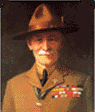
Robert S. S. Baden-Powell:
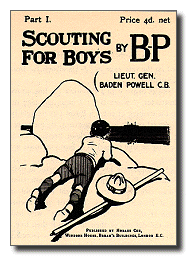
As a youth, Robert Baden-Powell greatly enjoyed the outdoors, learning about nature and how to live in the wilderness. After returning as a military hero from service in Africa, Baden-Powell discovered that English boys were reading the manual on stalking and survival in the wilderness he had written for his military regiment. Gathering ideas from Ernest Thompson Seton, Daniel Carter Beard and others, he rewrote the manual as a nonmilitary nature skill book and called it Scouting for Boys. To test his ideas, Baden-Powell brought together 22 boys to camp at Brownsea Island, off the coast of England. This historic campout was a success and resulted in the advent of Scouting. Thus, the imagination and inspiration of Baden-Powell, later proclaimed Chief Scout of the World, brought Scouting to youth the world over.
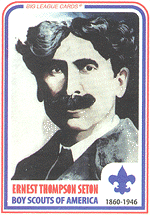
Ernest Thompson Seton:
Born in Scotland, Ernest Thompson Seton immigrated to America as a youth in the 1880's. His fascination with the wilderness led him to become a naturalist, an artist, and an author, and through his works he influenced both youth and adults. Ston established a youth organization called the Woodcraft Indians, and his background of outdoor skills and interest in youth made him a logical choice for the position of first Chief Scout of the BSA in 1910. His many volumes of Scoutcraft became an integral part of Scouting, and hes intelligence and enthusiasm helped turn an idea into reality.
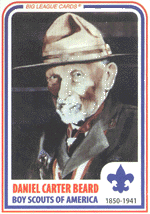
Daniel Carter Beard:
Woodsman, illustrator, and naturalist, Daniel Carter Beard was a pioneering spirit of the Boy Scouts of America. Already 60 years old when the Boy Scouts of America was formed, he became a founder and merged it with his own boys' organization, the Sons of Daniel Boone. As the first national Scout commissioner, Beard helped desigh the original Scout uniform and introduced the elements of the First Class Scout badge. "Uncle Dan." as he was known to boys and leaders, will be remembered as a colorful figure dressed in buckskin who helped form Scouting in the United States.
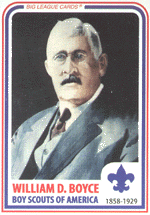
William D. Boyce:
In 1909, Chcago publisher William D. Boyce lost his way in a dense London fog. A boy came to his aid and, after guiding the man, the boy refused a tip, expaining that as a Scout he would not take a tip for doing a GOOD TURN. This gesture by an unknown Scout inspired a meeting with Robert Baden-Powell, the British founder of the BOy Scouts. As a result, William Boyce incorporated the Boy Scouts of America on February 8, 1910. He also created the Lone Scout, which merged with the Boy Scouts of America in 1924.
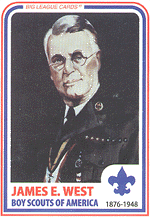
James E. West:
James E. West was appointed the first Chief Scout Executive of the Boy Scouts of America in 1911. Althought orphaned and physically handicapped, he had the perseverance to graduate from law school and become a successful attorney, This same determination povided the impetus to help build Scouting into the largest and most effective youth organization in the would. When he retired in 1943, Dr. West was recognized throughout the country as the true archetect of the Boy Scouts of America.
Robert Baden-Powell's
"Aids to Scoutmastership"
Rober Baden-Powell's,
"Scoutig for Boys"