
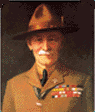
Robert Baden-Powell
Founder of Boy Scouts
The name Baden-Powell is known and respected throughout the would as that of a man who, in his 83 years, devoted himself to the service of his country and his fellow men in two separate and complete lives, one as a soldier fightinig for his country, and the other as a worker for peace though the brotherhood of the Scout Movement.
Robert Stphenson Smyth Baden-Powell was born at 6 Stanhope Street (now 11 Stanhope Terrrace), Paddington, London on Februrary 22, 1857. He was the sixth son and the eighth of ten children of the Reverend Baden-Powell, a Professor at Oxford University. The names Rorbert Stephenson were those of his Godfather, the son of George Stephenson, the railway pioneer.
His father died when B.-P. was only three years old and the family were left nont too well off. B.-P. was fiven hes first lessons by his mother and later attended Rose Hill School, Turnbridge Wells, where he gained a scholarship for admittance to Charterhouse School. Charterhouse was in London when B.-P. first attended but while he was there it moved to Godalming, Surrey, a factor which had great influence in his later life. He was always eager to learn new skills.he played the Piano and Fiddle. He acted - and acted the clown too at times. He practised bricklaying, and it was while a scholar at Charter House that he began to exploit hes interest in the arts of Scouting and woodcrafts.
Unofficially, in the woods around the school, B.-P. would stalk his Masters as well as catch adn cook rabbits, being careful not to let the tell-tale smoke give his position away. His holidays were not wasted either. With hes brothers he was always in search of adventure. One holiday they made a yachting expedition around the south coast of England. On another, the traced the Thames to it's source by canoe. In all this, Baden-Powell was learning the arts and crafts which were to prove so useful to him professionally. B.-P. was certainly not a "swot" at school, as hes end of term reports revealed. One records: Mathematics-has toall intents fiven up the study'. and another French-could do well but has become very lazy, often sleeps in school'. Nevertheless, he gained second place for cavalry in open examination for the Army and was commissioned straight into the 13th Hussars, by passing the officer training establishments, and subsequently became their Honorary Colonel for 30 years. His army career was outstanding from the start. With the 13th Hussars he seved in India, Afghanistan and South Africa and was mentioned in dispatches for his work in Zululand. There followed three years service in Malta as Assistant Military Secretary and went to Ashanti, Africa, to lead the campaign against Prempeh. Success led to his being promoted to command the 5th Dragoon Guards in 1807, at the age of 40. It was to the 5th Dragoon B.-P.gave his first training in Scouting and awarded soldiers reaching certain standards a badge based on lthe north point of the compass. Today's Scout Membership badge is very similar.
In 1899 came Mafeking, the most notable episode in hes outstanding military career, by which he became a Major-General at the age of only 43. B.-P. became fomous and the hero of every boy, although he always minimised his own part and the value of his inspiring leadership. by using boys for responsible jubs during the siege, he learned the good response youth give to a challenge. During the 217 day siege, B.-P.'s book Aids to Scouting was published and reached a far wider redership than the military one for which it was intended. Following Mafeking, B.-P. was given the task oforganising the South African Constabulary and it was not until 1903 that he returned to England as Inspector General of Cavalry and found that hes book, Aids to Scouting was being used by youth leaders and teachers all over the country. He spoke at meetings and rallies and while at a Boys' Brigade gathering he was asked by its Founder, Sir William Smith, to work out a scheme for giving greater variety in the training of boys in good ciizenship.
The Befinnings of the Movement:
B.-P. set to work rewiting Aids to Scouting, this time for a younger readership. In 1907 he held an experimental camp on Brownsea Island, Poole, Dorset, to try out his ideas. He brought togerther 22 boys. some form public schools and some from working class homes, and put them into camp under hes leadership. The whole world now know the results of that camp.
Scouting for Boys was published in 1908 in six fortnightly parts at 4d a copy. sales of the book were tremendous. Boys frmed themselves into Scout Patrols to try out ideas. What had been intended as training aid for existing organisations became the handbook of a new and ultimately worldwide Movement. B.-P.'s great understanding of boys obviosly touched something fundamental in the youth of this and other countries.
"Scouting for Boys" has since been translated into many different languages and dialects.
With out fuss, without ceremony and completely spontaneously, boys began to form Scout Troops all over the country. In September 1908, B.-P. had set up an office to deal with the large number of inquires which were pouring in concerning the Movement.
There is no need to describe the way in which Scouting spread throughout the British Commonwealth and to other countries until it was established in practically all parts of the free world. Even those countries where Scouting as we know it is not allowed to exist radily, admit that they used its methods for thier own youth trainin.
As Inspector-General of Calvalry, B.-P. comsidered that he had reached the pinnacle of his career. The baton of Field Marshal was within his grasp but he retired from the Army in 1910 at the age of 53, on the advice of His Majesty King Edward VII, who suggested that he would do more valualbe service for his county within the Boyt Scout Movement than anyone could hope to do as a soldier!
So all his enthusiasm and energy was now directed to the develpment of Scouting and its sister Movement, Guiding. He travelled to all parts of the would, wherever he was most needed, to encoutage their grwth and give them the inspiration that he alone could give.
In 1912, he married Olave Soames who was hes constant help and companion in all this work and by whom he had tree children (Peter, Heather and Betty). Olave, Lady Baden-Powell, until she died in 1977, was known throughout the would as World Chief Guide.