

Report on Garden Silk Mills Ltd. Vareli promulgated by Raviprakash Shah
GARDEN SILK MILLS LIMITED
Industrial Training Report on Garden Silk Mills Ltd.
A
Report
On
Garden Silk Mills Limited (Surat)
Raviprakash R.Shah
(S.Y.B.B.A.)
Prof. V.B.Shah Institute of Management, Amroli
Surat
For the year
2000-2001
Preface
As a student of S.Y.B.B.A. of Prof. V.B.Shah Institute of Management Amroli, Surat, I am very glad to reveal the report on my industrial training at Garden Silk Mills Ltd., Vareli, Surat dated from 1-5-01 to 30-6-01.
It’s very important for us to realise the elements of the management in the practical field where the industries apply the elements in the most prudent way. So the training is a part and parcel for the Business Administration.
The report includes the details of Company from the viewpoints of Production management, Marketing management, Personnel management and Financial management.
The industrial training has streamlined my concepts about practice of managerial principles applied in industrial sphere.
First and foremost, I express my gratitude to Mr. Bipin Modi, and Mr. Kamlesh Vyas, Company Secretary as well as Managing Director of company for sharing me the knowledge about current scenario of market and position of company and its advances. I would also like to acknowledge my thanks to the Principal, Mr. J.B.Shah for providing me the opportunity of training. I also express my thanks to the faculty of the college, Shri Mahesh L.Abale, Shri Ambarish H.Ved, Shri M.V.Soni and Shri Dharmesh H.Shukla for giving me good direction regarding the training programme. I also wish to extend my thanks to the employees at all levels of the company for their active support and co-operation to me.
Contents
History and Development
Production Department
-Product Range
-Facilities at the plant
-Production System
-Process of Manufacturing
-Quality Control
-Future Plans
Personnel Department
-Departmental Structure
-Personnel Policy
-Recruitment and selection
-Wage and salary administration
-Amenities to employees
Financial Department
-Departmental Structure
-Financial Panning
-Long-term and short-term fund
-Dividend Decision
-Investment Decision
-Financial Position
-Dividend Analysis
-Inventory Policy
-Ratio Analysis
Marketing Department
-Departmental Structure
-Product Panning
-Market Segmentation
-Pricing
-Channel of Distribution
-Promotional Tools
-Sales Analysis
-Market Research
SWOT Analysis
The company belongs to Garden Vareli Group, which is one of the preceding manufactures of synthetic textiles in the country. The origin of this “Textiles House” goes back 75 yrs. To the early beginning of the Art Silk Industry in Surat. “ Garden Silk Weaving Factory”, as it was then named, manufactured viscose jacquard sarees, laying foundation of what it would become leader in jacquard fabric for years to come.
Today, the company is one of the largest manufacturers in India of high fashioned, premium quality, dyed and printed textile fabrics, both polyester and viscose comprising a range of chiffon and georgettes, chupbrag and crepes palace and faithful ladies; fashion fabric as well as Indian sarees. The company also manufactures an exclusive range of pure silk and cotton fabrics. The fabrics are marketed under the famous names “Garden” and “Vareli”.
The company also manufactures grey cloth, prepared yarns and a range of readymade garments.
Background :-
India’s oldest group in textile business.
Broad shareholder base.
Professional management.
Incorporated in 1979.
Export Awards : 1978-79, 1979-80.
Product Group : Viscose Jacquard Sarees
Sheer Chiffon and Georgettes
Palace and Failee (Saree)
Pure Silk and Cotton Fabrics
Prepared Yarns
Textiles Machinery
Achievements :-
The company is the first to set up a polyester filaments yarn project in South Gujarat. The project is capable of producing multifilament and microfilament yarn having capacity of 5000 tons p.a. in collaboration with NOY-VALLESINA AG of Switzerland. The project has a special significance for the company, as polyester filament yarn is the basic raw material for the product manufactured by the company. The company is also the first in producing of two for one twister in India.
Production Department
PRODUCTION DEPARTMENT
Product range : -
The company manufactures mainly Sarees and Dress materials. Bering synthetic Sarees it appears somewhat as pure silk sarees. So it is known as Art silk or Artificial silk. Nevertheless, the company has its pure silk range and it mainly manufactures Chiffons. Synthetic Dress Materials in various colours at reasonable prices are also manufactured.
Range of Sarees : - 5.5 meter unstitched clothe
1). Nara chiffon
2). Fuji chiffon
3). American chiffon
4). Seta chiffon
5). Marble chiffon
6). Silk crepe
7). Peach
8). Lentens
9). Cerano
10). Seta georgette
11). Marble checks
12). Cerena
13). Jacquard
14). Dechine saree
15). China yarny saree
Range of Dress Material :-
1). Dechine
2). Brasso
3). Heavy automation
4). Ultra satin
5). Satvario
6). Lapaz
7). Rexroth
8). Black pearl
9). Alfino youry
10). China youny.
Facilities at the plant : -
Garden provides excellent transport facilities for its employees. All the employees have to reach the Register office at Sahara Gate and from their Buses transport the employees to their respective plants whether at Vareli or Jolwa. Apart from this Bus that leaves at 8’oclock in the morning other shuttles also go to the plants. At 10-00 a.m. an air-conditioned Sumo car goes to Vareli. This facility is for the employees of a higher rank. Apart from this, a Bus whether vacant or full goes to the plant every hour.
For coming back from the plants also there are number of Buses. If an employee wants a half day leave at 12-30 p.m. and also at 1-00 p.m.
When the 1st shift ends at 3-00 p.m. Buses are ready to transport the employee.
After 5-00 p.m., when the 2nd shift ends, the Buses transport the employees.
Even during this time if someone of rank of officers or even supervisors wants to go to the plants the shuttle service is always ready for them. For employees for a very high rank, the company also has luxurious cars for the transport.
Medicare : -
The company has its own dispensary at the plant. If any worker is injured (minor types), then he is treated there an then at the plant. Event if a worker falls ill at the plant he is given proper treatment.
In case of a major accident in the plant the worker is rushed to Mahair Sanjivani Hospital, which is near Vareli. The company bears all the expenses of the hospital. Even in case of a serious illness or operation, the company bears all the expenses of employee. If the family member of any employee falls sick or meet with an accident, the company gives him money and Hospital facilities.
For this purpose the company has made a “Trust” from which the money is given. Every worker has to put a very small amount in this “Trust” every year.
Hence, the life of employees at Garden is secured to a certain extent. If any employee dies then each employee give Rs. 5/- to his family.
Canteen : -
At Garden, there is a very big canteen. This canteen is mainly for the employees. Everyone who wants to eat in the canteen has to buy coupons. There are different coupons for tea and lunch. These coupons are extremely reasonable and the employees are give food at a very reasonable amount. The canteen provides lunch at noon and tea or coffee whenever desired.
Security : -
The company, being very big, needs proper security. Hence it has employed professional security-men. They keep a check on anyone who comes and goes out of the company. No car is allowed in the premise of the plant without a gate-pass. All the employees are given Bus passes. Only if they have a Bus-pass they are allowed entry or exit of the premise of the plants. This entire job is handled by Jamadars.
Plant Location : -
The company has set up its manufacturing unit at Vareli and Jolwa.
Production System : -
The company uses different types of production system for the raw materials at different levels. For texturizing POY, they use continuous production system. While for dying the chip, batch production system is used.
Process of Manufacturing : -
Different techniques like weaving, printing, dying, shrouding, packing etc. are used in the production process. Yarn is the chief raw material of the company. It is not manufactured at the plant of Vareli but is manufactured for looms at Jolva.
Production process can be sequenced as below:
1) Obtaining the raw material
2) Storing raw material
3) Twisting the yarn
4) Texturizing or crimping the yarn
5) Draw Warping
6) Sizing
7) Weaving
8) Dying and printing
1). Obtaining Raw Material : -
The raw material consumed by the company is Parcel Oriented Yarn (POY). The yarn is produced from internal as well as external sources.
Internal Source :-
Internal sources of the company comprise the manufacturing plant of Jolva and material purchase from “Surat Textile Mills” (STM), Which is under the Garden Group of Company. Vareli plant also acquires raw material from Surat Textile Mills.
External Sources : -
In the peak season, if the internal sources are unable to match with the demand, the company also procures material from external sources like Modern, Indo-Rama, Reliance etc.
2. Storing the Raw Material :-
All the raw material needed by the various departments is purchased to-gather and kept in the storage area called “Dump Store” from where any department can access the required amount of raw material.
3. Testing the Yarn :-
Parcel oriented yarn is either twisted, according to the requirements of material consumed in production.
Process : -
1. Winding on bobbins : -
Firstly POY is wound on bobbins, which are twisted on the twisting machine. The winding of yarn is done on the winding machine.
2. Twisting machine : -
The POY wound on the bobbins is then tittled on the twisting machine. On which the yarn is twisted. In this process, first the yarn is passed trough spindles on which the yarn is twisted in both the opposite directions
There are 3 types of twisting machine
1.One for one twisting machine
2. Two for one twisting machine
3. Fancy Twister
1. In this machine, the yarn is twisted once for revolution.
2. In this machine, there are two twisters per one revolution. Now-a-days, YFOs are more widely used as they are quicker and offer a better quality.
3. Use: - The yarn before twisting is not very strong and breaks easily. It is twisted in order to increase its strength. Due to twisting, quality improves and hence production also increases.
4). Crimping or texturizing of POY :-
The POY is accessed from the dump store to the crimping or texturizing section to texturize it.
Denier is a unit for measurement of POY. That 9000 units of yarn is hanked and weighted in gms, is called one denier .It is decreased after crimping
Process of crimping :-
Firstly, POY is put on machine in a specific amount. The place is called CRILL where it is put.
After the first delivery, the yarn is heated. Then it is passed through cooling plate. After that, the yarn is passed through spindle assembly. Thereafter, it is passed trough boiler and at all it is taken up. This is what the crimping or texturizing process is
There are two ways for punching the yarn.
1. Rato - Punched or bound.
2. Crime – Not punched.
Kinds of crimping machine :-
1. Friction type.
2. Magnetic type.
Friction type machine is superior.
Yarn is made bulky after crimping. This process increases smoothness of material. It makes distinguishment in dyeing. The cloth gets dull finished after weaving.
5). Draw Warping : -
The POY is put directly on the Machine from the dump stove to draw warped process.
It’s the fully automatic system from the warping system. The process of drawing heat setting and intermingling is carried out. It is given tension and then wound on beam.
6). Sizing : -
Sizing is a process of saving of yarn. The raw material for sizing is accessed either from dump store, warp raw section or from texturizing department.
A beam is made at the beginning is the process on this department. Warp yarn i.e. Vertical threads are made
a. Warping.
b. Chemical processes :- Yarn is passed through a chemical called polyvinyl alcohol to find and arcyrize shining.
c. Waxing : - Where the yarn is waxed
d. Sizing :- Sizing is made in this process which involves many chemicals as well as heading of cobbling processes.
e. Beaming : - Yarn is wound on a bean after sizing.
Sizing which mean saving of yam is necessary because of regular wear and tear.
7). Weaving : -
After making the process of twisting camping, sizing or drawing warp, the yarn is rent to the weaving department. In grey cloth is manufactured through the process of weaving in this process one thread is horizontal and other is vertical. Horizontal thread is called weft and the vertical thread is called warp.
There are various types of looms on which the cloth is woven
1. Semi – automatic looms.
2. Water Jet looms
3. Fully automatic looms.
It is landmark that the production of grey cloth is 70000 mts/day and it increases every year.
8). Dyeing and printing:-
This is the last step of the process of production department in the company.
Process:-
The jet dyeing process is widely used for dying the grey cloth. It is dyed printed according to the requirement of design and colours.
A. First of all the grey cloth is washed and dyed, whichever colour is necessitated
The Company dyes 9000mts of cloth daily.
B. The second step involves putting the dyed cloth in the drum washer to give crepe and georgette crease effect along with washing the stains.
The super wash machine is used for finishing and washing white colour material.
Salvage or border outing machine is used for border cutting of the cloth.
Design department : -
The design department employs around 60 workers under the direct control of the Chairman and M.D. and is based at Surat with the assistance of CAD/CAN equipment, the department aims to produce up to 200 designs each month. Each design is available with number of different colours. These new designs are marketed for testing through selected dealers and depots, which is a contributory factor to a superficially high product return at 12 %. If the design fails to attract the customers, they are sold in spot sales of the company.
Percentage Share of the intermediary materials for sarees and dress materials
|
Materials |
Sarees |
Dress |
|
Chiffons & Georgettes |
25.4 % |
1.5 % |
|
Jacquard |
0.5 % |
12.0 % |
|
Dobbies & Crepes |
0.5 % |
0.5 % |
|
Others |
21.0 % |
38.5 % |
|
Total |
47.5 % |
52.5 % |
The Jacquard and chiffon georgette ranges one of the most profitable of all. Besides, Garden also manufactures cotton silks and blended fabrics, which constitute 10 % of total production.
-: Production facilities:-
|
Location
|
Total Acreage |
Factory area (Sq. mts) |
Activities |
|
Vareli |
40.8 |
1,60,000 |
Yarn, Weaving and Processing. |
|
Surat |
11.4 |
30,460 |
Design |
|
Jolwa |
18.3 |
6,763 |
Polyester yarn manufacturing |
90% of the company’s production capacity is at Vareli where a three-shift pattern is operated so that the factory is capable of operating 24 hours a day, seven days a week for continuous process.
Quality Control :-
There is a distinct Quality control department in the company where the fabric and yarn undergo various chemical processes for quality checking. They are rejected if they are not up to the mark.
The company’s plant at Vareli has been awarded the ISO 9002 : 1994 certification by Bureau Veritas Quality International (BVQI). The process certified are draw warping and texturizing, twisting, sizing, warping and weaving.
Future Plans : -
The energy cost is the second largest component after raw material in the cost of production. As a logical step in this direction to reduce the energy cost, the company is setting up a Natural Gas-based 6.6 MW captive cogeneration power project at its plant at village Vareli at a total project cost of Rs. 20.70 crores. The project envisages installations of 2 Nos. 3 x 36 MW (gas engine based) generator sets to be imported from M/S. Rolls Royce Marine of Norway on turnkey basis. The company’s proposal for financial assistance for the said project was appraised by the consortium member bank and sanction of Rs.15 crores has been received.
Personnel Department
PERSONNEL DEPARTMENT
-: Departmental structure: -
 Manager
C.E.O.
Junior Executive
General Staff
The personnel management of the company is indeed adept and sympathetic. The terms between management and employees are the most prudential.
Personnel Policy : -
The personnel policy of the company is complete adapted to the principles of the personnel policies. Recruitment of the right man for the right work, give training to the workmen or office employees, if needed, providing the right condition of work, security with opportunity and incentives. In short, a form of coordination is found in the employees of the company.
Number of workers : -
There are around 5000 employees in the company, out of those 3000 are at Vareli plant and the rest 2000 consists of the employees at the other plants like Jolva.
Recruitment and selection : -
Recruitment is a process of searching for prospective employees and stimulating and encouraging them to apply for jobs in an ideal organization.
Selection means choosing the most eligible candidate from all the applicants.
Selection process of the company : -
Mostly, the selection is done with regard to reference i.e. whenever the company requires skilled or unskilled worker, a notice is put on the notice board so that the can see it and bring the worker to whom they know.
The advertisement is also given in the newspaper. The government Employment Exchange is also one of the major sources of recruitment.
An interview is held after having been received the application of the candidates whereon the candidate has to fill the application blank. In addition to filling up the application blank, the candidate is also supposed to transit the colour blindness Test, colour Recognition Test, Design observation Test.
The candidate is called for final interview having passed the various tests. In the interview, aptitude, intelligence, background and adaptability of the job is scrutinized properly. Successful candidates in the interview are sent for physical examination. A candidate matched with the physical criteria is placed on the job suited to him.
Educational criteria for selection : -
For labourers : -
No educational background is required. They should have skills and experience for the job. Wages is given in accordance with the Daily Wage System.
For temporary staff of supervisory level : -
They should have minimum qualification to suit the requirement of the job. Generally, science graduates or diploma in engineering field are recruited. The commencing salary is around Rs. 3500/-.
For permanent staff of supervisory and managerial level : -
Engineers possessing textile, mechanical or production degree are employed to the respective jobs. The salary in the beginning is around Rs. 4500/-.
GRDN does not have rigid stipend system.
Training : -
Training makes the employees aware about the nitty-gritty of their jobs and the work environment in which they are supposed to work.
Garden has up-to-date programme for the training of its staff. Mostly, the training is on-the-job training in the company premises itself.
As the technology advances day-to-day, the staff requires periodical training. Hence, some of the high ranked technocrats are also sent overseas countries like Germany, Japan and Korea for enhancement of technical knowledge.
Promotion : -
Promotion is done for a vacate place. For that the company has two option either it recruits external person or elevates the experienced and able employee from within. Out of two, Garden has applied the latter policy. The rational behind the policy is to increase the moral and loyalty of employees to the company.
Performance Appraisal : -
Garden does not have the structured performance appraisal system. Workers are simply appraised by their seniors and are given the increment on the bases of recommendation of seniors.
The company follows the minimum wage scale declared by the government.
Employees at the Garden can be discriminated in three categories : -
1). Skilled
2). Semi-skilled
3). Unskilled
The minimum daily salary is Rs. 63.10/- for unskilled labourers. Dearness allowance is declared by the government and management decides salary accordingly every month. The labour union is also involved in process of determining salary.
Aggregate monthly salary of Rs.1500/- or Rs. 2000/- is given to the workers as per their experience and skills.
Gross salary : -
1). Basic salary and
2). Dearness allowances.
Bonus, Provident Fund and Employee’s share of Income is provided on basic salary. Apart from this, medical (quarterly), book and periodical and conveyance allowance is given to the employees every month.
Provident Fund : -
For provident fund, 12 % is curtailed from the employees’ salary and 12 % is contributed by the company. For unforeseeable requirements, the employees granted credit up to 30 % of their contribution in the provident fund. The deduction is made from very first day of the job.
House Rent Allowance : -
This allowance is meant for new employees for the period of 240 days.
In addition to a holiday in a week, they are also off-days on particular festivals. There are 39 days in a year when the employees get paid even on a holiday. The working days are taken into account and dearness allowance is paid accordingly.
Leave balance record register is also kept here, the leave is recorded and the remaining is carry forward in the next year.
Attendance card is provided by the company for marking absence and presence.
The attendance is recorded in the muster book of Gujarat factory Rules 1950.
The Employees Share of contribution is siphoned form salary and 12% it is transferred to A/c No.10, which is known as pension.
50 paise are deposited twice a year in June and December ending to the laour welfare fund.
Advance Company Loan, Society Loans, Social contribution is provided directly subtracted from the pay by the company.
Life Insurance : -
The company secures the Life insurance for the workers and then directly passes to L.I.C.
Medical Expenses : -
It is 8.33% of total one-month salary provided in the month of March and December consecutively.
Labour Union : -
Naised Desai is the leader of Labour union of Surat Silk Mills Majur Mahajan.
The slogan of the Union is “no strikes” which proves that there are no disputes and conflicts between the management and laboures. Thus the relationship between the management and the Union is harmonious and congruous.
Finance Department
FINANCE DEPARTMENT
There are two distinct departments viz. Accounting Department and Financial Department in the company.
-: Departmental Structure: -
Whole time Director
(Finance, Legal, Administration, Tax)

|
General Manager (Finance) |
Executive Manager
|
Company Secretary |
Legal Matters |
Tax Consultant |

Junior Executives |
|
|
The organizational structure of the finance department is formal one but the channels of reporting are informal.
The process of estimating the funds requirements of a firm and determining the sources of funds is called financial planning. This can be done by two types of funds.
1) Long term funds
2) Short term funds
Long-term funds are used for capital expenditure and as working capital while short term funds are used for payments, obligations like interest and repayment, dividend and as working capital also.
- Equity
- Long term borrowing
- Retained earnings
- IFCI
- Bank Of Baroda
- Bank borrowing
- Retained earnings
The company itself takes the decision regarding dividend from its total net earnings. Currently, the company has enough liquidity. The company mainly considers earnings for the current year and predicts earnings for the next year.
Dividend Declared for past years
|
Year |
Percentage of Dividend |
|
1993-94 |
32 % |
|
1994-95 |
27 % |
|
1995-96 |
10 % |
|
1996-97 |
15 % |
|
1998-99 |
12 % |
|
1999-00 |
12 % |
Whenever new project is to be established by the company or any existing project is to be updated, the company makes the investment decision for long term. The company takes 2/3 margin as loan from outside whereas 1/3 margin is sourced from the company itself.
Comparison of Profit and Loss Account of last three years
|
|
|
Schedule |
1997-98 |
1998-99 |
1999-00 |
|
i |
Income |
|
|
|
|
|
|
Sales & Job Charges |
|
58,871.04 |
46,044.16 |
40,347.01 |
|
|
Income from Financial Operations |
10 |
1,511.00 |
119.62 |
474.02 |
|
|
Other Income |
11 |
357.65 |
131.61 |
158.83 |
|
|
TOTAL |
|
60,739.69 |
46,295.39 |
40,979.86 |
|
ii |
Expenditure |
|
|
|
|
|
|
Consumption of Raw Materials |
|
36,230.37 |
26,335.24 |
19,543.91 |
|
|
(Increase)/Decrease in Stock |
12 |
(152.23) |
(364.91) |
1,698.33 |
|
|
Purchases |
|
1,826.74 |
1,327.39 |
3,488.50 |
|
|
Manufacturing & Other Expenses |
13 |
17,406.96 |
15,089.36 |
12,798.06 |
|
|
|
|
55,311.84 |
42,387.08 |
37,528.80 |
|
|
Profit Before Financial Charges |
|
|
|
|
|
|
Depreciation & Tax |
|
5,427.85 |
3,908.31 |
3,451.06 |
|
|
Less: Financial Charges (NET) |
|
2,304.96 |
1,798.41 |
1,446.27 |
|
|
Profit before Depreciation & Tax |
|
3,122.89 |
2,109.90 |
2,004.79 |
|
|
Less : Depreciation |
|
1,293.03 |
1,263.44 |
1,408.29 |
|
|
Net Profit Before Tax |
|
1,829.86 |
846.46 |
596.50 |
|
|
Less : Provision for Taxes |
|
65.75 |
9.06 |
3.00 |
|
|
Net Profit |
|
1,764.11 |
837.40 |
593.50 |
|
|
Add : |
|
|
|
|
|
|
(i) Balance brought forward last year |
|
2,778.76 |
3,822.86 |
4,129.29 |
|
|
(ii) Balance of Amalgamating Company taken over |
|
622.34 |
0.00 |
0.00 |
|
|
Balance available for Appropriation |
|
5,165.21 |
4660.26 |
4,722.79 |
|
|
Appropriations |
|
|
|
|
|
|
Proposed Dividend |
|
574.36 |
459.49 |
459.49 |
|
|
Tax on Dividend |
|
57.44 |
50.54 |
101.09 |
|
|
General Reserve |
|
710.55 |
20.94 |
14.84 |
|
|
Balance Carried forward to Balance Sheet |
|
3,822.86 |
4,129.29 |
4,147.37 |
|
|
TOTAL |
|
5,165.21 |
4,660.26 |
4,722.79 |
|
|
Note Forming part of the Accounts |
14 |
|
|
|
Comparison of Balance Sheets of last three years
|
Sources Of Funds |
Schedule |
(Rs. In Lacs) 3Oth June 1998 |
(Rs. In Lacs) 3Oth June 1999 |
(Rs. In Lacs) 3Oth June 2000 |
|
1. Share Holder’s Funds |
|
|
|
|
|
a. Share Capital |
1 |
3,829.06 |
3,829.06 |
3,829.06 |
|
b. Reserves & Suprplus |
2 |
31,128.43 |
31,455.80 |
28,583.62 |
|
|
|
34,957.49 |
35,284.86 |
32,682.68 |
|
2. Loan Funds |
|
|
|
|
|
a. Secured Loans |
3 |
9,118.03 |
8,772.48 |
9,645.37 |
|
b. Unsecured Loans |
4 |
1,425.53 |
2,988.07 |
254.09 |
|
|
|
10,543.56 |
11,760.55 |
9,899.46 |
|
Total |
|
45,501.05 |
47,045.41 |
42,582.14 |
Application Of Funds |
|
|
|
|
|
1. Fixed Assets |
5 |
|
|
|
|
a. Gross Block |
|
33,242.88 |
35,272.73 |
37,178.21 |
|
b. Less : Depreciation |
|
13,473.61 |
14,580.72 |
15,891.57 |
|
c. Net Block |
|
19,769.27 |
20,692.01 |
21,286.64 |
|
d. Less: Lease Adjustment Account |
|
30.91 |
69.50 |
122.47 |
|
|
|
19,738.36 |
20,622.51 |
21,164.17 |
|
e. Capital Work in Progress and Advance for capital Groods |
|
1,654.02 |
1,863.24 |
542.00 |
|
|
|
21,392.38 |
22,485.75 |
21,706.17 |
|
2. Investments |
6 |
3,261.27 |
3,049.86 |
3400.28 |
|
3. Current Assets, Loans & Advances |
7 |
|
|
|
|
a. Inventories |
|
6,912.78 |
7,460.98 |
5,631.97 |
|
b.Sundry Debtors |
|
6,309.55 |
6,673.30 |
6,532.28 |
|
c. Cash & Bank Balances |
|
1,732.94 |
655.97 |
1,248.23 |
|
d. Other Current Assets |
|
117.08 |
126.19 |
83.48 |
|
e. Loans & Advances |
|
9,560.06 |
10,169.44 |
7,936.42 |
|
|
|
24,632.41 |
25,085.88 |
21,432.38 |
|
Less : Current Liabilities & Provisions |
8 |
|
|
|
|
a. Liabilities |
|
2,972.47 |
2,886.68 |
3,214.35 |
|
b. Provisions |
|
856.90 |
744.25 |
794.42 |
|
|
|
3,829.37 |
3,630.93 |
4008.77 |
|
Net Current Assets |
|
20,803.04 |
21,454.95 |
17,423.61 |
|
4. Miscellaneous Expenditure |
|
|
|
|
|
To the extent not written off or adjusted |
9 |
44.36 |
54.85 |
52.08 |
|
Total |
|
45,501.05 |
47,045.41 |
42582.14 |
Dividend Analysis :-
During the 12 months ending 6/30/00, Garden Silk Mills Limited paid dividends totaling 1.20 Indian Rupees per share. Since the stock is currently trading at 9.00 Indian Rupees, this implies a dividend yield of 13.3%. The company has paid a dividend for 6 straight years. Garden Silk Mills Limited last raised its dividend during fiscal year 1997, when it raised its dividend to 1.50 Indian Rupees from 1.00 Indian Rupees.
During the same 12 month period ended 6/30/00, the Company reported earnings of 1.55 Indian Rupees per share. Thus, the company paid 77.4% of its profits as dividends.
Inventories are valued in accordance with requirements of revised accounting standards (AS2) on valuation of inventories.
1) Stores, Spare parts, Chemicals and Stock in Process are valued at cost.
2) Finished goods and raw materials are valued at lower of cost or net realizable value.
3) Waste is valued at net realizable value.
4) Cost of inventories is determined using Weightage Average Cost Method.
Inventory Analysis :-
As of June 2000, the value of the company's inventory totaled 563.20 million Indian Rupees. Since the cost of goods sold was 3.16 billion Indian Rupees for the year, the company had 65 days of inventory on hand (another way to look at this is to say that the company turned over its inventory 5.6 times per year). In terms of inventory turnover, this is a significant improvement over June 1999, when the company's inventory was 746.10 million Indian Rupees, equivalent to 78 days in inventory.
Depreciation on fixed assets has been calculated on Straight Line Method at the rates prescribed in Schedule XIV to the Companies Act 1956. On revalued assets, the depreciation has been charged by dividing the unamortized depreciable amount over the residual life of the assets.
Stock in trade is valued by First-In-First-Out method at cost or market value whichever is lower.
Ratio analysis is a powerful tool of financial analysis ratio is defined as “The indicated quotient of two mathematical expressions.” Ratios help to summarize large quantities of financial data and to make qualitative judgement about the firm’s financial performance.
Current Ratio : -
Current ratio = Current Assets
|
Year |
Current Assets |
Current Liabilities |
Current Ratio |
|
1997-98 |
15,673.31 |
5,378.75 |
2.91: 1 |
|
1998-99 |
15,845.63 |
7,608.10 |
2.08: 1 |
|
1999-00 |
14,050.11 |
9,238.94 |
1.52: 1 |
Generally, current ratio of 2:1 or more is said to be satisfactory. The Garden Silk Mills has current ratio of 2.91: 1 in 98,2.08:1 in 99 and 1.52:1 in 2001, which can be moderately satisfactory in the real life situation. This current ratio represents the margin of safety for the creditors. The higher the current ratio higher Is the safety margin. We can see the decreasing margin of safety in Garden Silk Mills in the last year.
Here, both long-term debt-equity ratio and total debt-equity ratio have been calculated.
Long Term Debt Equity Ratio = Long Term Debt
Total tangible net worth
|
Year |
Long –term debt |
Total tangible net worth |
Long –term debt equity ratio |
|
1997-98 |
8,931.75 |
34,913.13 |
0.26 : 1 |
|
1998-99 |
7,722.72 |
35,230.01 |
0.22 : 1 |
|
1999-00 |
4,609.63 |
32,630.60 |
0.14 : 1 |
Total Debt-equity Ratio : -
Total Debt-Equity Ratio = Total debt
Tangible net worth
|
Year |
Total Debt |
Tangible net worth |
Total Debt equity ratio |
|
1997-98 |
14,372.93 |
34,913.13 |
0.41:1 |
|
1998-99 |
15,391.48 |
35,230.01 |
0.44:1 |
|
1999-00 |
13,908.23 |
32,630.60 |
0.43:1 |
This ratio reveals the proportion of total funds acquired by the firm by way of debts. The ratio considered appropriate goes on changing at one time it was thought that more than half the long-term requirements should be raised by way of long-term loans. The debt equity with total debt was 0.41 in 97-98 and it increase to 0.43 in 99-00 which indicate good sign of the company as it shows comfortable debt position of the company because a low debt equity ratio is favourable. The debt in an even better position as it was 0.44 in 2000. Thus the long-term debt position is even better. Thus on the whole the solvency position of debt and equity in Garden Silk Mills is quite satisfactory.
Gross profit Ratio : -
Gross Profit Ratio = Gross Profit x 100
Net Sales
|
Year |
Gross profit |
Net Sales |
Gross Profit Margin |
|
1997-98 |
4,891.85 |
60,382.04 |
8.10 % |
|
1998-99 |
3,908.31 |
46,163.78 |
8.47 % |
|
1999-00 |
3,451.06 |
40,821.03 |
8.45 % |
A high gross profit margin is a sing of good management. A low Gross profit margin may reflect higher cost of goods, sold due to the firm’s inability to purchase raw material at favourable terms, inefficient utilization of plant and machinery as over investment etc. The gross profit ratio was 8.10 % in 97-98 that was increased to 8.45 % in 99-00 that shows a healthy sign with relation to the company’s profitability.
Net Profit Ratio : -
Net Profit Ratio = Net Profit x 100
Net Sales
|
Year |
Net profit |
Net Sales |
Net Profit Margin |
|
1997-98 |
1,706.67 |
60,382.04 |
2.83 % |
|
1998-99 |
786.86 |
46,163.78 |
1.70 % |
|
1999-00 |
492.41 |
40,821.03 |
1.21 % |
The net profit in 97-98 was 2.83 % that decrease to 1.21 % in 99-00, which is not a good sign for the profitability of the firm. A firm with a high net profit ratio can make better use of favourable conditions, such as rising selling prices, falling costs of production of increasing demand for the product. Such a firm will be able to accelerate its profits at a faster rate than a firm with a low net profit margin.
Manager (Marketing)
Executive (Marketing)
C.E.O. (Marketing)
General staff (Marketing)
Garden silk mill Ltd. is one of the oldest manufacturers of Synthetic Sarees and Dress Materials in the country. The company practices both industrial and consumer marketing.
Philosophy of Marketing : -
As the company concentrates on the quality rather than the quantity, and company holds the product concept.
Marketing Aim : -
The aim of the company is to crate brand image by offering the qualitative or sterling products to cream hype and maintaining the market are sub-goal for the slump period prevailing in the textile industry at present.
Product Planning : -
Since the very much importance of the product planning as the part of marketing, the company plans the product it should produce according to the trend of the market.
The taste and preference of the consumer differs with reference to time. Therefore to succeed, the company has to take into account such changes in their planning process.
Market Segmentation : -
Market segmentation consists of taking the total heterogeneous market for a product a dividing it into several sub-market or segments, each of which tends to be homogenous in full significant aspects.
The company segments the market as following : -
Age : -
Taste and preferences of the people of different age varies. Teen-agers and youngsters choose the fashionable and stylist clothes. While the married women whether housewife or official has to permanent dainty for sarees are mostly Punjabi Dresses. So it can be said that the chief segment of the company comprises the women aged 20th and onwards for sarees while 20th and onwards.
Income : -
The segment consist of the upper middle income earning people.
Geographical : -
According to geographical segmentation, the market is divided into zones viz., west, north, east and central.
Zones |
State |
% Of Product Sold |
|
West |
Gujarat, Maharashtra, |
32% |
|
North |
Delhi, Punjab, Hariyana, Rajasthan |
32% |
|
South |
Kerala, Tamilnadu, Karnataka, Andhra Pradesh. |
29% |
|
East |
Assam, West Bengal |
2% |
|
Central |
Bihar, Orissa, Madhya Pradesh, Chhattisgardh, |
5% |
Zones |
Sarees |
Dress Material |
|
South |
55% |
- |
|
West |
30% |
25% |
|
North |
10% |
70% |
|
East |
5% |
5% |
Pricing : -
PRICE = COST +MARGIN
This criterion is called forward pricing. However, in cutthroat competition, Garden has adopted backward pricing, i.e. first of all, they determine the price at which it can be sold having deducted the required margin from the basis of which it achieves the cost. Then it strives to reach the determined cost. It assists the company in effective cost control in reducing wastage.
For wholesale customer, there are two types of discount, that is, Trade discount and Cash discount. Garden has motivating discounting policy rather than threatening one
1). To pay the bills in 30 days or to pay 2% interest after due date.
2). To pay the bill at last in 60 days and if you pay bill a month early you will get 2% discount.
Generally, the payment period of raw material as well as credit period for finished products is 90 days due to competitive market. However, it is not rigid, it changes as per the demand-supply position of the market of a particular product.
Channel of Distribution : -
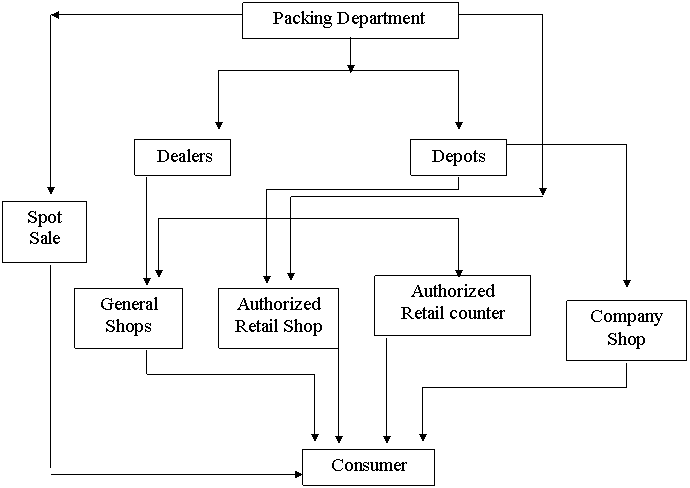
Channel of distribution indicates routes or pathways through which goods and services flows, or moves from producers to consumers.
The channel of distribution of Garden Silk Mills Ltd. can be easily understood from the following chart.
Sales Promotion : -
Sales promotion consists of diverse collection of incentives tools design to stimulate quicker or greater purchase particular products or services by consumers or the trade mostly in short term.
The difference between sales promotion and advertisement is that advertising offers the reason to buy while sales promotion offers an impulse to buy. In Garden, there is ling term planning for the sale on its product.
Garden has the slogans “You fascinate me” for Vareli and “Garden creates new woman” which are impressive and attracts women consumers.
There are three types of sales promotional tools: -
1). Consumer promotional tools
2). Trade promotional tools
3). Business and sales force promotional tools.
Samples : -
The company offers the samples to its retailer, that is, in terms of returning the saree with its particular design not liked by the retailer or wholesaler. This is in the case of marketing of sarees only.
Premium (Gifts) : -
The customer who purchases direct from the companies shop is given incentives by offering them free gifts or premiums.
1). On the purchase of the products up to Rs. 1500/-, one gets 2.5 mts fabrics in the form of top-bottom clothes.
2). On the purchase of the products up to Rs. 3000/-, one gets 5 mts fabrics in the form of top and bottom clothes.
3). On the purchase of the products up to Rs. 4000/-, one gets complete Duptta set, which consist of a complete dress for customer. Thus the scheme is very effective for promoting the sales of company.
Free goods : -
To comply with the changing taste and preference of the consumer the company has to know the current consumer market. Therefore a questionnaire is prepared including the customers’ choices and market demand with the given options for the answers. If the questionnaire is completely filled up and submitted by the customer, she will get one scarf free. On the basis of response and analysis of the data, the management decides to change its product.
Discount : -
Usually, quantitative discount is given to its retailer gravitate and fillip to purchase the product of the company.
Trade Promotion Tools : -
The trade promotional tools are as under: -
Price off : -
The company often has to offer price off to its retailers or wholesalers to carry the particular brand. The company offers price off in terms of discount on the basis of amount of sales of retailer’s sale in more than current month then management give more discount to retailer or wholesaler.
Buyback Guarantees : -
The company also gives full buy back guarantees to its retailer or wholesaler that is, the defected goods are purchase back by the company.
These tools are used to outclass the business, to motivate the customers and to increase sales force to greater efforts.
Trade Show : -
The company participates in the annual trade show organized by the Textile Industry Association in Delhi every year. Apart from it the company also organizes a show named as, “text style” which is a sort of fashion only for the products of the company.
Advertising : -
The advertisement of the product of the Garden is given in the ladies oriented magazines namely, Women’s Era, Femina, News papers etc. print-media as well as occasionally on T.V. The ad budget of the company depends on the sale of previous year. Generally, it is 2 % of the sales of previous years.
Sales Analysis :-
Garden Silk Mills Limited reported sales of 3.63 billion Rupees (US$77.34 million) for the fiscal year ending June of 2000. This represents a decrease of 9.7% versus 1999, when the company's sales were 4.02 billion Rupees. Contributing to the drop in overall sales was the 13.8% decline in Yarn, from 2.71 billion Rupees to 2.34 billion Rupees. . However, these declines were partially offset by the increase in sales of Fabrics (up 3.4% to 1.58 billion Rupees) .
Recent Sales at Garden Silk Mills Limited
|
2.41 |
2.15 |
2.81 |
4.96 |
4.02 |
3.63 |
|
1995 |
1996 |
1997 |
1998 |
1999 |
2000 |
(Figures in Billions of Rupees)
Garden Silk Mills Limited has changed its product mix within the past five years. In 2000, the largest segment was Yarn, while in 1996, the largest segment was Fabrics. During the past four years, sales of Yarn increased 106.1% (from 1.13 billion Rupees to 2.34 billion Rupees), while during the same period, sales of Fabrics experienced an increase of only 4.3% (from 1.52 billion Rupees to 1.58 billion Rupees).
Market Research : -
Marketing research is the systematic design collection, analysis and reporting of data and findings relevant to a specific marketing situation facing the company.
There is no distinct market research team or department. However the distributors execute the market research to some extent.
The gamut of the market, the company has a good market all over nation. There is higher sale in the West, North and South part of India while relatively nether sale is found in the Eastern India.
The company also has a credential market in the over-sea countries like U.K., Spain, Middle-East, U.S.A. where the material are exported.
Protection of the Environment :-
At present, any company wishing to undertake a capital project has to obtain the consent of the State Pollution Control Board. The company has received such a clearance in respect of each of its capital project including the (PFY) manufacturing plant. It does not expect its production process to be adversely affected due to current or proposed environmental legislation.
GRDN places significant emphasis on the protection of environment and pollution control. The company has, with the help of its workers, created a green environment friendly belt around its manufacturing units.
The major part of the company’s activities does not generate effluents. The company takes step to minimize any adverse effect to the environment or ecology arising from the processing and printing of the synthetic fabrics. The Vareli site includes a pollution control plant for the treatment of waste liquids. These liquids are neutralized and filtered and then discharged as non-toxic waste.
SWOT Analysis
Strength :-
1) Healthy relationship between management and employees.
2) Integrated production complex.
3) Sound financial base.
4) Strong distribution system.
5) Market leader in quality product and leading manufacturer of textile products.
6) Innovative and fancy designs are strong features of products of the company.
Weakness :-
1) Higher cost compared to local manufacturer.
2) The lead time is higher for manufacturing the new product or design.
3) Sales promotion and advertising expenditure is lower than rivals.
4) Gradual disappearance of brand image.
Opportunities :-
1) Increasing attention on cost and thirst for cost reduction will enable the company to win the war of price.
2) Company is consistently investing in Research and Development to improve the quality of existing products and entered into new products. This will help the company in forth coming time to sustain and enhance its market share.
Threats :-
1) Textile Industry as a whole is adversely affected by over capacity and demand recession and unfortunately the future seems to be grim.
2) The equation – ‘ Bigger cannibalizes smaller’ has been changed. It has been twisted to ‘ faster is master’. Hence, GRDN has to update its structure to be responsive to the volatile market.
References :-
Production and Operations Management – K.Ashwatthapa
Personnel Management - .C.B.Memoria
Marketing Management – S.A.Sherlekar
http://www.corporateinformation.com
And other documents of the company


