The type of meditation practised in these two places is Vipassanna meditation(or "awareness of breathing", also known as annapanasati in other places). There are no mantras, no singing, no rituals, no worshipping, no visualisation techniques, no breath control, nothing except breathing in and breathing out naturally.
Wat Suan Mok is a large monastery located just outside the town of Surathani. It is a sort of forest monastery, being situated on the verge of a forest. Backpackers pay a small fee upfront to cover food costs(its very nominal only) and then spend the next 10 days practicing Vipassanna meditation. Silence is encouraged but not enforced here and meditators do talk to each other occasionally. Interestingly enough, the monastery grounds has a hot spring pool. This being a forest, there are bound to be creatures around. Once, while a monk was giving an evening discourse, he was rudely interupted for a full minute by a really loud lizard sounding off in the hall.
|
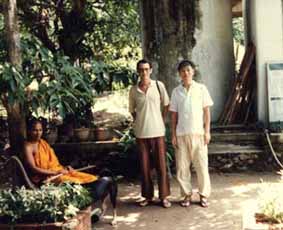
| With Steve(in centre), the meditation teacher from Australia. |
If meditating in the forest is not your thing, then consider the other alternative. Ko Phangan, the island of the infamous Haad Rin beach and its full moon parties, is also the island where you find the small monastery of Wat Khao Tham. Its is located on a hilltop just outside the island's main town. It has a magnificent view of the sea and the food is good(vegetarian). Silence is more strictly enforced here. As the number of intending meditators are more than the number of places, it is best to write in first. Meditatators are accepted on a first-inform-first-serve basis. Meditators stay in tiny huts such as the one shown below.
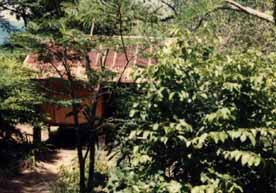 | Staying in a tiny hut. The toilet is some distance away and you need a good torchlight to walk to the toilet at night. |
The food fees here are lower than what one normally spends at the beachside eating places. To get to Ko Phangan, you have to go to Ko Samui first by boat or ferry, and then take a boat to Ko Phangan.
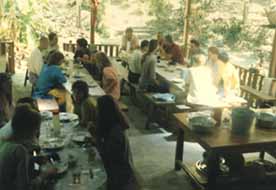 | The dining hall where backpackers eat in silence. |
The other island, Ko Samui, has a place for meditation as well(which is somehow connected with Wat Suan Mok) which is open only at certain times of the year. However, not having seen the grounds, I am not able to comment. Any meditating backpacker out there care to enlighten me on this?
If you are wondering why the wooden walls of beachside chalets at Ko Phangan have such a rough hewn texture, wonder no more. They are actually made from planks sawn out from old coconut tree trunks using a chainsaw. Timber is scarce on the island, but they have coconut trees a-plenty. While in many countries, old coconut tree trunks are burnt, at least here they are put to good use.
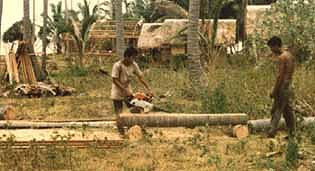 | Sawing planks from old coconut tree trunks. |