Pulau Redang is an island in the South China Sea situated in a marine park off the coast of Terengganu in peninsula Malaysia. It is one of the cleaner islands and visibility in the waters is good and is suitable for snorkelling and diving. The corals grow quite close to the surface in many areas and for most people, snorkelling is sufficient to see a good variety of sea life.
Getting there from Kuala Lumpur.
Terengganu is 7 hours by road from Kuala Lumpur(one hour if by air). The sea journey to the island starts from the Kuala Terengganu jetty by fishing boat. The boat trip took 3 hours.
If you drive, you can go to Merang(which
is still another 45 minute's drive north of Kuala Terengganu) and take a speedboat
to Redang island. Many campers take the easy way out by booking
an all-inclusive package with a camping tour operator from Kuala Lumpur.
They will put you on an overnight coach in Kuala Lumpur. When the coach
reaches Kuala Terengganu early next morning, the operator will transfer
the campers to a chartered fishing boat for Pulau Redang. Most people
sleep on the coach and on the boat from Kuala Lumpur to Pulau Redang.
Note: Today, most people would prefer to go to the little seaside village of Merang(north of KT) to take the speedboat to Redang as the speedboat takes only 40 minutes to reach the island. There are now regular speedboat services due to higher tourist traffic. The morning sea is quite calm, but the afternoon speedboat rides can be bumpy.
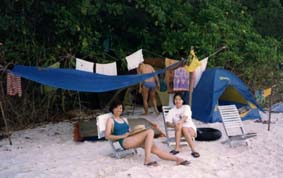 Eileen
and Chin Hsien outside our tent.
Eileen
and Chin Hsien outside our tent.
Why camping?
There is nothing quite like the experience of lying on the beach staring
in wonder up at the stars overhead and letting the sound of the lapping
waves lull you to sleep .... and when the dawn breaks, peering through
half-opened eyes at the morning calm of the beach and enjoying the unique
smells of the open sea, while waiting for the breakfast horn to sound to
tell you it's time for coffee and tea. Although my wife and I normally
prefer to stay in resorts by the sea, in Pulau Redang we prefer to camp.
Why? Because Pulau Redang is one of the few places where camping can be
fun, safe and clean.
Camping operators
There used to be a few camping operators around. The two that had been around
the longest were Camping Holidays Sdn Bhd and Cherry Pop Travel. There were
also a few smaller outfits which organised camping tours to Pulau Redang
just a few times a year. There was only one stretch of beach
which was designated by the authorities for camping, i.e.Teluk Kalong beach. This stretch was divided
into two portions by a rocky outcrop and a small freshwater stream. One
portion was leased by Camping Holidays Sdn Bhd and was cleaner, equipped
with toilet facilities and was much more private. The other portion was used
by all the other camping operators as well as other self-organised camping
groups and students.
Joining the tour
Camping Holidays Sdn Bhd organised camping trips to Pulau Redang out of Kuala Lumpur. Outstation people, Singaporeans and other
foreigners normally join the tour from Kuala Lumpur as it was much more
convenient, rather than trying to meet up with the tour elsewhere. On the
designated night of departure, we would make our way to the bus station,
where the tour operators will meet us and put us on the coach(usually around
9 p.m.) We would reach the Kuala Terengganu jetty around 5 a.m. the next morning.
(The coach can be very cold at night so warm clothing on board the coach
was a good idea for us campers.) At the Kuala Terengganu jetty, the tour operator would
transfer us to a fishing boat. The boats were clean(being used mostly to
ferry tourists) and have toilets.
The boat journey
The seas are normally quite calm in the morning. Most people however, prefer
to lie down flat on the boat and sleep all the way(a good way to avoid
sea-sickness). A light breaksfast of buns/cakes and Milo was served halfway
along the boat journey.
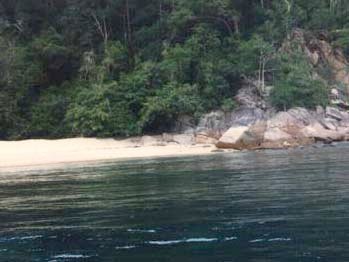 Arriving
at the Pulau Redang beach campsite.
Arriving
at the Pulau Redang beach campsite.
On arrival
Arriving at the campsite was an experience I always enjoyed(even though
I have been there more than ten times). The place looked secluded, the beach
looked big enough and clean and the waters are crystal clear....much like
Fantasy Island! Although the boat can come right up to the beach, we have
to get down the side of the boat and wade the last five metres Ah...the
adventure begins!
Smart campers would normally change into their swimming gear on the boat
for this. Others plunged right in with gusto. The bags, equipment, foodstuff
etc were put in a small sampan(like a tiny rowboat) and then pushed ashore,
thus keeping the stuff dry. Once on the beach, most of us would head for
the toilets or for another cup of coffee.
Briefing
Once on the island, the camping organisers would call for a meeting for
all campers and explain the rules for low-impact camping to us. These included:
One concept practiced here which I really liked was that all rubbish generated by us was collected in large bags and then transported back to the mainland for disposal at the end of the camping trip. Well done!
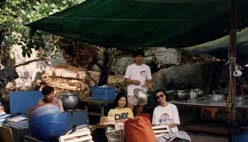 This
part was the kitchen end of the Main Tent under the trees.
This
part was the kitchen end of the Main Tent under the trees.
Main Tent
There was one very huge tent(which I call the Main Tent) where campers have
their meetings and it also housed the kitchen and dining area. Small chairs
and tables were provided for card and board games.
Equipment
On the first day itself, the tour opereater would issue out snorkels, masks
and camp cots(for sleeping) to each camper. Tents were allocated on a sharing
basis(normally 2-3 per tent). This was the advantage of joining an organised
trip.....we don't have to bring our own equipment. However, flippers are
not supplied and we had to bring our own. It was possible to rent flippers
from the camp operator(USD 2/- per trip) but they were normally of the shorter
type(good enough for most people, but I prefer to
bring my own flippers).
Meals
We ate 5 times a day....breakfast, lunch, tea-time, dinner, ....and if
we are still up to it, supper as well. If these are still not sufficient,
there are bunches of bananas hanging in the Main Tent and campers grab them
when they want a meal on the go. The cooking and washing up is done entirely
by the staff of Camping Holidays Sdn Bhd. Although the food supplied was
not elaborate, it was nevertheless pretty decent fare and the proportions
are more than sufficient. Vegetarians had to make known their status to
the camp operators before the trip itself. If we were lucky, sometimes small
fishing boats will bring some freshly caught fish to sell to the camp cook.
Oh yes, on the first night in the camp, we were given a barbeque. The barbeque
was done on a spit made from an empty oil drum, and charcoal fire was used.
That way, the sands do not get dirty with time. All other cooking was done
in the Main Tent using gas fires. No campfire was allowed. Campfires degrade the environment and we are surprised that many youth groups still practise it.
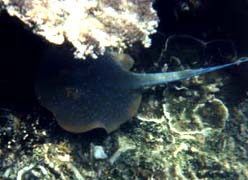 |
This blue-spotted stingray was resting in very shallow waters. I used a waterproof disposable camera to photograph it while swimming a metre over over it, taking care not to kick it accidentally with my flippers. |
Daytime activities
Snorkelling was the main activity. Boats would take us out to various reefs
to snorkel twice a day....once in the morning after breakfast, and once
in the late afternoon after tea-time. Snorkellers were advised to wear T-shirts
during snorkelling as protection against sunburn. Of course, sun block
lotion helps, but it will not be as effective as an old T-shirt. Inflated
rubber tyres were available to people who wished to snorkel but were not powerful
swimmers. This place is a marine park, so fishing, collecting of coral,
shelfish etc is strictly forbidden. There was plenty to see in the shallow
tropical reefs: stingrays, hawksbill turtles, Ridley turtles, humphead
wrasses, huge greasy groupers, other colourful fishes, giant clams, the
occasional black tipped shark, and of course, the various types of corals.
The organizer provided a few snorkelling guides who would point
out the various types of sea life to the newbies.
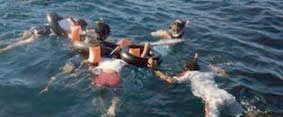 |
Some folks like to snorkel with rubber tyre tubes. |
What did we do when we were not snorkelling? Well, there was always beach
volleyball, card and board games, beach combing or taking naps. We used
to bring books to read on every trip we went, until we finally wised up....there
was simply too much to do.
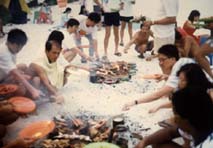
Nightime activities
After dinner, people generally gathered in groups on the beach for singing
sessions(guitar players are very popular here), card or board games, joke
telling sessions etc. We generally wandered from group to group. Those who
wish to stroll along the beach at night were advised to wear sandals to
avoid stepping on a sharp shell, rock etc.(In the daytime most of us go about
barefoot.)
Lighting
The camp had a generator supplying electricity at the Main Tent for lighting
purposes. The generator was shut off around midnight. A small torchlight(small
enough to carry in your pocket) was generally sufficient for the trip(in
case you need to go to the toilets in the middle of the night).
Bathing facilities
Water was piped down from a clear mountain stream to the camp. Outdoor showers
were available. People bathed with their swimsuits and trunks on. There was
however, one enclosed shower for people who require more privacy.
Toilets
Toilets were clean although slightly cramped, and of the squatting type.
You hand flush with a pail of water. What you flush went into a septic
tank where it decomposed. It was a good thing that the camp only open 8
months in a year. During the monsoon season(November to February), the
camp was closed and this allowed the environment to recover a bit.
Other fauna
Sometimes goats wandered into the camp. They were quite harmless though.
Monkeys could be seen occasionally in the distance. Squirrels did come into
the Main Tent and try to grab a banana when they think they can get away
with it. Tiny hummingbirds(the size of a thumb) were common.
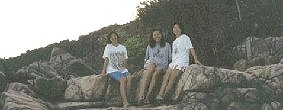 | Rock
climbing at the camp attracts the very athletic types. |
Sleeping
Most people took their campcots to the beach to sleep at night. If it rained,
then campers would sleep in the Main Tent. Few people actually slept in
their own tents. Bringing a pillow, blanket or sleeping bag is a good idea.
So is mosquito repellent(Tabac works quite well).
Trip duration
Camping Holidays Sdn Bhd offered trips that gave you either 3 nights on
the island or 2 nights on the island(not counting the nights you spend
on the coach travelling to and from Kuala Lumpur. It was better to book
the longer trip. The first day on the island, most people would still be
slightly tired from the journey(an afternoon nap helps though). Generally,
people are most lively on the second day on the island....and then you
still have the third day to enjoy.
Costs
Costs were RM400 per person for a round trip that allowed you
three nights on Pulau Redang. The cost covers coach transport, boat charges,
meals, and equipment(except flippers...those are rented out for USD2/-
for the whole duration of the trip). There were hardly any hidden costs.
The above charges were for the year 1995. A few of us campers preferred to fly back to Kuala Lumpur instead of taking the
coach, so we bought our own air tickets.
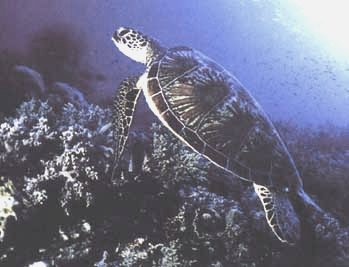 |
One of the most beautiful turtles to be seen is the hawksbill turtle, so called because of the shape of its beak. |
Camping season
Camping was available from March to October. From November to February,
the strong northeast monsoon made camping impossible. Not only that, the
waves would be too high for swimming. June, July and August were popular
months because there was a chance of seeing the great leatherback turtles("the
size of a Morris Minor", exaggerated one local). In the old days, the
camp will have a number of between 20 to 100 people. In our opinion, a camping
population of around 60 people was the most fun.
Due to the lack of popularity, it is almost impossible to get a group going for a camping trip nowadays. As far as I know, the only organisation that takes bookings for camping nowadays is Ping Anchorage. They are not the organisers, as they hand the activities to some other chalet operator. We have no idea on how good they are. You may have to guarantee them a minimum number of people though. Check out their website for details.