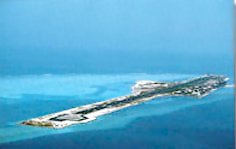
On the left shows the island airport.
|
The Maldive islands lie in the Indian Ocean just south of India. They consist of nearly 2000 tiny islands out of which only 200 are inhabited. In fact the airport occupies a whole island by itself. The airport was practically empty when we got there. Getting through the immigration and customs was a breeze. On the left shows the island airport. |
On coming out of the airport, towards the left there is a souvenior shop as well as a bank where we can change foreign currency into the local currency, the Rufiyaa.
US dollars and other major currencies are accepted and so is the Singapore dollar. Malaysian ringgit is not traded here. The souvenior shop will sell you stuff in USD but it was 10 per cent cheaper if we change the money first in the bank and make the purchase later in Maldivian Rufiyaas.
On the right hand side of the airport exit, there are two rows of stands(much like hot dog stands) with each stand operated by each tourist resort. We headed for the stand operated by Club Med and the guy there took down our particulars before leading us a short distance to the jetty to wait for the boat going to Club Med(on the island of Farukolufushi). A boat came in carrying tourists from the island resort of Bandos(about one and a half hour's boat ride) and they looked as though they just survived the sea journey. We figured that for resort islands further than Bandos, it would be wiser to take the sea plane or a helicopter to the resort if one does not wish to spend the rest of the day recuperating. The sea can be quite rough...actually this is not a sea but an ocean(the Indian Ocean to be exact).
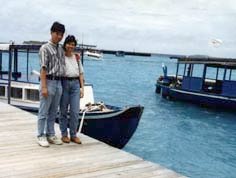 Standing on the jetty while waiting for the boat to Club Med.
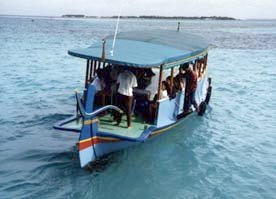 The tourist boat
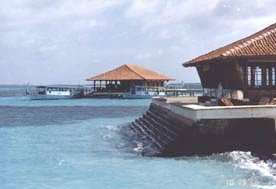 The Club Med jetty
After going through the formalities, we were taken to our quarters.There is a small bank for changing currency on the island just in case we need to buy any souveniors in the Club Med souvenior shop. The exchange rate is the same as that in the airport. After a good buffet lunch, one of the GOs took us to one of the halls and gave us a briefing. After that, the rest of the day belonged to us.
Meals
All meals are buffet-style(breakfast, lunch and dinner). The dining room served a mixture of fare like Maldivian dishes, some western food, a bit of Chinese food and they also have a Japanese food section. Eileen, who loves Japanese food and European bread, enjoyed the meals immensely. The tuna here is superb.
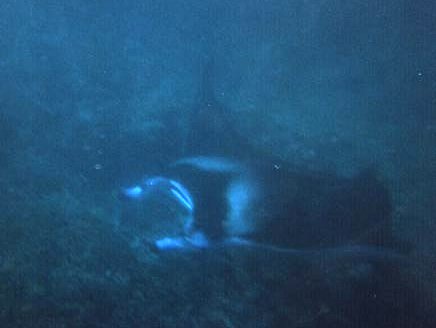 |
This monster of a manta ray, at 5 metres wide, was the biggest manta we have ever come across. The photo was taken from the surface using a disposable camera purchased from a souvenior shop. |
Diving
Club Med gives diving lessons as part of the vacation package. You have to undergo a swimming test first(held every afternoon
at 2 p.m.). On passing the swimming test, one can attend lessons the next day. There will be three days of lessons(theory and practical) before one can
qualify as a diver. This makes it 4 full days a person needs to stay at Club Med to get their diving certificate. However, this diving certificate is only recognised
by the Club Med organisation and you can't use it anywhere else except at Club Med resorts. Bummer, isn't it? But hey, the lessons come without any additional
costs and a freebee is still a freebee(if you can call it that)! Beginners who wish to take up diving here, should go for the swimming test the first day they arrive(forget
the other tour briefings, they can wait!), to avoid wasting a day. Boats will take divers out to the various reefs every afternoon.
Other sea activities
Kayaking, pedal boating, windsurfing, catamaran sailing are available.
Paf-paf
This is a very popular hobby for people learning to design their own patterns on T-shirts. It's probably the only activity one can do if it rains. Templates of various designs are available and we only had to dip the provided sponge into some paint paste and then paf-paf(means"dab-dab", we think) the paint through the templates onto the white cotton T-shirts. The T-shirts sold there, however, were not of that good a quality, and Eileen thought it funny when, after one wash, one of my sleeves out-shrank the other, making me look very lopsided when I wore my "designer" T-shirt.
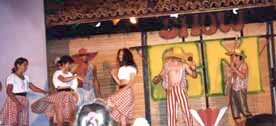 Guests putting up a show for other guests.
Nightime entertainment
There is no television at Club Med. During dinner time, wandering minstrels would go around serenading dinner guests from tablw to table. At 9 p.m.,the GOs would put up a show at the outdoor stage. The shows were often hilarious and well done. Being held totally outdoors, the show was at the mercy of the weather. During one performance, the rain came suddenly and the audience ran for cover. The performers gamely carried on(hey, the show must go on!) without an audience until even they were forced to retire. We only continued after the rain ended(it ended suddenly as well).
Other islands
Trips were often conducted to other islands, but they do not come cheap. People who have stayed on other islands remarked that the coral reefs were much better in the atolls that were further from the airport. They could be right.
Seasons
There is the dry season(October to April) and the wet season(May to September). According to the GOs, the skies were much sunnier in the dry season. We went in the tail end of the wet season and experienced rain and more rain at first. The rain would come suddenly. When we see people running in the distance, it is a sign to quickly look for shelter before the rain reaches us. With the strong winds, the raindrops would come at an angle lower than 45 degrees, so people have to hold their umbrellas a bit sideways(if they can hold onto their umbrellas, that is).We managed to catch two glorious sunny days,though, and when the skies are clear, you can see the sheer beauty of the place, which is why we intend to visit the Maldives again.