
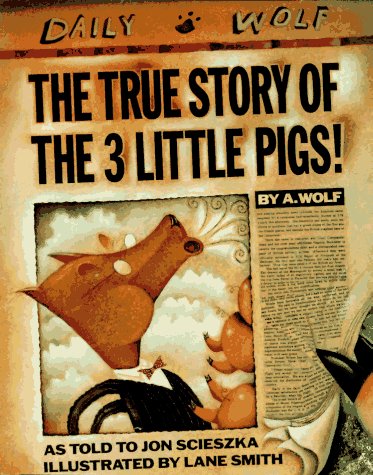
This same style of writing is found in his book The Stinky Cheese Man where we see him manipulate the stories we know by heart such as The Gingerbread Man and many others.. Both books have been illustrated by his friend Lane Smith. The True Story of the Three Little Pigs has received the Texas Bluebonnet Award as well as being nominated for the American Bookseller's Book of the Year. The illustrations in this book are comical and full of detail. On one scene, we see how the wolf could not resist having dinner, since the entire scene after the house is blown away resembles a plate and utensils. The cover resembles the front page of a newspaper and the author of the headlining article is shown as A. Wolf. The back cover features a picture of "the scenes of the crimes." Mr. Scieszka�s creativity is seen in the way he mixes details from the story we already know, and the new version he created in this book. For example, when A. Wolf goes over to the second pig�s house, the pig tells him he is, �shaving the hairs on my chinny chin chin.� According to this version, the story we know was somehow �twisted� to have the pigs saying they would not open the door by the �hairs on their chinny chin chin� when in reality, the pig was merely shaving his face and that is what he responded. This is truly a creative work which children and adults have grown to enjoy. This book will certainly be in libraries� shelves for years to come. Both Mr. Scieszka and Mr. Smith make an amazing team, and the proof is in this book.
Click here to see how The True Story of the Three Little Pigs became a puppet show!
Scieszka, Jon. 1989. The true story of the three little pigs. New York: Penguin Books, Ltd.
ISBN: 0-670-82759-2.
