
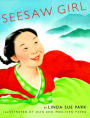
Seesaw Girl
         Seesaw Girl is a story of longing and unattainable dreams. In a time and place where women were respected, but their feelings and desires were not taken into consideration, a young girl must learn to accept this way of life. It is seventeenth-century Korea, and Jade Blossom does not have the liberty to walk outside the walls of her family�s Inner Court. Custom dictates that women who come from a good family never leave their home. They are expected to spend their life learning to sew, embroider, cook, and do laundry in order to prepare for marriage. Only when she marries is she allowed to leave the home, only to be confined to her husband�s home thereafter. The Inner Court was big and beautiful, but �it was Jade Blossom�s whole world...[she]
would be allowed to leave her home only twice in the future�to attend [her brother�s] wedding at the home of the bride, and finally to move to the home of her husband after her own wedding.� This was the way things were and every woman was used to it. It was not uncommon for a woman of that time to see nothing of the world but her family�s house and her husband�s home during the course of their lifetime. Sometimes the only other time they left their husband�s home was to a parent�s funeral, but this depended on whether the husband allowed it. Women were also deprived of other things. One example is the fact that they were not allowed to express themselves through laughter. They were allowed to smile, but not laugh out loud. When Jade and her aunt Willow played a prank on their cousins, they laughed out loud in secret because �they would have been scolded; such laughter was not proper for women or girls.� Another part of the story tells us that Willow covered her mouth when she giggled because, �It was considered impolite for a woman to show her teeth when smiling.�
         
The story revolves around twelve-year-old Jade Blossom, who begins to question and defy this type of lifestyle. When her aunt Willow gets married, Jade misses her dearly. She devices a plan to sneak out of the house in order to go visit her. Once outside, she realizes the countless things she�s been missing out on. She notices that other girls and women are outside and not worried about being seen. She sees trees, rivers, mountains, and a bit of the world she has never been allowed to view. She never forgets this experience and although she is never allowed to do it again, she never forgets the beautiful mountain just beyond the walls of the Inner Court.
          The author�s way of presenting the information and history of Korea is truly remarkable and the characters are so full of life that it is easy to learn and retain the information presented. Facts are presented without losing focus of the plot and characters. The characters often use the dialogue which goes with the time. For example, Jade refers to her father as
�Abu-ji� instead of �Ah-pa� because the latter is the most respectful and formal way of approaching him, which was the custom at the time. It is obvious that the author researched the era before creating the story. History is not presented always in a glamorous or positive way. There is talk of decapitation of captives and of women giving up hope for a more free lifestyle. The central theme of the story is self-discovery and the choices one must live with. The ending is not necessarily a happy one.
          School Library Journal describes the book as
�full of lively action and vivid descriptions, enhanced by appealing black-and-white paintings to give a clear sense of the period.� A great reading experience...the reader will never look at a seesaw the same way after reading this book.

Park, Linda Sue. 1999.
Seesaw Girl. New York: Houghton Mifflin. ISBN: 0-395-91514-7.
http://www.backgroundcity.com/
Hosted by www.Geocities.ws

1