

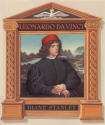
The author works at maintaining an unbiased point of view when telling of Da Vinci�s life. She presents from accomplishments to failures, to unfinished jobs and avoids letting her opinion on this show. Readers are allowed to decide on their own what type of person Da Vinci was. In this way, we are able to see him more as a real person, and not as someone who has always perfect and glorified. For example, readers will learn that Leonardo took risks and they did not always work. He tried to fly and did not succeed, despite spending many years trying to accomplish this feat. He tried to create a huge bronze sculpture of a horse, but �the Moor used the bronze to make cannons instead!� On another occasion, he tried a different method of preserving a painting which resulted in, �the top part of the painting was darkened by the smoke and the rest began to run. Completely discouraged, Leonardo gave up.� By showing this side of Da Vinci, readers are able to see that he was a person just like us. The author allows readers to decide for themselves whether Leonardo was a hardworking and persevering man, or one who gave up easily.
Diane Stanley provides readers with a more realistic view of Leonardo Da Vinci�s life, and allows readers to know him much better than any encyclopedia ever could.
Stanley, Diane. 1996. Leonardo Da Vinci. New York: Morrow Junior Books. ISBN 0-688
10438-X.
