


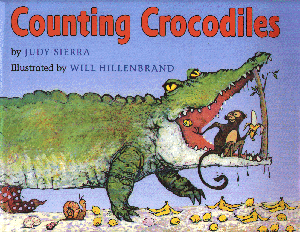
The author has very cleverly incorporated a number of uses for this book. It can simply be a great storybook about a clever monkey, a counting book, a poetry book, and even a book that teaches us a lesson (little guys can be successful!). The plot is quite engrossing, making readers turn the page to find out how the monkey gets a hold of those delicious bananas. On her way to success, the monkey counts the crocodiles one through ten, and then ten through one on her way back. Finally, the author�s use of rhyming allows teachers to introduce poetry to their students. Young readers will enjoy reading this book out loud over and over due to the lyrical content of it. Every page offers us another small poem. �One crusty croc who chanced to hear her/snorted. �It could not be clearer/ that lurking just below the waves are crocodiles galore./Why, head to tail, we�d reach across the sea!� the reptile roared.� Yet another use for this book is to introduce the �ock� sound. For example, the author uses the words: crocs, fox, mohawks, socks, blocks, chicken pox, etc. and this can help students learn the different ways to spell this sound. As Publisher's Weekly states, "Author and artist, working with traditional materials, arrive at an altogether fresh presentation." Certainly, a valuable book in more ways than one.
Sierra, Judy. 1997. Counting crocodiles. New York: Gulliver Books Harcourt Brace &
Company. ISBN 0-15-200192-1.
