

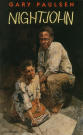
The author�s talent in bringing the story to life truly helps young readers relate to the characters and to their suffering. Students may be able to relate to the story because it is told by someone close to their age. Very quickly, they will learn that life was very difficult for some children, and that learning to read and write was not as easy for them as it is nowadays. �Nightjohn� is a story of courage. It is fast paced and strong, and full of history. The story is brought to life even more through the dialog used by the main character. Often times, there is a lack of subject to verb agreement, and some sentences are short and choppy. For example, when speaking about the master�s dogs, she says, �The dogs be mean. He feeds them things to make them mean. Blood things.� In this way, the author gives life to the character and allows it to feel more real to readers. Newbery Honor books by this author include �The Winter Room,� �Hatchet,� and �Dogsong�.
Paulsen, Gary. 1993. Nightjohn. New York: Delacorte Press. ISBN 0-385-30838-8.
