


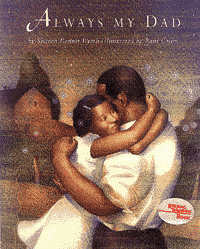
The story is based on the author�s childhood, in which her father was often gone as well. The illustrations, as we learn from the copyright page, are created using a variety of mediums such as, �watercolor, charcoal, colored pencils, and lithograph pencils on Fabriano watercolor paper, and etched with tools including an empty ballpoint pen and a scratcher.� The author�s choice of words portrays the feeling that the young girl is neither resentful nor scarred by her father�s absence. She simply shares the story without sounding preachy or hurt. The illustrations are nostalgic and the colors utilized are soothing to the eyes. The opening and closing images are very much alike. We see the young girl standing by a mailbox, longingly looking at the road in front of her in hopes of seeing her father approaching. On the opening image, we see that it is summer, and on the ending scene, we see that it is now fall. One very interesting detail about the illustrations is that not once do the readers see the father�s face. On most of the illustrations, he is giving his back to the readers or he is too far away to view. Other times, he is hugging his children and this prevents us from seeing his face. Perhaps this was done to allow readers to see that this man is at all times making eye contact with his children. He wants to see them as much as he can and remember all the precious few moments together. Another reason for this may be that perhaps the narrator or author has little recollection of her father�s features. Whatever the reason, it is a magical and mysterious touch given to the entire content of the book. Booklist refers to this book as �a vivid portrait of a treasured time with Dad.� This is a story to share with students who might be going through a similar situation at home.
Wyeth, Sharon D. 1995. Always My Dad. New York: Apple Soup Book. ISBN 0-679-93447-2.
