|
Kerala Ancient
History
Kerala has a long and lengthy history. There are some
interesting mythological stories associated with the creatoion
of Kerala. One of the most popular legends associated with the
creation of Kerala pertains to the story of Parasurama, a
warrior who defeated the Ksharthriyas. He gave the land he
conquered to the Brahmins in order to save his soul, and went
off to do penance. Reportedly, then threw his battle axe into
the ocean. When it struck the water, land rose from the sea.
This became "The Land of Parasurama", now known as Kerala.
Another widely-known legend is the story of the demon Bali,
the asura king who ruled Kerala and made her prosper.
The name Kerala is derived from two words;
Kera meaning coconut, and allum, meaning land.
Thus, the combination, Keralum (now Kerala) means "The
Land of the Coconuts". And little wonder, for the state is
covered with coconut palms. The language of Kerala is
Malayalam, which, besides being a nine-lettered
palindrome, is also the official language of the Lakswadweep
and Maldives Islands. Malayalam is thought to have originated
from Tamil, the language of the neighboring state Tamil
Nadu.
In ancient times, Kerala was extremely prosperous. With the
help of trade winds, the world was opened to the rich markets
of Kerala. In fact, the sea-port of Kodungallor was once
considered one of the greatest eastern markets. Here,
merchants bought spices (which it is most famous for) and
silks, which they toted off to distant empires like Rome to
make a profit.
Many of the merchants who came were Jews. These Jews of Kerala
came and settled here, some to escape persecution. They formed
a tidy little community and managed to establish themselves as
prosperous businessmen. Though greatly diminished, a Kerala
Jewish Community still exists to this day.
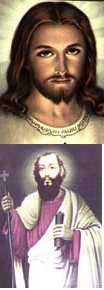
According to legend, the apostle St. Thomas came to Kerala
in 52 AD, where he attempted to convert the Jews there to
Christianity. However, as he soon realized, he had better luck
with the Hindu Brahmins there. As a result, St. Thomas
converted 68 families to Christianity, and established 7
churches. After the arrival of the Portuguese and Vasco Da
Gama in 1498, the St. Thomas Christians of Kerala split into
different rites and sects. Regardless of all the
denominations, all Christians (or the majority, excluding
those converted by the Portuguese) claim ancestry to the
original 68 families converted by St. Thomas. Today,
Christians make up 22 % of Kerala's population. Read more in
The History of Christianity in Kerala.
Click here For a more Detailed
Document on Kerala's Ancient History
else proceed to
Kerala Medieval/Colonization History

|
|