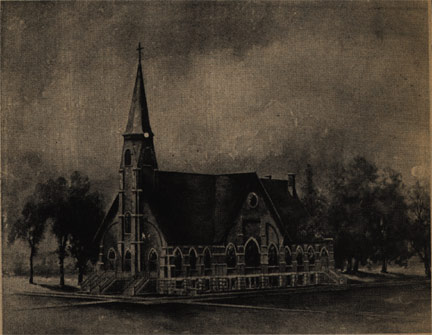
Above is a painting of St. Francis de Sales Church, in Herkimer, when it was new. Below is a current picture from the same angle.
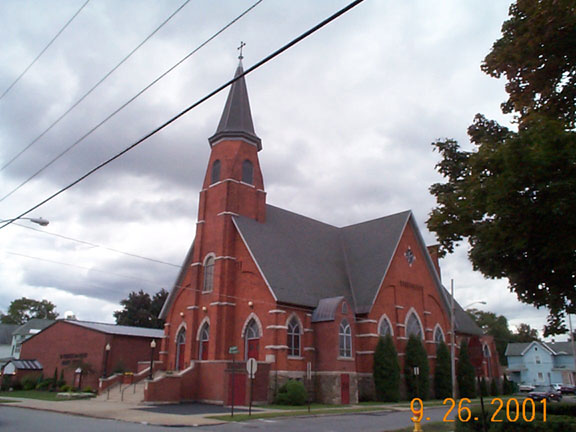
St. Francis de Sales Roman Catholic Church is a wonderful historic church in the Village of Herkimer, NY. The parish has been around 125 years and the current church for about 100 years.
As the village of Herkimer grew toward the mid-1800's, the number of area Catholics also increased. They used to only be served by the church in Utica, about 15 miles away. This soon changed as numerous parishes were established throughout the region to serve the growing number of Catholics. In 1875, after approval from the Bishop of Albany, 30 families together with the Revrend William Howard purchased the old Methodist Church in Herkimer for $2,000. It was dedicated on June 6th of that year. Father Howard served the congregation until 1884 when he retired due to old age. At this time, St. Francis became a mission out of near by Ilion as it once had been. However, by the end of that year, the Revrend James H. Halpin was appointed the parish's new pastor. Under his leadership, the original church had an addition built that doubled the seating capacity. Also, Calvary Cemetary was established next to Oak Hill cemetary which was owned by the Protestants. More importantly, though, he was incharge of having the new church built because of the ever increasing number of members. In 1897, the plot of land where the present church sits was purchased. Two years later, the rectory was completed next to the current church. Today, it no longer stands for they tore it down to build the parish center a couple years ago. This is the red brick building in the above picture to the left of the church.
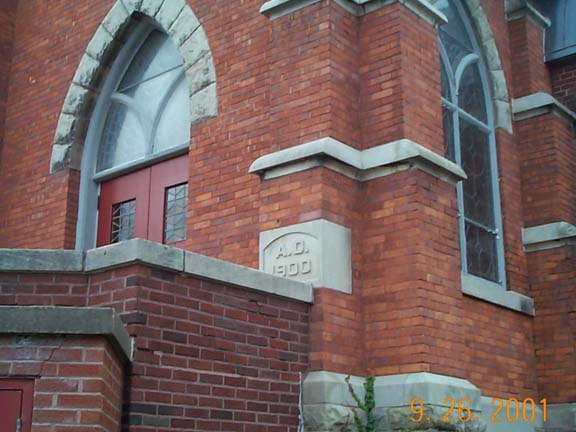
The cornerstone, as shown above, was laid on June 10, 1900 by then Bishop Burke of Albany. The initial cost of the structure was $30,000 and it was dedicated on Halloween in 1901. At this time, the congregation numbered 1500. In 1906, Father Halpin died leaving the parish in much mourning. The next pastor named to the parish was the Revrend Patrick F. Harrigan. He served the parish for 13 year having many smaller accomplishments including a modernization of the cemetary. After he retired due to illness, the Revrend James J. Dasey was appointed to St. Francis. He was only there for less than two year but during that time, the parish school was built in 1921 and a home next to the school was purchased to use as the convent for the Sisters of St. Joseph who were incharge of the school.
 |
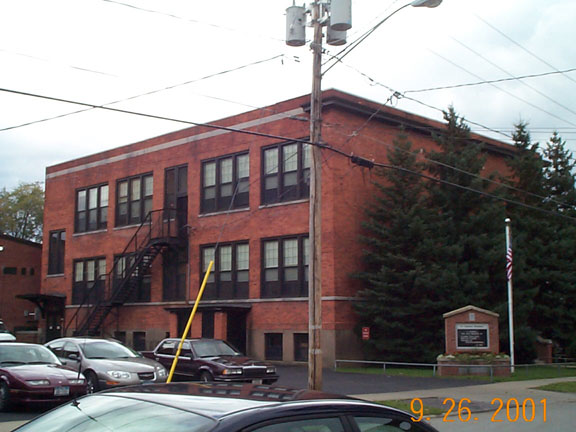 |
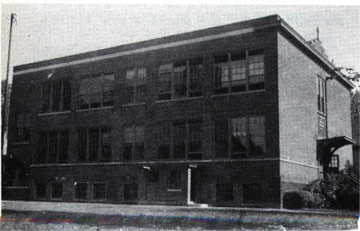
The picture on the above left was of the school from before World War II while the one on the above right is current. The brick structure has basically stayed the same except for the small cross that used to be centered at the top of the front wall has been removed and the fire escape was added about 50 years ago.
In 1921, the Revrend William H White took over as paster of St. Francis de Sales. He served the parish for 7 years during which time he cleared much of their debt and had the final approach to the front of the church completed. He was a very friendly man, taking a great interest in the congregation and stopping over to the school on a daily basis to visit. He was transfered to a parish in Schenectady in 1928 at which time the Revrend John J. McCann took over as pastor. Sadly, he was only pastor for two months when he suddenly died in December of that year.
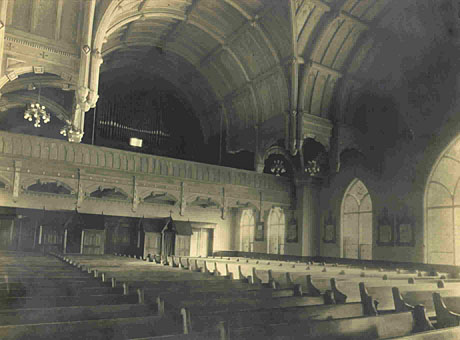
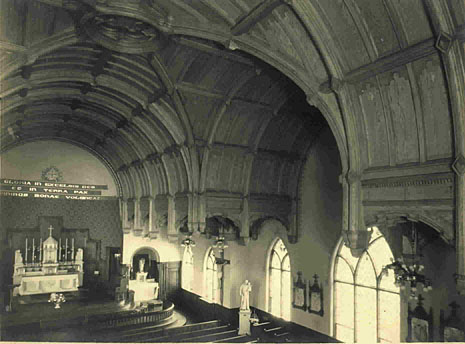
The next pastor, the Revrend Daniel J. McCarthy came from the church in Mohawk in 1929. He served as pastor for 14 years during which time many things were accomplished including the marriage of my grandparents in 1942. The most prominant of these was the installation of the beautiful oak ceiling. It took over 32,000 feet of red oak and 26,000 feet of veneer to complete the ceiling. All the millwork was done in a temporany mill setup on the church's property. The contractor was McLaughlin-Stevens Inc. of Mohawk. The architectural style was Romanesque with gothic details. Also, he had three bells placed in the previously empty bell tower. After this was completed, the church was rededicated in November of 1931. The following are some pictures that were taken after the completion of this magnificant ceiling, descibed as "...one of the finest pieces of architectural workmanship on the American continent." An interesting note: there are two small rose windows near the top of the middle of the side walls of the church. When the new ceiling was installed, these windows were covered up on the inside so they can only be seen from the outside now.
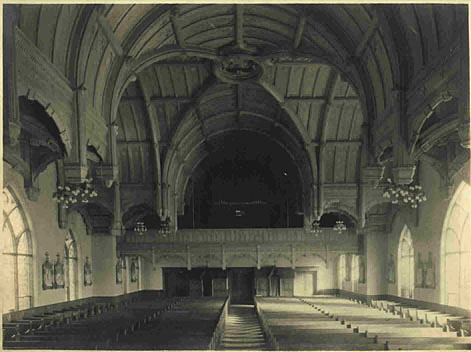
This picutre is looking at toward the choir loft. Also, notice the wonderful old lighting fixtures that have since been replaced.
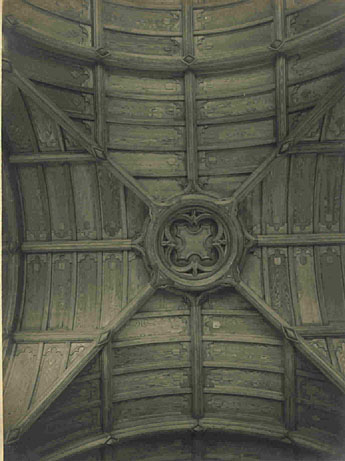
This picture is of the very center of the new ceiling within the church which took 7 weeks to build.
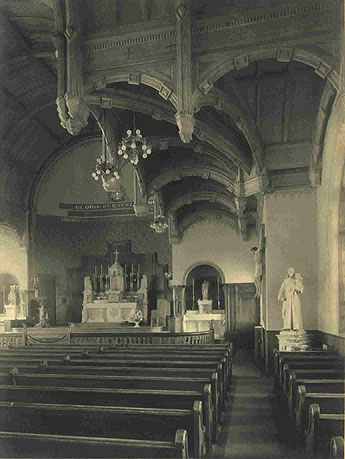
Here's another reward view of the church. Notice the wonderfully constructed Confessional Boxes in the back as well as the nice Stations of the Cross on the Walls. These are no longer there and those confessionals are no longer used (the pitched tops to the confessionals were removed as well). Instead, they purchased new, less beautiful Stations of the Cross in 1970 to replace these historic ones and the Confessional is now in a hallway to the right of the altar that has been blocked off.
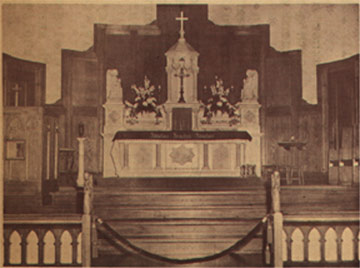
Here's a great picture of how the altar used to look. Also visible are some stautes and a large crucifix that are no longer there. Basically, much of the original character of the interior, except for the ceiling, has been destroyed.
The next pastor to come to St. Francis was the Rev. Msgr. John R. Kehoe. He replaced Father McCarthy in 1943. Under his authority, certain improvents were made to the parish to meet new federal and state regulations. These improvents included the installation of fire escapes on the school, convent and rectory in addition to a sprinkler system and steel stairways in the school. He also helped organize the "Parish Club" which frequently held dances in the church hall as well as the Catholic Men's Demonstration. In addition, he was very active during the Holy Year of the Catholic Church during his term. Another accomplishment of his was the purchasing of 10 acres of land along the West Canada Creek which would become Camp Kehoe in his honor. The lodge on the camp site was built in 1958. This site has been used a lot by local Scout troops and for parish picnics.
Msgr. Kehoe retired in 1965 at which time the Rev. Edward A. McManus was appointed as pastor. He was only at St. Francis for 4 years but during that time, he helped the parish raise the necessary money for renovations to the facilities. Also, repairs were made to the front and side steps to the church, aluminum siding was added to the convent and the school received a new heating system and fire escapes.
In 1969, Father McManus was transfered to another parish, so the Rev. Peter J. Nabozny was appointed to take his place. It was under his directions that the church under went major renovation which resulted in the destruction of much of the interior's historical character. Details of the renovation included the cleaning and polishing of the beautiful oak ceiling, the installation of new carpeting, refinishing of the pews, a complete remodeling of the altar, re-wiring of the entire church and the installation of a new boiler and heating system.
Father Nabozny served this parish well for about 30 years. More recently, he saw the parish through the shortage of priest and declining population to where the other two Catholic Churches in Herkimer merged and also to the closing of all the other Catholic Schools in Herkimer County except for St. Francis. Despite my strong disagreement on the remodeling of the church in 1970, Father Nabozny otherwise was great asset to the parish. He retired just a couple years ago. The Rev. Mark Cunningham took over as pastor of St. Francis where he currently remains, leading the parish into the new millenium and the next 100 years with this historic church building. Father Mark came from a church in Guilderland though he's a native of the valley, being raised in Mohawk. Just a recently (Nov. 2001) the parish celebrated the 100th anniversary of the church building.
And this concludes the current history for the parish. Updates will be made in the future as important events occur.
Highlights
|
This is what the altar originally looked like.
(top in 1970, bottom in 1930's)
|
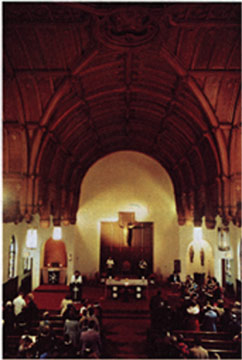
A view of the altar from 1975 (same as current)
after the renovations in 1970.
|
 |
 |
 |
A sad and unfortunate transformation. In 1970, just before my parent's wedding in June of that year, the church under went some major interior renovations. They had decided to outfit the church for the new more leanient rules set forth by Vatican II in 1965. One of these was that the priest was now able to say the mass facing the people, rather than with his back toward them. This meant that churhces needed to install new altars out from the wall so the priest could stand behind it to face the people. Many older churches kept their original altars because of their beatuy. Sadly, as part of the renovations, the original altar (probably made of marble) shown in the above left picture was torn out as well as much of the wood paneling, the built-in wooden pulpit and the great altar rails with the angels adorning the entrance through the gate. I feel that this action destroyed part of the historic character of this wonderful building. As you can see in the picture on the right, the altar is much more modern and plain looking, not at all fiting for a church that was built at the turn of the century.
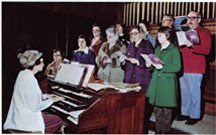
I have a big connection to this parish thorugh my family. My great-great-grandmother, great-grandparents, grandparents and parents (for only several years) all belonged to this church. Further more, my grandmother, mother and sister all attended the parish school. Additionally, my great-grandfather (a draftsman) help to design the wonderful oak ceiling. Finally, my grandmother played the organ in this church on and off for about 60 years. Below is a picture of my grandmother playing the organ for the choir. This photo appeared in a booklet commemerating the parish's 100th anniversary in 1975. Thus, this building holds a special place in my heart.