|
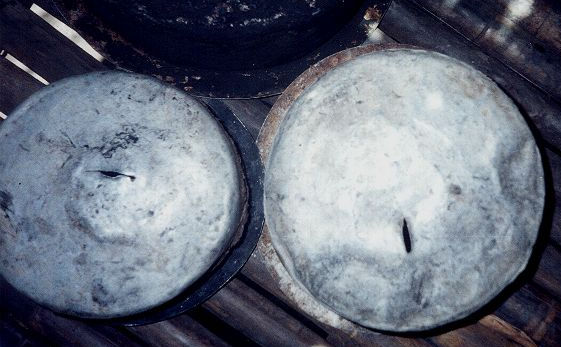
The bottoms of cookpots owned by Karen villagers, showing how SPDC troops destroyed them by slashing holes in them with their bayonets. When SPDC troops rampage through villages looking for valuables and porters, they make a point of destroying whatever they cannot take with them in order to make life impossible for the villagers. Slashing holes in the bottom of cookpots, rendering them useless, is one of their most common offenses. For villagers living on the brink of survival in outlying areas, new cookpots can be difficult if not impossible to obtain, and more expensive than they can afford. |
Most of us take for granted the pots and pans in which we cook our food. If we think about it though they are essential for most everything we eat. A cooking pot is even more essential to those for whom rice is a staple. Last week Tii-wa-doe a Karen village of 2,000 people was burned to the ground by Burmese troops. The villagers were supposedly harbouring guerillas opposed to the military regime. So according to the brutal logic used by the (sic) State Peace and Development Committee the villagers had to pay the price, losing their clinic, their homes, the rice they had stored for the coming dry season and their cooking pots. Many villagers were in the fields bringing in their scant harvest of hill rice when the invasion took place, so they had to flee with no warning and no time to gather their things. It is reported that the troops even took the time to climb the hills and burn some of the standing rice yet unharvested. |
|
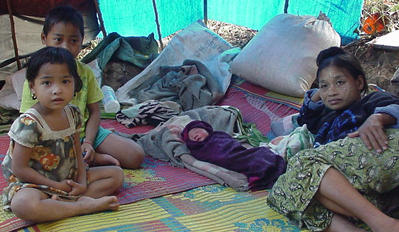
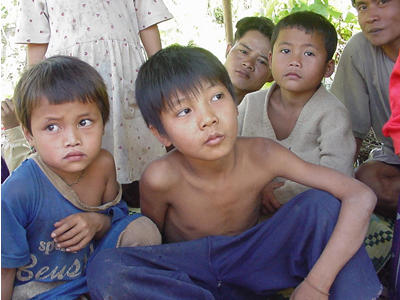
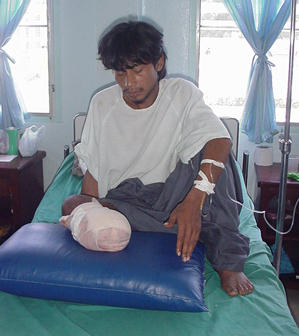
Three days later bands of villagers began emerging from the forest to which they fled. They converged outside the Mon border camp of Hilok-a-nee seeking shelter and safety. At last count there were over 800 former residents of Tii-wa-doe gathering there. Some were given shelter under houses, but most are left to sleep under the trees in this the coldest season of the year. What of the 1,200 others? Fifteen of the villagers were taken captive as porters for the Burmese soldiers. One was shot and has lost his leg. But of the others, no one knows their fate. Perhaps they will show up in the next few days or weeks, perhaps not. |
 |
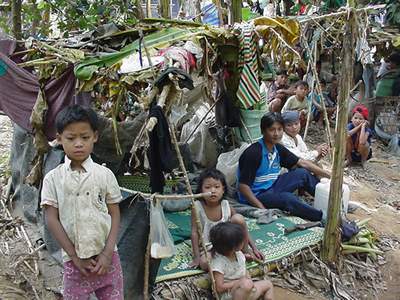 |
With the help of a generous gifts by people within and without Thailand it was possible to respond immediately to the crisis distributing blankets, sleeping mats, food, clothes and cooking pots. Soon afterwards other relief and refugee organizations began to respond and now there are plans for building temporary shelters and a sanitation system as well as regular rice distribution. Hilok-a-nee village being located in a narrow mountain valley is already overcrowded and there is little chance that the former residents of Tii-wa-doe will be able to settle there permanently. |
|
Three day old baby born after the evacuation
|
What does the future hold for these people? It is hard to say. For most of the former residents of Tii-wa-doe this is not the first time that they have had to flee their homes. Until the dry season offensive of 1997 Tii-wa-doe was a small backwoods village but as the Burmese troops burned and looted other villages along the border where the Karen traditionally live the population has grown. Most now would like to cross over the border into Thailand and find relative security in the refugee camps run by the United Nations, but the Thai army will not allow this. By some strange logic the Thai military contends that there is no fighting on the other side of the border so there is no reason for refugees to cross. There is an attempt at the moment to present proof of the situation to the Thai authorities. Let's hope that they will accept it and give sanctuary to those who so desperately need it. In the long term the best answer for the former residents of Tii-wa-doe, Karen people everywhere, and all the ethnic groups of Burma is the ascendance of a democratically elected government in Burma and the demise of the thoroughly discredited military regime. |