Westward From New Amsterdam

[Companies] [Famous Schoonovers] [Schoonover Mastertree1] [Schoonover Mastertree2]

[Other Resources] [Schoonover Places] [Unconnected Lines] [Main Page]
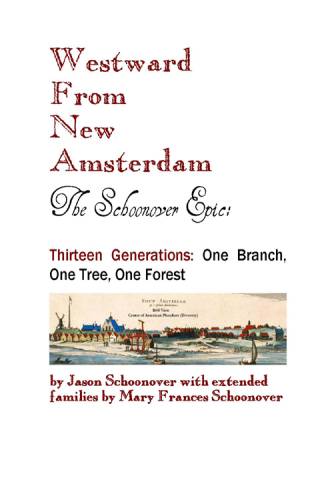
Cover new only 2.jpg (165595 bytes)

Dear Cousins,

The genealogical book--Westward from New Amsterdam—I have been working on since I was in  university in 1968, the last several years with Mary who so ably runs this website,  is “complete.” At well over 800 pages (and always growing), it is much too massive and expensive to publish in book form, so it’s on DVD. By purchasing it, you, in effect, become a subscriber--and receive email updates as Mary and I add to this weighty work-in-progress.

If you’d like a copy, please mail a Money Order for $25.00 + $3.00 postage (personal checks cost an arm and a leg to process because of the border) to:

Jason Schoonover
720 University Drive
Saskatoon, Sask.,
S7N OJ4
Canada

This book has important relevance to all Schoonovers for two reasons:   Although it follows our direct lines (my ggrandfather and Mary’s grandfather were brothers), it has exhaustive information on Schoonhoven,Holland (where I’ve been, and clears the Coat of Arms confusion).  There’s reams on Claes,Guert,Kit Davids (besides his never ending pages of court cases, there’s two chapters in two different books devoted to this hugely colorful ancestor) and Debra’s Scandal (Peg Leg is clearly identified with a link to that family’s excellent genealogical book which includes Peg Leg) and the early generations that moved up the Hudson, down the Old Mine Road to the Minisink and up the Susquahanna River after the Revolutionary War to the Troupsburg area before heading West in the Great Expansion. This includes early maps  - and even early actual drawings of two of Claes’ houses next to present day Wall Street! 


 The second reason is this: behind our entire 12-13 generations, I painted in  a detailed historic backdrop so we could better understand the forces affecting our ancestors’ lives – to bring them to life. In the spirit of genealogy—everyone shares freely—I grant you permission to use this rich tapestry for your own genealogical book. Indeed, everything in the book you’re welcome to use verbatim. Thus, this also has relevance to people not so fortunate as to be a Schoonover.

   In Augusts of 2001 and 2002 I drove from New York (down Broadway, a block from the Twin Towers, a week before they came down) to Washington State revisiting all my ancestral sites—many of which in the east are early common sites—and shot numerous photos. Did you know there’s a Davis Tavern in Marbletown, NY, with an historical marker? It’s named after one of Kit’s kids who lived in the stone, well kept structure.

 Here’s our line (and we’ve included in Westward from NewAmsterdam complete branches of several cousins we’ve met in our research): 

Hendrick Van Schoonhoven & Aeltgen Adriaens, Holland.

Klaas/Claes Hendrickse Van Schoonhoven & Cornelia “Neelti” Fredericks, Holland-Albany-Kingston, NY .

        Hendrick Claes Van Schoonhoven & Debra Davids & Peg Leg Derrick Van Vliet, Kingston-Marbletown, NY.

        Nicholas  (1) Van Schoonhoven a.k.a. The Bastard & Weyntjen De Lange, Kingston-Marbletown, NY.

        Jonas Van Schoonhoven & Engeltje Van De Water, Kingston-Fishkill-Warwick.

        Richard   Schoonover & Sally Pemberton, Warwick-Troupsburg, NY.

        Richard Schoonover & Eunice Potter-Troupsburg, NY

        William Leonard Schoonover  a.k.a. Blacksmith Bill & Almira Grinold NY-MN-MO.

        William Leonard Schoonover  a.k.a. The Shadow & Martha “Matti” J. Baker MO-Wash.

William Leonard Schoonover a.k.a. Showbiz Bill & Ida/Nora, MO-WISC-MN-MO/  Saskatchewan Canada. (Here Mary’s line descends from Showbiz Bill’s brother Clarence Jacob & Lucy Taylor, MO-WISC-MN, whose son Bert was Mary’s father)

        William Lenis Schoonover & Hilda Robinson, Ridgedale, Sask.

        Vernon Lennis Schoonover & Linda Lena Nowak, Sask./Alberta.

        Jason Brooke Rivers Morgan  Schoonover Sask/BC/Sask/Thailand.

    If you want further information, please email me at [email protected] or phone me at (306) 244-7365.

 A sample chapter – the Prologue – follows.

           Warmest regards—Jason

PROLOGUE

          Hendrick Van Schoonhoven is the suspected Grand Patriarch (in name if not always genetically) of virtually all carrying the Schoonover name in North America.  Today Schoonover - the Americanized version of Van Schoonhoven which evolved around 1700 on most censuses (but not until the mid 1800s for this line) - is one of the 50,000 most common names in the U.S. with over 7,000 Schoonover heads of household. A distribution of Schoonovers state-by-state from 1880, 1920 and 1990 can be found by searching out the Surname Distribution Map  (currently at http://www.hamrick.com./names/) and hammering in the name (and appears herein). We’re well distributed everywhere – except the Deep South.

 Hendrick may have been a lawyer, thus getting the family off to a bad start.  He is suspected of siring two adventurers - Claes/Klaas Hendrickse Van Schoonhoven (the namesake of my “line”; quotation marks will be explained later) and Guert Hendrickse Van Schoonhoven.  Claes and Guert were likely brothers, but perhaps cousins; there is no proof linking them other than names, ages and proximity.  Claes is known to have had a brother, Wouter, who apparently was born in Amsterdam where he remained dipping cheese into his brown beer and providing financial backing for his master carpenter brother’s property development dreams; as well as a probable sister, Barentje Hendrickse.   Guert had a brother, Jan Hendrickse.

 What kind of a life did they live? The one Claes and Guert left? Surprisingly, it’s one very familiar to us - particularly from the canvasses of Jan Vermeer. He was 43 and Rembrandt 44 - both in their primes - in 1651, which is approximately the year the first of the two sons to emigrate, Claes, boarded a ship for New Amsterdam.

 The Schoonovers - like everyone who came to this frontier - were an adventurous breed and were among the very first to risk the two month voyage  to America in a tiny ship, not much more than a boat. The long struggle against the Spanish back home in the Dutch War of Independence had hardly concluded (1568-1648) when Claes and Neeltjie married in Amsterdam and clomped in their wooden shoes onto Governor’s Wharf in New Amsterdam, which is believed to be that date of 1651, the first evidence we have of him there. Hendrick was born in 1652, the year Holland and England went to war.

 At that time, New Amsterdam was a raw frontier town of a few hundred people huddled on the southern tip of Manhattan Island. The entire European population of North America barely surpassed 50,000.


 (Two map photos deleted here in this sample to accommodate website space)

wpe4.jpg (29358 bytes)

The first arrows had already been shot in the Great Real Estate War with the reds and whites fighting for control of North America, a war that wouldn’t end until Wounded Knee 240 years later and which put our first six generations on constant alert. Claes and Neeltje entered an environment where fear from Indian depredation was a constant fact of life and death.  Collecting firewood, a daily undertaking, was hazardous even on Manhattan in the beginning where “savages” waited with raised tomahawks - despite us Dutch having paid very well for the island.  They were called savages by the early settlers because they were, well, savage. But then they often had reason to be: this was a hostile real estate takeover almost from the beginning (“almost” because the Dutch always purchased their land from the Indians).   

           Just before their arrival, during Governor Kieft’s War of 1643-45, about  1,000 lower Hudson River and Long Island Indians died at Dutch hands.  Clearly the land battle had begun. Beginning about the time Claes arrived, the Beaver Wars began, pitting the Iroquois - by far the most powerful alliance - against the Hurons and everyone else for control of the fur trade.

           Early Schoonovers had several  - quite literal - hair raising experiences. Three times  - that I can document  - early generations narrowly escaped being wiped out in Indian massacres. Eleven year old second generation Hendrick Claes and his mother managed to survive the 1663 attack when Indians put Kingston (then Esopus) to the torch - but his new born baby half-brother and step-father were slaughtered.  Details of this well-planned Indian  raid can be found in The Early History of Kingston & Ulster County, NY by Marc B. Fried. (Ulster County Historical Society, Marbletown, Kingston, NY). In another - a Sioux uprising in Minnesota in 1862 and the biggest Indian uprising in American history - my ancestors Blacksmith Bill and Almira were forced to flee for their lives.

           Claes, the colorful Kit Davids and the infamous Peg Leg  (important names you’ll meet along the way) were among the very first adventurers to strike out into the   wilderness. Before doing so Claes, a master carpenter and developer, made several real estate transactions in New Amsterdam, the sites of many of which can be located today. One is a famous landmark:  when you walk through the entrance and foyer of Trinity Church at the head of Wall Street, you are treading over the very land which Claes purchased in 1652. Unfortunately the very next year Peter Stuyvesant ran the fortification wall, which eventually became Wall Street, through a corner of Claes’ property, destroying his development plans and seriously pissing him off.


Trinity Church at the head of Wall Street with the exchange on immediate left. Whether the actual wall went through on the right, left or center, it cut right through Guert’s property.


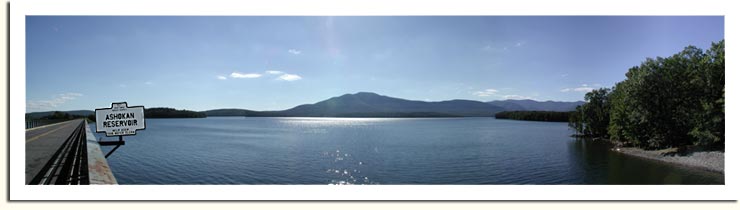
Because of this and other frustrating real estate transactions on Manhattan, Claes and Neeltje left the bright oil lamps of Herrewegh, later Broad Way, behind and sailed up the Hudson becoming one of the first Dutch to settle along that frontier river. They settled in Fort Orange (a.k.a. Albany a.k.a. Beaverwyck - Beverwijk, with the Dutch spelling, is a town in the province of Noord Holland) in 1654, and were there that year, as per The Book of New World Immigrants p. 128-130. He offered some chisels for sale August 20. He worked as a carpenter and a "considerable dealer in real estate,” according to Genealogies of the First Settlers of Albany on p. 133.  In 1657, he left Neeltje in charge of affairs and traveled south to Esopus/Kingston/Wildwcyk  - founded in 1652.  There he purchased much of the land where the present day Ashokan Reservoir, which waters 50% of Manhattan, stands today, just three miles south of the 1969 Woodstock Festival site.
            ash.jpg (7758 bytes)

The reservoir. From the web: Ashokan Reservoir Communities -- Nine villages were either removed or obliterated forever. These included West Hurley, Ashton, Glenford, Brown's Station, Olive Bridge, Brodhead, Shokan, West Shokan and Boiceville. Eleven miles of the Ulster & Delaware Railroad tracks were taken up and relocated. Sixty-four miles of highway were discontinued, including a long stretch of the famous Plank Road, and forty new miles of boulevard built, mainly of macadam. Ten new bridges were constructed. A sensational feature was the removal from thirty-two cemeteries of two thousand eight hundred bodies or skeletons, including those of many soldiers of the Revolution, and their reinterment in new pine boxes in neighboring graveyards.


Hosted by www.Geocities.ws

1