
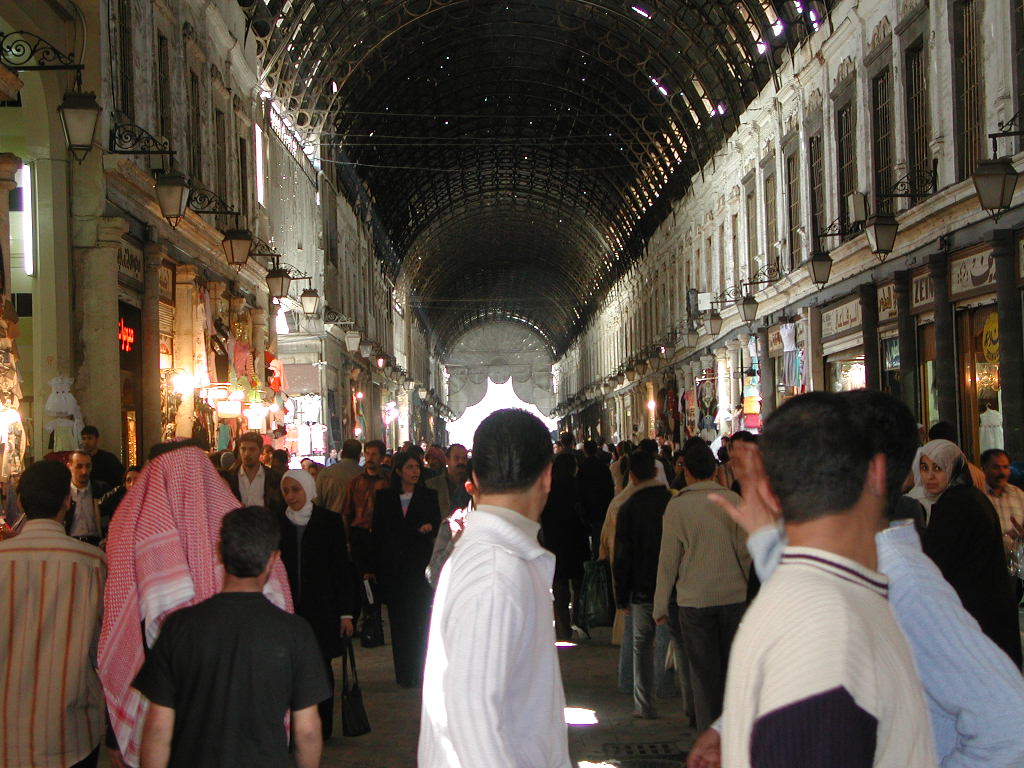
I came to the Middle East with an open mind about the state and status of women in the Middle East. I had read a good deal of criticism and apology regarding the role of women, and had mildly concluded that these circumstances had been worked out in a manner that probably benefited this society in a way that was generally appropriate for them. But, I left with a sense of pretty profound disappointment. The (few) women I had the opportunity to meet seemed to feel, or told me, that life was a dead end for them.
The vast majority of the women I saw in Syria wear at least the veil, or hajib. I would say about half also wear the full-length, loose-fitting, plain-colored (but not necessarily black) dress. Probably 5-10% or so wear the full black chador, with about half of those covering even the eyes. Many of those whose heads were covered, but whose faces were not hidden, wore makeup very often to excess, but occasionally in a manner that was striking.
I do not pretend to say that I understand this issue anywhere near its fullest. That said, I will relate what I did experience, most of which involved a small number of Muslim women who I met on a couple of evenings, two of which in particular (sisters) I got to spend some interesting time with.
These two, Saher and Listrina, both refuse to conform to what is considered proper Muslim behavior and dress for women. They dress as western women, even excessively. Saher, who is single and 28, spoke to me in some detail about her life, her family and her aspirations. More on Saher later. Listrina, single and 22, told me of her longing for a young man who, returning her affections, informed her of her expectations should they marry. He told her that he would expect her to wear the veil, report to him on her whereabouts and who she is with, at all times. She told him that that was a nonstarter. While they were negotiating these issues, his mother, a schoolteacher, strikes a pact with a coworker, another schoolteacher. The deal is made that her son will marry the coworker�s daughter, and this happens. But, he�s not happy. So he continues to telephone Listrina. She is delighted about this, because she really likes him. I almost fell out of my chair when she told me, sincerely, and with her sister sitting next to her, that she would be very happy to be his second wife, as long as he would permit her to live as she chooses. I asked how this works. The two responded together laughing, one week here, one week there; one month here, one month there. It wouldn�t be so bad, they said.
Saher, a beautiful, thoughtful Arab woman with a big heart, aspires to be either a model or a flight attendant. I suspect these ambitions both stem from the simple desire for change, in that both would take her away from her life in Damascus. But neither was possible because, she told me, her mother would never allow it. Her role should be to marry and have children. She should wear the veil, because her husband will insist on it, and she will subordinate herself totally to him. In conversation it was clear to me that her mother pretty much made all the significant decisions for her, and I asked her about this. A little surprised at the question, she said that parents do (and should) make decisions for unmarried females. (She was quite curious, and surprised, that my mother lives in Florida, far away from any of her children.) She told me that fathers, mothers, or even older brothers make all big decisions for single women. And once married, the husband played that role. Saher�s problem is that she doesn�t accept these rules. I need to add that Saher said that her mother was really great, in that she allowed Saher and Listrina veto-rights over marriages that the mother arranges.
Saher told me that her older brother, now married and out of the home, once struck her in the head so hard that she was unconscious for ten minutes (she went out of her way to say that he has now grown up, now that he is married � he has matured and is good now). She said that her younger brother (age 21) had once broken Listrina�s arm in anger, and that this same brother often threatened to kill her (Saher); most recently, the afternoon I was speaking with her. I asked her how common this was in families, whether she spoke to friends and neighbors about these things. She said no, she could talk to me as a foreigner about these things, but never to people in the community. From that comment of Saher�s, I suspect that community pressures that might curb some of this kind of behavior do not exist in this society, and that consequently the problem is pretty bad.
This, in a secular Arab society.