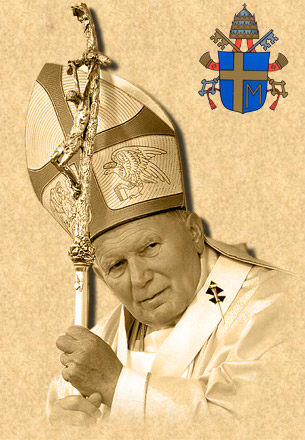
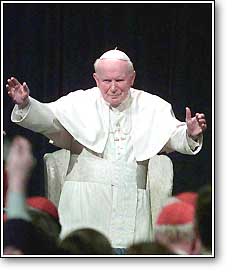
Pope John Paul II was born on May 18th, 1920 in Wadowice, a small town about 50 kilometers from Cracow, Poland. Of course he was not known then as John Paul, but as Karol Wojtyla, the second of two sons born to his father, also Karol, and his moth Emilia. His mother died while Karol was only nine years old. After his highschool graduation he enrolled in Jagiellonian University in 1938 and also in a school for drama. The Nazis closed the school in 1938 and Karol had to work in a quarry for four years and then in a chemical factory to earn a living. He became aware of his vocation to the priesthood in 1942 and began to take courses, secretly, in the Cracow seminary. After World War II he continued studying in the major seminary at Cracow, and finished his doctorate in theology in 1948. After becoming the Archbishop of Cracow, he was made cardinal of June 26th, 1967. He was elected Pope on October 16th, 1978.
Accomplishments
Since the beginning of his Pontificate, John Paul II has made 102 pastoral visits outside Italy and 144 within Italy. He has traveled altogether over half a million miles through 102 countries and has published more works than any of his predecessors with fourteen encyclicals, fifteen apostolic exhortations, eleven apostolic constitutions, and forty-three apostolic letters. He has also published three books, one being a book of poems. The Pope has overseen 143 beatification ceremonies and fifty canonization ceremonies.
From 1978 to the present he has presided over fifteen Synods of Bishops; six ordinary, one extraordinary, and eight special. He has held over 709 meetings with Heads of State and 241 meetings with Prime Ministers.
Faith
It seems pretty obvious that John Paul II would be a man of faith, doesn't it? After all, he is the pope. But what is it that really makes him a man of faith? Through all that the Pope has been through, as John Paul and as Karol Wojtyla, he still proclaims a message of faith and hope for all people. One of the pope's biggest messages is for the young people of the world. "You are the light of the world," he proclaims, and he has hope and faith that many of us will try to live the word of God. How else could a man survive the death of his mother, the toils of working for the Nazis, constant fear of being killed by the Germans, and the pain of having to watch a world at war and disunity even to this day, without having some sort of faith and hope that the message of Jesus is true. Why else would a man suffering from old age, Parkinson's Disease, and arthritis in many of the joints in his body want to get up every morning? He must believe that he has a purpose, and he must have faith that his purpose can be fulfilled.