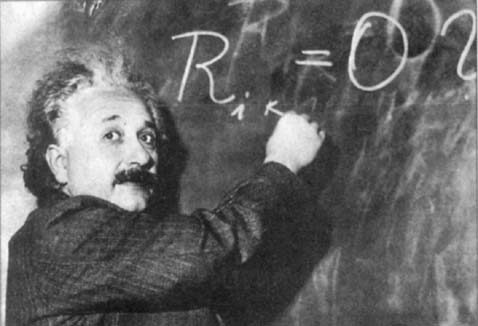
Einstein is known for many things, but probably the one physics equation that everyone knows is E=mc2. Among other things he received a Nobel Prize for his contributions to work on the photoelectric effect, was a professor at numerous universities including the University of Zurich and Princeton. His 1905 papers studied the behavior of light previously examined by Max Planck, and his studies led to significant advancements in Quantum Theory.
"It would be possible to describe everything scientifically, but it would make no sense; it would be without meaning, as if you described a Beethoven symphony as a variation of wave pressure." -- Albert Einstein
Einstein's belief in God throughout his life seems somewhat complicated. Though he definitely believed in God's existence, his ideas on how God played a part in the world seemed to vary. Einstein was a very peaceful man, and in his years as a physicist, he constantly advocated the complete disarmament of nuclear weapons from the world powers, maybe because he actually understood their destructive power. The way Einstein looked at the universe seems to be summed up in the quote, "God does not play dice," in which Einstein recognizes the beauty and complexity that has gone into the comsos, and cannot believe that it was all created randomly.
Sources:
http://www.humboldt1.com/~gralsto/einstein/einstein.html
http://www-gap.dcs.st-and.ac.uk/~history/Mathematicians/Einstein.html
Calder, Nigel "Einstein's Universe"
