Unanswered Questions About The Assassination
1.) What was the wound in President Kennedy's throat?
When president Kennedy was brought into Parkland Hospital, in addition to his massive head wound,
he also had a small hole in the throat. The doctors used the hole, opening it further to insert
a tube for a tracheotomy. By the time the President's body reached Bethesda Hospital for the
autopsy, the wound looked more like an exit wound of a bullet. From this, the Warren Commission
turned a bullet wound in the back into an exit wound in the throat.
Some witnesses described the wound as smooth and regular, while others remember it as jagged,
but all agreed that the hole was small. It was so small, that at least one doctor thought it too
small to even be an entrance wound of a bullet. The hole was described as between 3 and 5
millimeters in diameter, smaller than a 6.5 millimeter bullet which would be fired from Oswald's
Mannlicher-Carcano rifle. Test firings of Oswald's rifle through goat skins, produced exit
wounds of 10 millimeters as the smallest.
It seems unlikely that the wound was an exit wound from a bullet, by its small size. It also
seems unlikely that the wound was an entrance wound of a bullet, due to no exit wound in the back
of the neck. If neither of those, what was it? In his book "Six Seconds In Dallas", Josiah
Thompson came up with a theory that has gained much support.
During the autopsy, the President's brain was removed and place in formaldahyde. Later, an
examination of the brain turned up something startling. In the midbrain area, were found two
sizable lacerations. It is possible to pass a line through these lacerations from a point on the
right rear of the skull that will also pass through and out of the skull that will also pass through
and out the lower throat. (pg. 155) So, it is quite possible, if not probable, that the hole in
the President's throat was actually caused by a bullet or bone fragment, as a result from the
shot to the head.
2.) If the back wound did not exit the throat, what happened to the bullet?
At the autopsy, the surgeons located an opening which appeared to be a bullet hole, below the
shoulders and two inches to the right of the middle of the spinal column. The opening was
probed, and was determined that the trajectory of the bullet was downward at a 45-60 dgree angle.
Further probing determined that the distance traveled by the bullet was a short distance, because
the end of the opening could be felt with the finger. There was no track discovered that would
have carried the bullet out through the throat, where it then supposedly went on to strike
Governor Connally.
Where did the bullet go? One possibility that has been brought up, is that Kennedy was hit by
an accelerator or "sabot", a small plastic device which allows a smaller caliber slug to be fired
from a larger shell casing. Using such a device with a full charge of gunpowder in the shell
casing, the smaller slug will have increased velocity. The smaller slug also could have been
previously fired and recovered, resulting in ballistic markings which match the original weapon
and not the weapon which fired the "sabot" slug. Coincidently, a shell casing indicating the use
of a "sabot" was found in the 1970s on the roof of the Dallas County Records Building overlooking
Dealey Plaza. By using a partially charged cartridge, a "sabot" can be fired at low velocity and
does not penetrate the body, but is a marker found in the body that will trace back to a rifle
from which the bulletr was not fired. (Twyman, Noel. "Bloody Treason", pg. 101). This may have
been the "magic bullet", that later turned up on a stretcher at parkland Hospital, or perhaps the
bullet simply fell out and went unnoticed, while say the President's body was being removed from
his limousene.
3.) Who was the Umbrella Man?
The first shots were fired at the presidential limousine as it passed the Stemmons Freeway
sign on the north side of Elm Street. Standing next to the sign was a man holding an open umbrella.
He was dressed in a suit, in his thirties or early forties, and seems almost to be a marker of
where the assassination was to occur. The fact that no other picture has ever materialized of
anyone with an open umbrella in the whole parade, the fact that this one, at this particular spot
would seem suspicious. Some people have come up with theories that it was a visual signal, or some
type of dart shooting weapon. During the House Assassinations Committee Investigation, someone
came forward saying they recognized the man as Louis Steven Witt. He testified that he disliked
the Kennedy family and that he held an open umbrella to taunt Mr. Kennedy. The umbrella was
supposed to remind Kennedy that his father, Joseph, had sympathized with former British Prime
Minister Neville Chamberlain's attempts to appease Germany before the start of World War II
(Chamberlain's trade was an umbrella). (Groden, Robert J. "The Killing Of A President", pg. 188)
Uh, yeah. I for one can't really buy that story.

At left is a picture of Kennedy's limousine, with the "umbrella man" in the background.
4.) Who was the assassin(s) on the sixth floor, and how did he/they escape?
One question I've always wondered and no one has ever really been able to give a good explanation,
is if Oswald was not the assassin on the sixth floor, how did whoever was the assassin make his
escape? As mentioned on another page on this site, Oswald was seen on the second floor approximately
75 seconds after the shooting by Dallas Police officer, Marrion Baker and building superintendent,
Roy Truly. This pair proceded to take the stairs to the other floors, but saw no one, at least who
they suspected of being an assassin. Did the person or persons on the sixth floor hide out on
another floor or the roof, then slip out, where he/they may have been seen running out of the
back of the depository by a couple of witnesses? Did he/they hide out, then mingle in with law
enforcement, carrying some type of law enforcement credential himself/themselves, then walk right
out the front door of the building a short time later? Another thing related to Oswald that neither
me nor any other pro-conspiracy person can really explain- if Lee Harvey Oswald did not fire any
shots in the assassination of President Kennedy, but the powers that be planned to have him
blamed as a patsy, how could they be assured that he would not have an ironclad alibi for the
time of the assassiantion? However, if he was told to hang out by the phone in the lunchroom on
the second floor at the time of the assassination, conspirators probably could assume that he would
be alone, figuring everyone would be outside to see the President. But if that were the case,
why would Oswald not defend himself concerning that? Who knows.
5.) Were backyard photographs of Oswald with a handgun and rifle real or faked?
The day after the assassination, a search of the garage of ruth Paine's house, yielded two
"backyard" photographs. They both appeared to be Lee Harvey Oswald holding the rifle and pistol,
linking him to the deaths of President Kennedy and Dallas Patrolman J.D. Tippit. However, there
are problems with the photographs.
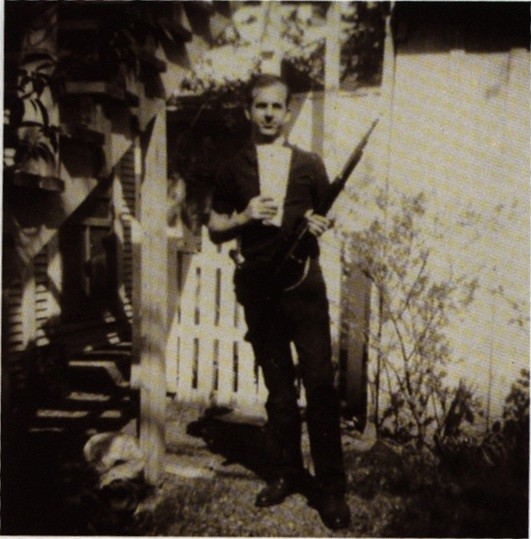
In the photograph at left, notice the shadows across the face and on the ground do not match.
It falls right under the nose, but to the right of his body behind him.
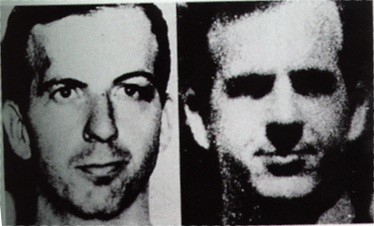
In a closeup of the same photo at left, you see the man in the picture with a square chin, while
Oswald, at far left, has more of a pointed chin with a cleft. There also seems to be a crop line
below the lip in the backyard photo closeup.
When he was shown the photos, Oswald said they were fakes, with his head superimposed atop
someone else's body. He said he was familiar with photography and would prove they were fakes.
Unfortunately, he never got the opportunity. There is at least one negative attached to the
"backyard" photographs, but a photographic panel proved that Oswald's camera could produce
counterfeit "original Negatives." (Groden, Robert J. "The Search For Lee Harvey Oswald", pg. 94)
Back to home page