 |
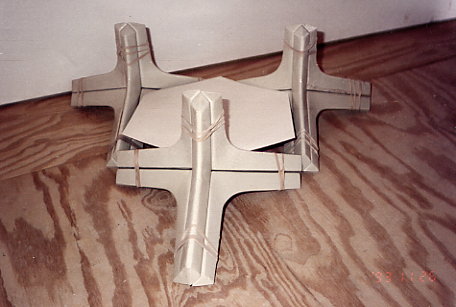
| In 1993, i was still "isolated" from the Architectural Profession, and 3D Computer Modelling was still in it's infancy. This model was constructed from Gypsum Board. |
| From Farmhaus to Your House... |
| In 1985 the Science Program NOVA broadcast on PBS a study by Researchers at Massachusetts Institute of Technology (MIT) called "Shapes in Nature". It explored the similarities of various forms such as beehives, soap bubbles, and snowflakes, and attempted to explain the physical principles behind them. i had been familiar with the numerous attempts in the Architectural profession to devise "industrial-modules"... ...and was well aware of the problems of "stacking" cubes. You simply cannot construct a very large building this way. The "beehive" solution seemed to be the way to make 'modular- industrialization' a practical reality. My first models were rather small, but i wanted to 'see' what kinds of large buildings would result from a dense-clustering of the "natural-module". Geometrists' had been writing about these 'space-partitioning' modules in the architectural theory books for years. A number of the students of R. Buckminster Fuller went on to publish their studies in a series of books about "Natural Shapes". My preference was for the "dodecahedron" (...of which there are two variants.), a twelve-sided shape symmetrical about four axis'. after one design session, i decided to "flatten" the module, so what i ended up with was not truly 'symmetrical', nor "natural", but i suppose an array of soap bubbles subjected to the forces of gravity would flatten out. |
 |
 |
| The Early History of Arcadia Research |
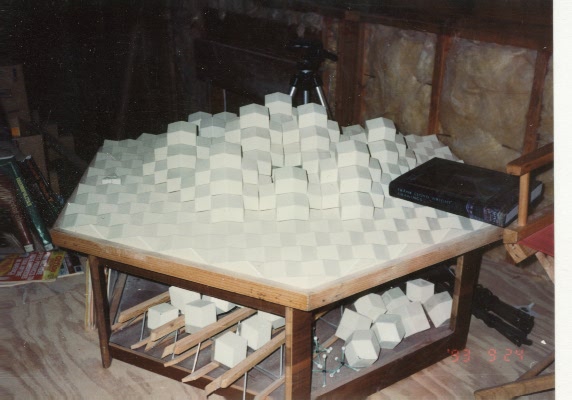
| This Model would be an appropriate scale for a large 'villa'. |
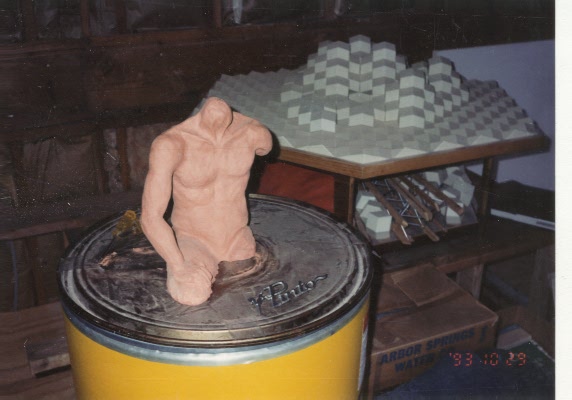
| The sculpture in front was done in about 1987 by my girlfriend at the time. She helped me construct some of the early 'experimental-trusses', such as the ones' under the table. |
| In 1987 i began filing for a U.S. Patent on an Improved Structural System for Buildings, but my early drawings were rather crude. I seriously doubt the Patent Examiner could 'visualize' my idea for a building as i had spent years trying to identify an appropriate "living-environment", and still could not draw it in any other view than a strict "Elevation". I had been using a number of physical tools to aid in the "visualization" process, and in 1988 i purchased a large number of ceramic hexagonal bathroom tile of various colours. These i used to study the largest "clusters". After spending countless hours studying these "micro-cities"... ...i realized there HAD to be some kind of game that could be played in a 'stacking' of hexagonal modules. The rules for such a game finally came to me in a dream, just before i awoke. I was awarded the Patent in 1990, and sincerely expected the Architectural Schools to welcome me with open arms. Instead, i found that few Professors' would even talk to me... ...and the students seemed to be like "golden-eggs" under their watchful eyes! Until i acquired access to Computer-Aided Modelling software in late 1994, at a local Community College, i found the 'visualization' process rather difficult. Few people around me seemed to understand my insatiable enthusiasm for these 'modules'! It would take me several years before i had a structural solution that i really felt confident about. My early efforts were an attempt to "rigidly" apply the theories of the Metabolist School to the geometry of the "dodecahedron", which resulted in a great deal of internal redundancy in the design of the open-web trusses. In 1999, i began to consider that a much simpler solution could be achieved by simply tracing the lines of connection between the carbon atoms in the structure of diamond. |
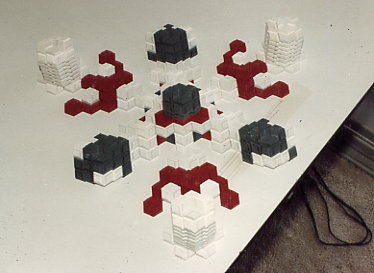 |
| This is a collection of ARCADIA game tiles arrayed into a dense cluster of "mixed-use" buildings. The Arcadia Tiles were much easier to work with than the bathroom tiles, because they "nested" on top of each other at the appropriate place. With enough of them... ...you could visualize a very large city. |