Water: Rebirth, Cleansing, and Fertility
A Look at Water as a Literary Symbol
Water may flow in a thousand channels, but it all returns to the sea. --African Proverb
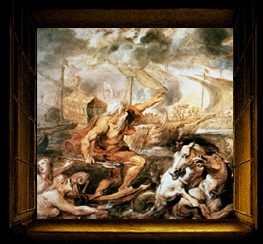 Water has been used for thousands of years as a symbol of rebirth, cleansing, restoration, and fertility. When one thinks of water, one thinks of the cycle of life or the so-called "circle" of life. This can mean that water stands for death as well as for life, as we see in many mythological universes. This page will be an attempt to look at the symbol of water in three different areas in order to form a base of knowledge about water as a symbol. This base of knowledge can then be used to inform our reading of book V, "What the Thunder Said," of The Wasteland by T. S. Eliot.
The Three Areas I will discuss are:
Conclusion
As we can see, there is a culture surrounding the symbol of water throughout the ages. Different cultures have used water to portray fertility, rebirth, renewal, and cleansing, in order to help their perception of the world.This symbol of water is also used heavily by T. S. Eliot in the fifth section of The Wasteland. In this section, entitled "What the Thunder Said," we get the feeling that Eliot really envisions a cleansing of our society (the "wasteland" mentioned in the title) in order to give us some hope for the future. In this sense, water becomes a symbol of hope.Clearly, there must be a death before something can be reborn, and this is what happens here. When Eliot states, in lines 328-29, "He who was living is now dead/ We who were living are now dying," it reminds us of Christ's death and sets up a rebirth at the end of the poem. In fact, if we want to discuss the Christian aspect of the poem even further, lines 369 and 370 mention "hooded hordes swarming/ over endless plains" a reference to the apocalypse that is foretold at the end of the bible. All the images of bats and flying towers and decaying holes in the mountains give a really ominous overtone to the first half of this book, all the way up to the "flash of lightning" in line 394. The poem is particularly rich in that it shows that this cleansing process will be a gradual one. It will take time. Eliot shows this by making "What the Thunder Said" start out as a search for water--"If only there were water amongst the rock," he writes in line 348"--but then mentioning that there is only "dry sterile thunder without rain." (342) He keeps this up, imagining this gradual build up by wishing for water, then a pool of water, then "the sound of water over a rock," (356) then finally the "drip drop drip drop drop drop drop" of rain. (358) Again, this shows that the buildup to cleansing will be a gradual one, an entire process, one which may be slow but could take time.
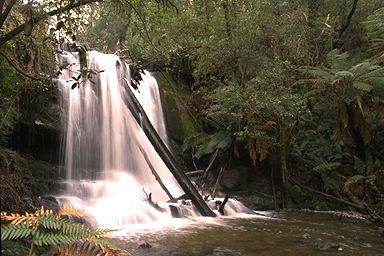
But then something happens.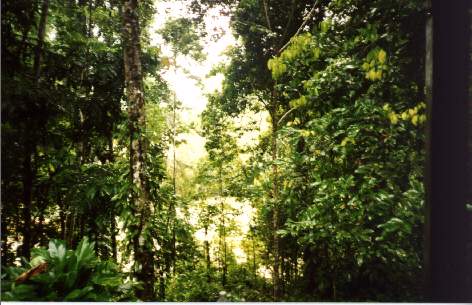 We get rain. Life giving, rebirth spawning, fertile rain, water coming from the heavens to help cleanse the earth, this "wasteland," of impurities. Eliot writes, in lines 396-98, "Ganga was sunken, and the limp leaves/ waited for rain, while the black clouds/ gathered far distant, over Himavant," telling us that the land of the Himavant forest was literally waiting for rain, but that our society as a whole has also been waiting for this rain to cleanse and renew us, to make our culture a fertile ground again. The poem culminates in the line "Shantih Shantih Shantih," whcih Eliot tells us in his notes means "The Peace which paseth understanding," but also seems to create the sound of rain cascading over rocks, such as what one might hear when looking at a waterfall like this:
  By ending the poem in this fashion, Eliot challenges us to recognize that our society will need to cleanse itself in order to find peace. The water in this passage shows us hope, much in the way that rain dances or rain gods provided ancient cultures with hope. The poem shows us that the "wasteland" we have created will be changed, that there is hope for a future of cleansing, renewal, and fertility, of mind, of body, or culture, of society.
Water as Renewal and Rebirth
Water as Fertility
Water as Cleansing
By ending the poem in this fashion, Eliot challenges us to recognize that our society will need to cleanse itself in order to find peace. The water in this passage shows us hope, much in the way that rain dances or rain gods provided ancient cultures with hope. The poem shows us that the "wasteland" we have created will be changed, that there is hope for a future of cleansing, renewal, and fertility, of mind, of body, or culture, of society.
Water as Renewal and Rebirth
Water as Fertility
Water as Cleansing
 This page hosted by
  Get your own Free Home Page