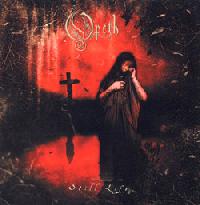
 Track Listing
1. The moor 2. Godheads lament 3. Benighted 4. Moonlapse vertigo 5. Face of Melinda 6. Serenity painted death 7. White cluster Year: 1999 Label: Peaceville - Official Site |
Opeth - 'Still life' - S. Regan
I�ve never really been a fan of bands and albums that utilise the verse/chorus/verse format, or in fact seem to follow convention. When I listen to music, I like to hear signs of innovation and originality. Bold moves at creating musical masterpieces reaching feats not yet accomplished in other works. Opeth�s fourth full-length outing spawns a concept album, built around the sole story of a man who had been banished from his town because of religious beliefs. Years later, he has returned, with intent to find the love of his life who had been living there all those years. It is this man�s return where the epic tale begins, in the form of the album�s opener; a song entitled "The Moor". Generally, all of the distorted guitar work on this album is either doubled or tripled at least. There is a lot of clarity to the guitar sound, yet it's extremely heavy. They used lightly distorted guitars, but they have piled on the layers to add heaviness. These sounds are almost always panned left and right respectively, and this gives a true stereo effect. The positioning of the microphones for the drums have been placed out very precisely: the different cymbals are in the different sides of the mix, and the toms and snare all panned in the mix all to match their respective positions in the drum kit. The distorted vocals are mixed dry, and are very upfront. In acoustic sections, they often appear to be drenched in reverb, whereas in contrast, on distorted sections of guitar, they are often much drier, sometimes using a slight delay, or an overdub harmonizing with the original vocal line. This effect is something I personally have always had a soft-spot for where Opeth are concerned - and it always gives me goosebumps! The bass is mixed rather low, however it can be distinguished as the tones carry through the rest of the mix but more as a feeling than an actual recognition of notes for the most part. Although at certain times (most noticeably when an acoustic section of a song is playing) the bass jumps through the mix and takes a prominent role. It is this role that often leads the way to the next section of a song and can act as a segue to a new guitar arrangement. I absolutely adore this album, simply because of the amazing innovative sounds that this band pulls off. They are by no means conventional and I would perhaps even compare a lot of their work to experimental composers, who stray from celebrated or well-known ideas and methods of making music. On this (and their other releases) Opeth utilize many varied musical techniques, including mixing extreme dynamics with sudden "surprise" contrasts in the form of acoustic and melodic Adagio sounds. There is heavy usage of dissonant chords to establish feelings of the character portrayed in the story. Opeth blends seemingly unrelated keys together seamlessly. I know that a lot of people enjoy repetition in music, something that is predictable, Opeth however is neither. And that is what I like about this band. So what of the songs themselves? Well, the aforementioned opener �The Moor� starts off with an almost dreamlike, very mysterious, clean guitar mix. There seems to be no actual timing or rhythm to this intro and the sounds come across as almost hypnotic. This unusual melody is made up of two clean electric guitars, and two distorted electrics that are playing independent melodies. With almost two minutes of this uneasiness, you begin to find yourself thoroughly prepared for the intense ride that will inevitably soon follow. The song soon builds up to a mellow, acoustic interlude with three acoustic guitars and the bass effortlessly jumping into the fray. Upon hearing this build up I find myself embracing it with extreme eagerness of what is to follow. And what�s to follow? Well just a little under two and half minutes into this eleven and half minute epic opener all hell breaks loose, as distorted, multi-layered guitars kick right along with the drums and bass parts, each playing off the rhythm established by the acoustic interlude of the intro. The pace soon picks up and there is a variety of intense drumming and strange dissonant chords with a seemingly atonal melody. The crisp growling vocals scream one line and leave the last word trailing, before this voice is finished another layered voice cuts in with the next line. Then building more, a harmony joins this lead. Its all about building. This opener is full of beautiful, soaring, harmonic vocals that push forth the character�s message of despair, only to be followed by a confused lead full of odd passing tones that add to the chaos. To help you to comprehend the state of mind we�re dealing with without you hearing the music, a sample of the lyrics should give you an insight. As vocalist Mikael Akerfeldt harmonically sings "Pale touch, writhing in the embers. Damp mud, burning In my eyes. All the faces turned away, and all would sneer at my demise". You truly can feel the sorrow, the despair, and the utter hate and rage toward those who have cast him out and away from his home, and true love. Around half way through this opener you get a glimpse of Opeths aforementioned �sudden surprise changes� as suddenly, all is quiet, bar a lone acoustic guitar, solemnly playing it's unconventional, ringing chords. This section of the song leaves you feeling the inner emotions of sadness and sorrow, loneliness of the character. Soon the multi-layered instruments and drum work kicks back in again, thus indicating the characters sudden change from calm confusion back to fury. The Moor ends suddenly, leaving you craving for more. Then you must listen to the next song, the second chapter of the story. Godheads Lament kicks straight in and the distorted vocals continue the journey though his mind. The fantastic appropriate switches between distorted and clean vocals are beautiful and fantastically placed. Listening to this album it is clear how powerful it is, the wonderful tempo changes, the odd chord structures, and the unconventional chord progressions. This album also has some truly beautiful ballads, most notably �Benighted�. The acoustic guitars and softly sung clean vocals carry this song beautifully. Upon it�s beautifully serene closing you feel at ease and content, before being thrusted back into reality with the guitars of �Moonlapse Vertigo�. Following seamlessly into equally acoustic-laden �Face Of Melinda�, the character�s apparent beautiful tributing homage to the woman he loved and lost. This song plays along beautifully, much like �Benighted�, until around the last 2 minutes where it erupts with a fantastic melodic guitar in the forefront and more clean vocals, before winding down again towards the end. The only slight dip in this album comes with �Serenity Painted Death�. Although this is a fantastic death metal song, it is just that, a death metal song. Don�t get more wrong, I have far from anything against Death Metal as it�s most definitely one of my favourite musical styles, however this song�s conventional verse/chorus/verse layout is very un-characteristic of Opeth�s style. However, as a straight up Death Metal track, it is truly mind-blowing. I could go on forever, depicting every detail of the beauty of this album and each of its songs, but I somehow doubt anyone would want to wade through it all. Simply put, this album is a large musical journey, with over an hour of wonderful music. Metal Obsessive Grade: 95% |