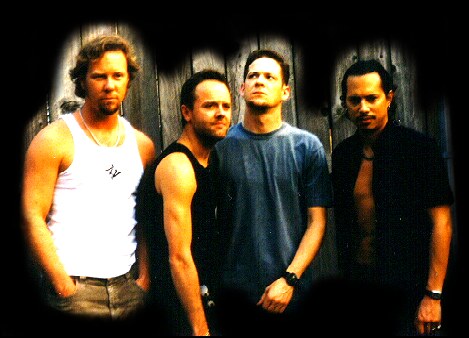
BIOGRAPHIES-
THE BAND
METALLICA
On October 28th, 1981, drummer Lars Ulrich
makes guitar player/singer James Hetfield the offer he can't
refuse: "I've got a track saved for my band on Brian
Slagel's new Metal Blade label."
The truth is, Lars didn't have a band at that time, but he did
that day when James joined him. The two recorded their first
track on a cheap recorder with James performing singing duties
(with a sore throat, even!), rhythm guitar duties and bass guitar
duties. Lars dutifully pounded the drums, helped with musical
arrangements and acted as manager. Hetfield's friend and
housemate Ron McGoveny was eventually talked into taking up bass
and Dave Mustaine took lead guitar duties.
The band adopted the moniker Metallica: Young Metal Attack, and
began gigging in the Los Angeles area opening for bands like
Saxon. They eventually recorded a full-fledged demo called No
Life Til Leather. The demo was circulated near and abroad by Lars
and his metal tape-trading buddies.
No Life Til Leather stirred up some interest in the underground
metal community and the band started garnering some attention,
especially in San Francisco and New York.
Metallica performed 2 shows in San Francisco and found the crowds
there more friendly than LA's "there to be seen" crowd.
They also caught up-and-coming band Trauma, and most importantly
their bass player, Cliff Burton. Eventually, Metallica moved
upstate and Cliff joined Metallica.
In New York, a copy of No Life Til Leather made its way to Jon
Zazula's record shop, the aptly-named Metal Heaven. Zazula
quickly recruited Metallica to come out east to play some shows
and record an album.
The band made it to New York in a stolen U-Haul only to make
announcement to their now manager/record producer: "Our
guitar player has got to go." Roadie Mark Whitakker
suggested a guitar player from a band he knew back in SF, and on
April 1, 1983 Kirk Hammett joins Metallica.
Metallica's first album, Kill 'Em All, is released in late 1983.
Metallica toured behind Kill 'Em All, and in 1984, a second album
Ride The Lightning was recorded and released. This album was a
more mature album, both lyrically and musically while not missing
a beat of the ferocity of Kill 'Em All.
Notable on Ride The Lightning's eight songs is track four; Fade
To Black. Inspired by the theft of the band's equipment earlier
that year in Boston, the song delves rather deeply into dealing
with loss. Other tracks are inspired by H.P. Lovecraft and the
movie The Ten Commandments.
The band signed with major management agency Q Prime and soon
after is signed to major record label Elektra.
1986 brought their third album, Master Of Puppets, and a tour
with Ozzy Osbourne. Metallica was reaching new highs: the new
album reached #29 and enjoyed a 72-week run on the US charts. The
Ozzy tour helped them gain wide exposure.
The band endured a minor downfall when James broke his arm
skateboarding and was unable to play guitar. John Marshall pulled
double duty, acting as Kirk's guitar roadie and filling in on
rhythm guitar until James healed.
With the Ozzy tour complete the band moved on to Europe and
planned their first venture to the Far East. It was hoped that
James would be ready to handle his guitar duties, but for the
first shows in Europe, Marshall filled in.
James returned in full guitar and vocal duties on September 26th,
1986, the last time Metallica performed with Cliff. Early the
next morning, the tour bus skidded out of control and flipped,
killing Cliff Burton.
It probably would have been easier for Metallica to call it quits
right then and there. Cliff was a major part of the band, not
only supplying bass but being somewhat of a teacher and mentor,
sharing his musical wisdom and "be yourself" attitude.
Knowing Cliff would be the first to want them to carry on,
Metallica minus one carried on.
Jason Newsted was chosen from over 40 auditions to play bass with
Metallica. His many strengths included being able to keep up with
the band`s drinking habits!
It was decided they would jump right back into "tour
mode" to initiate the new bass player and wrap up loose
ends.
The band also released an EP of all cover songs as an
introduction to Jason. The EP, titled Garage Days Re-Revisited is
considered a sequel of sorts to Garage Days Revisited which
appeared as a B-side in 1984.
With Jason established, the band went back to record their fourth
full-length album, äAnd Justice For All, released in August
1988. It reached #6 on the US charts, and received a Grammy
nomination for Best Metal/Hard Rock album.
The band took the show back out on the road and toured
extensively to all parts of the world. ...And Justice For All
produced two US singles and the band's very first venture into
music video for the song "One". They finally won a
Grammy for the "One" single.
In 1991 Metallica released the self titled "black
album." With new producer Bob Rock, this album was a
departure from the previous album. The songs were shorter and the
sound was fuller, deeper and less monotone. The "black
album" went straight to number one all over the world.. and
stayed there for several weeks.
The album spawned several singles and videos and remains the most
successful Metallica album to date. The band won several awards
including a Grammy for the album and several MTV and American
Music Awards.
The band toured and toured and toured (get the picture?) playing
all alone in "An Evening With Metallica" or with Guns
N' Roses, or as headliner at many festivals. Metallica took the
Black Album (and the other songs as well) to the people.
Five years would pass before the next Metallica album saw the
light. The album was called Load and was the longest Metallica
album to date. With 14 songs it took all available room on a
compact disc. The album was again produced by Bob Rock, as was
ReLoad, which followed in 1997. Both albums were written and
mostly recorded together, and continued what the self-titled
album started. Soundwise, the album was thick and punchy, the
songs were loose, powerful and eclectic.
It would be unfair to say Metallica changed a great deal, as the
band is the same band that recorded Kill 'Em All, ...And Justice
For All and the rest, but the Load twins show a Metallica that
has grown towards expanding past the "all attitude and
speed" days and back to the "be yourself"
attitude.
With the completion and subsequent touring for Load and ReLoad
and quite possibly the end of this phase of Metallica, it's
natural only to become somewhat introspective. While lyrically
the Load albums reflected a great deal of what lies inside each
of us emotionally and subconsciously, it came a time to look into
what made this band.
No greater reflection of what makes Metallica
"Metallica" are their influences. And as they did in
1981 when they started, 1984 with Garage Days Revisited and 1987
with Garage Days Re-Revisited, the band did what comes
naturally.. they went back to the garage.
Metallica was and is very much a garage band. Whether it's in
Kirk's basement, Jason's Chophouse, Lars' Dungeon or on stage in
front of 50,000, Metallica always plays that song or that riff
that helped them out somewhere along the road. They had already
released 2 garage projects and put out a smattering of cover
songs as B-sides. In fact, the Garage Days projects had become so
collectable and rare, that poorly-recorded bootleg copies have
been circulating for outrageous prices.
The band chose 11 new songs to record its third "in the
garage" project, again with Bob Rock. The project was
aptly-titled Garage Inc. as it incorporates ALL the
previously-recorded garage cover songs along with the 11 new
tracks.
So what's next? Look for the band on tour in some new, as well as
the old familiar places. A new project unlike anything you'd
expect, and a welcome to the year 2000 that most certainly be one
to remember!
Bio Courtesy of Official Site- http://www.metallica.com
I Hope You've Enjoyed My Biographies Section.
Come Back Soon!