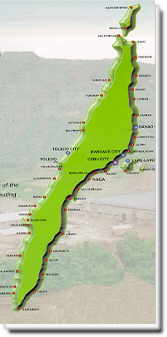
MAGELLAN MARKER, Punta Enga�o, Lapulapu City- about 20 kms. from
Cebu City- Encouraged by the success of Christianizing
the people of Cebu, Magellan crossed the channel to Mactan
Island in an effort to spread the faith. Before he reached
the shores, he was killed by the chieftain of the island,
Lapulapu and his men during the battle for supremacy and
freedom on April 27, 1521. Efforts to retrieve the body of
Magellan were futile inspite of the offer to trade jewelries
and spices for the dead body.This marker was erected in 1866
to mark the spot where the great explorer died.

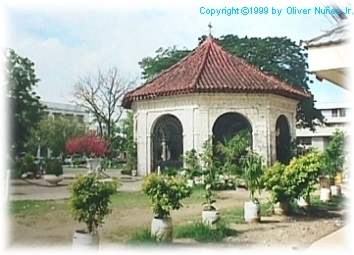
Ferdinand Magellan, this marks the spot where the first
Christian Filipinos, Rajah Humabon and Queen Juana and about
400 followers were baptized by Fr. Pedro Valderama. In 1525
to 1740, the Agustinian priests built and open shrine for
the cross, but the natives began to take chips from the
cross believing it had miraculous power.So a kosk-like
structure was built to protect the cross from total
destruction. To protect it further, a hollow cross of
tindalo wood was made to encase the original cross which
still stands today.
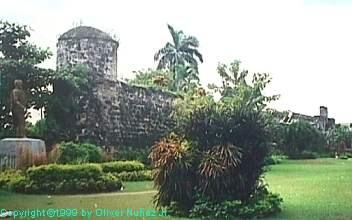
fort in the country. This served as the nucleus of
the first Spanish settlement in the Philippines. It has a
total inside area of 2,025 sq. meters. The walls are 20 feet
high, 8 feet thick and the towers are 30 feet high from the
ground level. Work was first started on May 8, 1565 with
MIGUEL LOPEZ DE LEGASPI breaking the ground. After the
battle of Manila Bay, Commodore George Dewey turned the fort
to the local Cebuanos, then it became an American Warwick
Barracks during the American Regime which was later
converted into classrooms where the Cebuanos received formal
education. During World War II, from 1941 to 1945, it served
us fortification for Japanese soldiers, when the battle for
iberation was fought, the fort served as an army camp .
After 1950, Cebu Garden Club took over and fixed the inner
court into a miniature garden. For a couple of years it also
housed the Cebu City Zoo. In 1978 to August 15, 1993, it
housed the offices of the Department of Tourism and the
Philippine Tourism Authority. At present, it is under the
care and administration of the National Museum.
LAPULAPU MONUMENT, Punta Enga�o, Lapulapu City - Site where the
battle between Mactan Island Chieftain Lapulapu and the
foreign aggressor Ferdinand Magellan occurred in April 27,
1521. It depicts the hero holding a bolo in one hand and a
pestle on the other. Said weapons were believed to have been
used during his combat with Magellan. This monument stands
as a reminder of Filipino bravery.
UNIVERSITY OF SAN CARLOS, P. Del Rosario St., Cebu City - The
oldest school in the country established in 1565. This was
formerly called Colegio de San Ildefonso established by the Jesuits.
COLON STREET, Downtown Area, Cebu City - This is also known as
Parian District, the oldest street in the Philippines built
by the Spaniards during the time of Miguel Lopez de Legaspi.
Named after Christopher Columbus, it is the heart of
downtown Cebu, a glittering city by night lined with
moviehouses, restaurants, department stores, and other
business establishments.
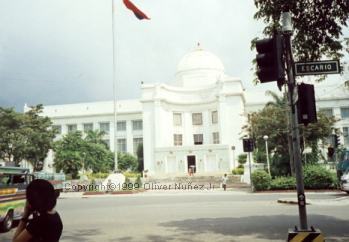
Provincial government, is of pre-war vintage and has the
undulating mountains of Cebu for its background. Majestic
and imposing, its high dome can be seen along Osme�a
Boulevard. A replica of the United States' White House. One
of the many beautiful capitol buildings in the country,
constructed in 1937 under the administration of Governor
Sotero Cabahug. Cultural Attractions
CASA GORORDO MUSEUM, 35 Lopez Jaena St., Cebu City - Located in
Lopez Jaena Street, it is the home of the first Filipino
Bishop of Cebu. A tour inside this residence is a brief
journey into a Filipino lifestyle in a particular period
between 1860 to 1920. The place presently features noted
paintings, museum relics, a courtyard, antique household
items and furniture. Open from 9:00 am to 12:00nn and 1:00pm
to 5:30pm,Monday to Saturday. Admission fee is PHP 15.00 for
adults and 5.00 for children.
Artifacts taken from the old Spanish Galleon known as SAN
DIEGO within the deep sea of Fortune Island off the coast of
Nasugbo, Batangas are on display in this centuries-old Fort.
The Museum used to house the offices of the Department of Tourism and the Philippine Tourism Authority.
The artifacts on display include Ming porcelain pieces of all sizes, coins, lockets, swords fragments, cannons and helmets.
Well-kept flower beds, cannons, lush vegetation, and neat walkways align its interiors along with a canteen and a museum.
Open from 8AM - 7PM daily. Entrance fee is P15/head.
UNIVERSITY OF SAN CARLOS MUSEUM, P. del Rosario St., Cebu City - A
product of years of research, the collection in view are
anthropological and biological. The anthropological section
portrays the cultural development and influence into society and
its close affinity with the people of Southeast Asia. The
biological section presents samples of the flora and fauna of the
country in general and Cebu in particular. Admission fee PHP 5.00
per person; open Monday thru Friday from 8:00 am to 12:00 nn and
1:30pm to 5:30pm; Saturday from 8:00am to 12:00nn only.
THE SOUTHWESTERN UNIVERSITY MUSEUM, Urgello Private Road, Cebu City -
It gives a quick look of Cebuano art and lifestyle, from the
prehistoric to hispanic times. Also in this room are burial jars,
boat coffins, death masks in gold, trade pottery ( from China,
Cambodia and Vietnam, including Ming, Celadon and other China trade
jars, as well as Ban Chieng and Haripunchai pottery), gold teeth
peggings ( the design of the decoration showed where its owner came
from, whether from Cebu or Leyte or Bohol, or wherever), excavated
trade beads and heirloom jewelry, santoses and church carvings and
other church accessories. The Museum is open to the public from
10:00a.m. to 12: noon, and 1:00 p.m. to 5:00 p.m. from Tuesday to
Saturday while the Filipiniana Research Center is open from Monday
to Saturday from 7:00 a.m. to 7:00p.m.
JUMALON'S FAMILY CULTURAL PROJECT, 20 Macopa St., Basak, Pardo, Cebu
City - A LEPIDO MOSAIC ART collection, so called because it
utilizes butterfly wings as its medium. Beautiful and intricate
samples of these artworks can be seen at PROF. JULIAN JAMALON
residence at 20 Macopa Street, Basak, Pardo, Cebu City. No Admission fee.
RIZAL MUSEUM AND LIBRARY, Osme�a Blvd., Cebu City - Located within Cebu
City Library along Osme�a Boulevard showcases a collection of
antiques donated by famous and rich Cebuano families. Also on
display are collection of artworks of the Cebuano painters and
artists. Its upper floor is utilized as a performing arts hall for
concert and theatre productions by Cebu talents. On the ground
floor is the Rizal Memorial Library which keeps some important
books on Cebuano history and culture.
AZNAR-ALFONSO ANTIQUE COLLECTION - Owned by Dr. Lydia Aznar-Alfonso,
the antique collection is of much younger vintage. Pieces of lovely
period furniture, a very wide collection of antique jewelry, "
santoses" as well as authentic "grave goods" from various
archaeological diggings in the island of Mactan and Cebu helped
enrich Dr. Alfonso's beautiful collection.
ARCENAS ANTIQUE COLLECTION - Spanish period furniture and "santoses",
jewelries, pottery, porcelain wares are on display at Dr. and Mrs.
Ramon Arcenas residence located at Banawa, Cebu City.
ROSE ONG ORCHID COLLECTION - So beautiful and varied, the biggest
orchid collection in the province.
PRES. SERGIO OSME�A MEMORABILIA - Contains the late president's
historic car, his personal belongings and mementoes.
RIZALIANA MUSEUM - Contains the memorabilia of Dr. Jose Rizal given by
his sister to the University of Southern Philippines Museum.
SALA PIANO MUSEUM, Gorordo Avenue, Lahug, Cebu City - A unique
collection of hundreds of pianos of varying sizes and shapes. Venue
to classical concerts and houses a music foundation. Open from 9:00
am to 12:00 nn, afternoons by appointment. Admission fee: PHP 5.00
for adults and PHP 1.00 for children.
MACTAN ISLAND - A coral island and famous for scuba diving, where beach
resorts of international standards are located. Also the site of
the Export Processing Zone, with 102 companies in operation,
employing 37,118 people. Land area - 150 has.
MOALBOAL, South of Cebu - Located 89 kms. southwest of Cebu City, it
offers cheap to moderate rates of room accommodation, white sandy
beaches and excellent corals for scuba diving.
BADIAN ISLAND, South of Cebu - Located 97 kms. southwest of Cebu City,
famous for beautiful corals and reefs, white sandy beaches
excellent for diving. Accommodation is offered by the Badian Beach
Resort, a "AAA" class resort.
MALAPASCUA ISLAND - It was on Christmas day when the Spaniards reached
the island. According to townfolks, it was supposed to be a
special day for celebration but unfortunately a storm hit the
island and so came the name "MALAPASCUA", MALAS SA PASKO, which
means "Unfortunate Christmas" in English. Malapascua is sometimes
referred to as "LOGON", the main community in the south. "Logon"
got its name when the Japanese and Spaniards fought over the island
during the World War II. The island is 3 kms. long and 1 km. wide,
with a population of about 3,000. It has white sand beaches, and
crystal clear waters. The west coast is ideal for swimming and
snorkelling but one should be careful because of unpredictable
weather. A walk or tour on the whole island can be done for about two hours.
CAMOTES ISLAND - The island is located at the northeast of Cebu
province and is composed of 4 towns, namely: Poro (composed of 17
barangays), San Francisco (composed of 15 barangays), Tudela
(composed of 8 barangays) and Pilar (composed of 5 barangays). To
cross the island, one has to go to Danao City, an hour away from
Cebu City or take a fastferry. There are two boats which travel to
and from the island and Danao City everyday, one fastcraft which
travels twice a day and a regular boat thrice a week . Travel to
and from the island is around 2 hours and transportation within the
island are motorcycles.
KAWASAN FALLS - Located in Badian , one can feel the coolness of the
surrounding lush greenery of this panoramic waterfalls.
Accommodation from cheap to moderate rates are available. NONOC
CAVE - Located in Borbon, 83 kms. north of Cebu City, very
picturesque view, shelter for picnickers and bathers.
OLANGO WILDLIFE SANCTUARY - Olango Island supports the largest
concentration of migratory birds found so far in the country.
Migration starts from the breeding places of birds in Siberia, ,br>orthern China and Japan. Anticipating the scarcity of food and
winter cold, these birds fly as far as Australia and New Zealand
from late July until late November. This is usually referred to as
the Southward Migration. By late February until May, these birds
return to their breeding grounds in the reverse Northward
Migration. Based on data gathered so far, the birds use Olango as a
major refueling station as well as a wintering ground. At Olango,
the birds can replenish their fat reverses by feeding on rich
supply of invertebrates in the intertidal mudflats. These fat
reserves must fuel the birds on the next lap of their journey which
may cover from 3,000 to 15,000 km. of non-stop flight. Land Area - 1,022.6228 has.
RELIGIOUS IMAGE OF SANTO NI�O - Considered as the oldest religious
relic in the Philippines. It was on April 14, 1521 that Magellan
gave the image to Queen Juana as a baptismal gift. Forty-four years
later, on April 27, 1565 when Miguel Lopez de Legaspi arrived, Fr.
Andres de Urdaneta who formally christianized the Cebuanos, found
the natives hostile. Legaspi himself besieged the settlement and
set the village on fire. It was on one of the burnt houses that
Juan Camus, a soldier, found the image of Sto. Ni�o unscratched.
Since then, the miraculous image has been venerated by the Cebuanos
as its Patron Saint. At present , the miraculous image is kept in
the Parish Covent, and a replica is adorned with gold and precious
stones and enshrined in glass. It is housed in a side altar inside
the Basilica Minor del Santo Ni�o.
BASILICA MINOR DEL SANTO NI�O - This church was built by Miguel Lopez
de Legaspi and Fr. Andres Urdaneta on the site where the image of
Santo Ni�o was found in 1565. The first structure of the church
was, however, destroyed by fire on November 1, 1568. It was rebuilt
in 1602 under the administration of Juan Albaran and was
rehabilitated in 1740. On May 1965, the church was conferred the
title of Basilica Minor del Santo Ni�o by Cardinal Antonuitte,
Papal Legate during the Fourth Centennial celebration of the
Christianization of Cebu.
TAOIST TEMPLE - Located at Beverly Hills, Cebu City. This temple
preserves the teachings of Lao-Tse, the 600 B.C. Chinese
philosopher. Everyday people climb its 99 steps to light joss
sticks and have their fortune read.
HEAVENLY TEMPLE OF CHARITY - Located at Peace Valley, Lahug, Cebu City.
It is a temple built on top of a sacred hill. Beneath the hills,
the sacred waters from a natural spring is believed to have curative effects.
PHU-SIAN TEMPLE - A Buddhist Temple, the third Chinese temple on
Beverly Hills, is located at the right side of the road to the Taoist Temple.
CHAPEL OF THE LAST SUPPER - Life-sized carvings of the Lord Jesus and
his 12 apostles seated at a long table for the Last Supper. This is
the only one of its kind in the country. This treasured relic is
found in the Church of Mandaue City that dates back to 1601.
CELESTIAL GARDEN - Located in Banawa Hills, Cebu City. Owned and
managed by the Tanchan Foundation. A 12-hectare of Rolling Hills
where life-size statuses depicting the drama of the stations of the
cross were built.
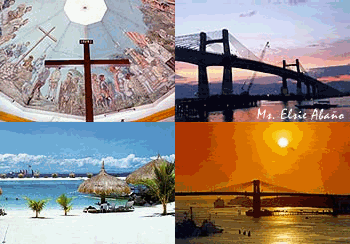
MANDAUE-MACTAN BRIDGE - Built in 1972 at a cost of P65 million. This
864-meter bridge connects the islands of Mactan and Cebu. TOPS -
Situated high on top of cool Busay Hills, an excellent sight seeing
spot which offers a breathtaking view of Metro Cebu and the islands
of Mactan and Olango. Cottages are available for daytime picnics
and instant evening parties.
BEVERLY HILLS - A scenic subdivision on Lahug Hills commands a
breathtaking view of the entire city.
LILOAN LIGHTHOUSE - Found in the municipality of Liloan, around 18 kms.
north of Cebu City. Built by the American in 1904.
THE NEW CEBU COLISEUM - A sports center located at Sanciangco Street
where concert and ball games are usually held. YMCA - Along Osme�a
Blvd. is a sports complex equipped with body building equipment,
swimming pool, bowling lanes and ball game courts. Accommodation is also available.
CEBU CITY YOUTH AND SPORTS COMPLEX - Located at Abellana National
School grounds, was constructed for the Palarong Pambansa 1994. The
sports complex is considered the country's best today. It boasts of
the following facilities: 2 grandstands which can accommodate
15,000 people, Olympic size swimming pool, rubberized oval,
baseball field, and quarters for athletes and officials.
CEBU GOLF AND COUNTRY CLUB - An 18-hole golf course located in Banilad,
Cebu City.
ALTA VISTA GOLF AND COUNTRY CLUB - An exclusive membership club located
in the rolling mountain ranges of Pardo, Cebu City. It commands a
breathtaking view of the islands of Mactan and Bohol against the
backdrop of the city straits. With a world class golf course of 60
hectares, par 72, 18 hole course covering 5,670 meters.
FUENTE OSME�A - A lovely circular park with a beautiful fountain in the
middle. Named after Cebu's Grand Old Man, the late President Sergio
Osme�a, Sr.
SPECIAL INTERESTS FIRING RANGE - A tourist come-on, located in
Barangay Pusok, Lapulapu City, for pistol-shooting
enthusiasts. GUITAR
FACTORIES, Maribago District, Lapulapu City - One can actually
see how guitars are made. It is amazing, however, to note
that while the occupation of the people is in that Mactan
District, the raw materials used have to be shipped from
Mindanao and nowhere on the island can be found such materials.
CEBU BOTANICAL GARDEN, Camp Marina, Capitol Hills - Plant
hobbyists can see collection of greenery.
R&M PRESERVES, V. Rama Avenue, Guadalupe - A plant processing
for fruit preserves like mango, orange, papaya, jackfruits,
etc. Fiestas and Festivals SINULOG - Celebrated every 3rd
Sunday of January, is Cebu's biggest and most popular
festival. The feast is in honor of the Holy Image of Senyor
Santo Ni�o de Cebu. Fiesta Senyor, as it is widely known ,
is the most celebrated among Cebu's festival where people
converge along the routes of a grand solemn procession and
partake in the gaiety amidst a mardi gras parade immersed in
wild colors and the constant beating of drums.
TRES DE ABRIL CELEBRATION - Celebrated every 3rd of April in
commemoration of the Spanish resistance in the south. This
historic battle under Leon Kilat's leadership gave Cebu the
glory of being the first major island ourside Luzon to
oppose Spanish dominance.
SANAYON - Agro-tourism festival in the southern towns of the
second district about 100 kms. from the city. A month-long
activity to spread out tourism to the countryside.
PASKUHAN, Cebu City/Province wide - A christmas celebration of
songs and lantern making held during the month of December
to spread good cheer to local residents and visitors alike.
KADAUGAN SA MACTAN, Lapu-lapu City - A one-day reenactment
celebrated with pomp and pageantry every 27th of April to
commemorate the historic battle of Mactan between the forces
of Lapulapu and Ferdinand Magellan.
SEMANA SANTA SA BANTAYAN, Bantayan Island - A unique mixture of
solemn religious rites and local celebration highlights the
Holy Week activities in Bantayan Island. The normally quiet
island is visited by relatives and friends of the residents,
as well as tourists to experience the solemn rites or to
cool off the summer heat in the beautiful white sandy
beaches and clear tropical waters.
TAGBO, Poro, Camotes Is., Cebu - Celebrated every January in
honor of Patron Santo Ni�o de Poro. Beloved memoir of a
living past, TAGBO is the cornerstone from which this great
municipality has sprung. Rich in cultural heritage and deep
in spiritual values, TAGBO is a very significant event
preluding the birth of a town very dear to the hearts of her
sons and daughters.
CASSAVA FESTIVAL, Camotes Island, Cebu - Held with the aim of
creating awareness among the people on the different uses
and economic opportunities offered by cultivating cassava.
CARCAR FIESTA, Carcar, Cebu - Celebrated on November 24-25 in
honor of the town's patron, St. Catherine of Alexandria.
Carcar town is noted for its old Spanish style houses in the
quiet countryside setting . During fiestas, the residents
would invite friends, relatives and town visitors into their
homes to taste popular local delicacies. A lively and
enjoyable event.
NUESTRA SENORA DE REGLA FIESTA, Lapulapu City - Held to honor
the patroness of Opon on November 20-21, this religious and
social event reveals the deep religious faith of the people
and the penchant for merry making. A food fair, carnival,
procession and a coronation of the Fiesta Queen highlight
the festivity.