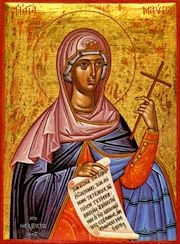
SS Timothy and Mavra the Martyrs
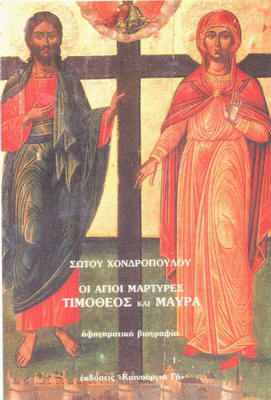
During the Diocletian persecution of the Christians (AD 284-305), a governor, named Arianus, was appointed to a province in Thebaid[1] in Egypt. This man was renown for his ruthlessness and cruelty in dealing with Christians, and his appointment aimed at extermination of the Christian faith through fear, torture and death.
A group of Christians was arrested and brought before him. Among them was Timothy, a church reader whose duties included, besides, the care of ecclesiastical books. He was from a village called Perapi. He was a young man only recently wedded to a girl called Mavra. Twenty days after wedding, Timothy was arrested by the idolaters and brought to the ruler for interrogation.
“Who are you and what is your occupation?” was the first question of the governor.
“I am a Christian and am a reader in the church of God.” Answered Timothy.
“Are you the only one who have not heard of the emperor’s decree to put to torture, even to death, all those who refuse to make offering to our great gods?”
“I believe with all my heart in my Lord Jesus Christ to whom I am wholly devoted.” said Timothy, “Therefore I cannot sacrifice to your gods.”
“Don’t you see the instruments of torture that are set ready for you?’’
“Certainly you do not see the angles of God who strengthen me.” Answered the holy man.
“Give me your books[2], so that I might understand the magic power they contain.” said Arianus.
“Mindless and senseless man!” Answered Timothy, “Do you not know that no one ever delivers his children to death? The books, which I copied, are my children. When I read them, the angels of God stand before me.”
“Well, you do not want to sacrifice to our gods, nor you want to show your books”, said the governor, “Beware, lest your disobedience become the cause of your torture.” But St. Timothy gave him this reply, “I shall neither sacrifice to your gods nor shall I show you my books, because I am a Christian.
At this point the incensed governor ordered his servants to bring two pointed iron rods and, heating them hot red, pierce the ears of St.Timothy. From this horrible torment the eyes of the martyr fell out and he became blind. The servants of Arianus then said to him, “Since you refused to make an offering to our gods, behold you have lost your sight.” But St. Timothy answered to them, “My physical eyes, that have seen much of unseemly things, now have suffered by being blinded. But my inner sight, the eyes of my soul, illumine me.”
When the saint said this, the governor ordered to tie his hands behind his back, put in his mouth a piece of wood and hang him head down. To intensify his torment, Arianus ordered to hang on his neck a heavy stone. When the servants commenced to carry out this order, the holy man lifted his eyes towards heaven and said, “I believe that there is God who dwells in the heaven, who can deliver me from these torments.”
The suffering of the martyr was so frightful that even his tormentors were moved with compassion and begged the governor to convince Timothy to obey the emperor’s will by mercy rather than by cruelty. “Besides” they said, aiming at softening the heart of the ruler, “Timothy got married only twenty days ago and his wife is very young and beautiful.” On hearing this, the ruler ordered to summon to him the wife of Timothy and said to her,
“What is your name?”
“ I am called Mavra.”[3]
“I feel strong compassion for your misfortune that you, at your young age, are about to become a widow. I command you, therefore, go and array yourself in your best clothes, arrange your hair in a splendid style, put make-up on your face and come quickly to your husband. Convince him to make sacrifice to the gods, otherwise you will surely become a widow at such young age. If you can manage to convince him, I shall reward you with many presents, gold and silver.”
Mavra has done all that the governor ordered her to do. Donned in bright clothes, she went to her husband and entreated him at length to obey the order of the governor at least temporarily, so as to avoid many tortures. But her spouse could not utter a word, because the chunk of wood sealed his mouth. Mavra then went to Arianus and ardently begged him to give the command to remove the wood from the mouth of Timothy, so that he may be able to speak. Arianus agreed and the wood was removed. Mavra again went to her husband. The holy man, though being unable to see, sensing the smell issued by Mavra’s clothes, exclaimed loudly, “Where is my father Pikolpos?”[4]
His father, who was among the crowd of people watching the suffering of his son, came to him and said,
-“What is your need my beloved son?”
“I beg you, my father, do me a great favor, take some tatters and cover my face, that I may not smell a soul-ruining odor issued by Mavra’s clothes. This fragrance is a source of sensual desire, the companion of devil; it is disgusting and loathsome to the holy and righteous men.”
When he ended, Mavra said to him,
“My beloved Timothy, why do you abase me so? I have not offended you by anything yet. It is only twenty days since we were wedded, you have not become familiar with my character, neither had I the time to learn the rules of your house. I am far from the vice you accuse me of, I have promised myself to no other man. Seeing you suffering so awfully, I bitterly cry and my heart aches, because you suffer for having done nothing wrong. Your wounds pierce my soul, because they may make me a widow. Perhaps you have borrowed money and, being unable to pay the lender back, you suffer these torments? If this is the case, let us sell our best clothes and repay the debt. Or if you suffer because you cannot pay the national taxes, behold, there are all our belongings, our gold and clothes. Sell them and pay your tax to the king.” St. Timothy said to her,
“My sister Mavra, when I saw you with the eyes of my soul leaving the house, I have noticed the devil walking along with you at your right side. He held a key with which he was turning your heart towards the worldly pleasures and attachments.”
“My brother Timothy” said Mavra, “It is you whom I am seeking for[5], later on where shall I find you? There will come Saturday and Sunday and who is going to read your books?”
“Leave the vanity of this world, Mavra, and come along with me to the valiant strife. God will forgive us our sins because of this, and will make us worthy of the crowns of His grace in His kingdom.”
Mavra then said, “When I was on my way to you, my heart indeed was preoccupied with vain attachments. But as soon as you began to talk to me, the grace of God has dawned on me. Be sure, my beloved brother, that I desire the same things. St. Timothy said to her, “If this is true, then go to the governor and expose his profane belief.”
“I am afraid, my brother, that I may be intimidated at the sight of instruments of torture, and by the wrathful face of the governor. I am afraid that I shall not be able to endure the ferocity of torments because of my age; I am just seventeen years old.”
“Put your hope in the Lord and God Jesus Christ, and all your torments will seem to you as if your body is being anointed with oil, or as if dew drops refresh your bones and make your sufferings light.” St. Timothy then began to pray to God saying, “O God and Father of every good, who gave help to the three youths who were cast in the fiery furnace, who saved Daniel from the lions’ teeth, who sent food to the prophet through the prophet Habakkuk. who rendered help not only in the den of lions, but also in the fiery furnace and saved those who hoped in You, so as to testify before everyone Your love of man that makes prophets and martyrs out of captives. Lord; behold now this servant of yours, Mavra! You, O Lord, who united us by the wedlock, do unite us also in this exploit, so that we may not be deprived of the choir of martyrs. You, O Lord, give us the strength to valiantly endure all torments and even death, so as to put to shame our opponents when they fail to divert us from our faith in Jesus Christ our Lord. To Him, together with His Father and the Holy Spirit is due every glory unto the ages. Amen.”
After St. Timothy prayed to God about Mavra his spouse, she became inspired by the Holy Spirit and, having come up to the governor, said to him,
“O most profane ruler! You promised to give me silver and gold in order to bring my soul to perdition. You wish nothing except bringing souls to perdition. However, you will not prevail over me by any temptation, because I stand before you in the armor of God our Lord.” Arianus said to his counselors and servants,
“Have I not told you that Timothy is a sorcerer? Behold, he has enchanted with his magic his wife, suggesting to her to oppose our orders.” Then, turning towards Mavra, he said, “So, you too, together with Timothy chose death instead of life? Think a little so that you may realize that you deprive yourself of this sweet life and deliver yourself to bitter torments. But may be it is with consideration of the death of your husband and your early widowhood that you decided to die with him. In such a case do not be troubled or grieved, because you will not be a widow; I shall give you into marriage to one of my best and wealthiest centurions, so that you may enjoy your life with him and become more glorious. Such husband will be more noble than the first one.” To this St. Mavra answered, “I have renounced every worldly vanity, therefore, I have no need of your centurion. I say to you in truth that I have betrothed myself to the Heavenly Bridegroom Jesus Christ the Son of God. Having put my hope in Him, I stand before you with courageous heart and fear not your unjust judgment.” The enraged ruler then ordered to pull out Mavra’s hair till all were pulled out. Then he said to her,
“See, all the hair of your head is plucked out. I advise you to make an offering to the gods in order to avoid more and severe torments.”
“Now I have begun to realize, O ruler, that Christ Himself accepts me and forgives me my sin committed in ignorance, namely that I, heeding your evil advice, adorned my hair so as to seduce my husband. You have done well in pulling out my hair, because by removing it, my great sin has been taken away and I shall not be a cause of temptation to the people standing here and watching me.
On hearing such words the governor grew exceedingly wroth and ordered to cut off Mavra’s fingers and cast them away. St. Mavra said to him, “Also by this you are doing me good, for you deprive me of the fingers by which I adorned myself with vain ornaments. You do not even realize that by cutting off my fingers you are cleansing me from my second sin. I, therefore, gladly and joyfully stand before you, ready for all torments.” Arianus marveled greatly at the remarkable patience of the holy martyr. Presbyter Pigol, the father of Timothy stood nearby among the crowd watching the trial of the saint. Being astonished at the courage of St. Mavra, he said to her gently, “O Mavra, my honorable daughter, how could you bear the severing of your fingers?” she answered, “Just as you, my father, watch in the vineyards the vines are dressed by cutting off their branches. Likewise, I looked at the severing of my fingers feeling no pain.”
Arianus gave orders to his twelve soldiers to fill a large cauldron with water, bring it to boil and cast Mavra into it. When the water began to boil loudly, the martyr was cast into it. But she stood in the middle of the cauldron without any harm and said to the governor, “I thank you again for your order to wash me and cleanse me from my sins. Now, I will approach my God with a pure heart and receive from Him the crown of eternal life. The pains, you wish to inflict on me, bring me salvation in Christ our Lord. However, it looks like you have flung me into the cauldron in haste, because it is not hot yet, the water in it is rather cold. I feel no scalding, just as before I felt no pain during the tortures”
The governor, filled with indignation, began to think that may be the soldiers, out of compassion for the martyr, poured out the hot water and filled the cauldron with cold water to keep her alive for their carnal desires later on. He immediately left his seat and went to investigate the matter whether the water was cold or not. “Pour some water in my hand.” He said to the martyr, “I want to know if it is cold.” “It is very cold.” Said Mavra; “I feel no warmth in it at all. If you are short of fuel to heat the cauldron, send one of your servants to my father who is a carpenter, he will give a bundle of wood to warm it up." After saying this, she poured the boiling water from the cauldron on the hand of the governor. Immediately, his hand was scalded so badly that the skin peeled off. The governor cried loudly in pain and said in bewilderment, “Blessed be the Lord God of Mavra, there is no other god, save Him alone, through whom Mavra is now glorified.”
Saying this, he ordered to release the saint. But, before she left the place of torments, the devil entered the heart of the governor again and incited him to oppose all those who had the right faith and kept clean conscience. He called Mavra again and said to her,
“Do not lay your trust or your hope in your Christ, Mavra. It is better to make offering to our gods.”
“I shall not sacrifice to idols because I have Christ who will protect me.”
“I shall fill your mouth with burning coals, if you do not make offering to our gods.”
“You do not understand what you are about to do through your mindlessness. If you fill my mouth with burning coals, I shall be cleansed from my sins committed with my tongue and my mouth. Even so, my Lord, before revealing His glory to prophet Isaiah and making him worthy to hear angelic chanting, sent him one of the Seraphim holding in his hand a burning coal, which he had taken with tongs from the altar. This Seraph touched the prophet’s mouth with the coal and said, ‘Behold, this has touched your lips, your guilt is taken away and your sin is forgiven.’(Is 6:6,7). If the prophet received remission of sins through the touching of the coal to his lips, then I entreat you to fill with burning coals my mouth. Also, my face, my head and all around my body, put burning coals to scorch it, that I may become a fragrant offering to Christ. God, who in the past, cleansed the sins of the prophet, can cleanse my sins as well.”
At these words Arianus became inflamed still more and ordered to bring a lamp [6]filled with pitch and brimstone in order to roast the martyr. At this moment, the crowd shouted with loud voices to the ruler,
“How long will you be inventing more and more new torments for a young girl? Stop your wrath, O governor, for we are very astounded by her patience.”
But, St. Mavra turned to the people and said, “Let each of you take care of his own business, may the men attend to their duties and the women to theirs. Let no one be concerned about me. I do not ask any of you to help or to defend me, because I have my Defender, my God in whom I trust.”
While she was saying this, Arianus gave orders to start singing the saint. Looking at the lamp, she said to him, “You fancy to intimidate me with this lamp, as if the earlier trials were not sufficient to prove my patience. Have you not dipped me in your frightful large cauldron of the boiling water that did not harm me, but was felt as if it was filled with cold water? You yourself can testify that whereas that water scalded your hands, I suffered not the least harm. Should I be afraid of this small lamp you think? If you wish, O governor, heat a furnace and throw me in it and you will see the power of my Christ whose servant I am. I believe that my God, who called me to this exploit through my blessed husband Timothy, will not abandon me. As for the lamp, by which you singe my body, I feel it as if it were the morning dew that descends on the earth to facilitate the growth of trees and fruits.”
Being overcome by the words of the holy martyr substantiated by the very deeds, and knowing not what other torments to invent for her, the governor became much grieved. He, then, decreed to crucify Timothy and Mavra, setting their crosses face to face with each other. When the holy martyrs were walking to the place of execution, Mavra’s mother ran to them embraced her daughter and cried,
“My daughter Mavra, why are you leaving your mother who is seeking for you[7]? Who is going to wear your jewelry? Who shall have your silver and gold and precious clothes if you, my daughter, will die?”
“Gold and silver will perish and moth will eat the clothes, mother. The beauty of a young face will also fade away with time. But, the crown that Jesus Christ will grant me, shall not fade unto ages.”
The mother could say nothing to this. The holy martyr tore herself away from the arms of her mother and hurried to the place of execution, saying to her, “Why do you impede me from the cross and let me not delight in the crown of my Lord, whom I want to imitate in my death?”
The soldiers crucified the martyrs face to face. They remained on the crosses nine days and night nights, exhorting and comforting one another. St. Timothy admonished his spouse till the evening, while St. Mavra exhorted her co-sufferer till the morning. Meanwhile, St. Mavra said to Timothy, “Let us not fall asleep, lest our Lord Jesus Christ comes and finds us sleeping and become angry with us. In the house of a man who keeps vigil at night, a burning candle staves off the thieves. But, when the candle is quenched, a thief enters the house easily and robs it. Therefore, let us be vigilant and pray continually, so that our Lord may find us patiently awaiting His coming. Besides, the enemy will not dare to approach us nor have the audacity to insult us while we are on the cross.”
After a while, St. Mavra said again to Timothy, “Be vigilant my brother, and keep the drowsiness away. Be vigilant and comprehend what I saw. I was as if in a rapture and saw before me a man holding a cup full of milk and honey. This man said to me, ‘Take this and drink.’ But I said to him, ‘Who are you?’ He answered, ‘I am the angel of God.’ I said to him, ‘Let us pray to the Lord.’ He then said to me, ‘I have come to you to relieve your suffering. I saw that you were hungry and thirsty, because until this time you did not partake of any food.’ I further asked him, ‘Who has incited you to do me this charity? And what do my endurance and fasting have to do with you? Do you not know that God is mighty enough to do what is not possible for men?’ Then I began to pray and saw that the man was turning his face towards the west. I understood thereby that this was a satanic delusion, that Satan wanted to tempt us on the cross. Soon after, the vision vanished. Then, there came another man and, as it appeared to me, brought me to a river flowing with milk and honey. He said to me, ‘Drink!’ But I answered, ‘I have already said to you that I shall not drink either water or any other drink until I drink to the bottom the cup of death for the sake of Christ my Lord, which He himself will mix with salvation and immortality of eternal life.’ While I was saying this, that man was drinking from the river. After that, I saw a third man of most attractive countenance. His face shone like the sun. He took me by the hand and ascended to the heaven where he showed me a throne covered with white clothes, and a crown most beautiful to look at. I was surprised by such splendor and asked my heavenly guide, ‘To whom these things belong, Master?’ ‘This is the reward of your strife’ he said, ‘this throne, the white clothes and the crown are prepared for you.’ Then he brought me a little higher up and showed another throne which was also beautifully adorned, and on it white clothes and a crown. I again asked my guide, ‘And to whom these things belong?’ He answered, ‘To your husband Timothy.’ I dared to ask him, ‘Why these thrones are not side by side, but a long distance from each other?’ He said to me, ‘Because there is a great difference between you and your husband. Do you not remember that you took upon yourself the yoke of martyrdom through his exhortation? Therefore, to a certain extent, he is the cause of your crown. Now return to your body. In the morning, in the sixth hour[8], the angels of God will come to take your souls and bring them up to heaven. However, continue your vigilance, lest the foe starts to tempt you again.’
This vision St. Mavra related to her brother St. Timothy and they were comforted in the Lord.
Finally, on the tenth day of their suffering on the crosses, at the sixth hour, the angels of God came to take up the souls of the martyrs. At this moment, St. Mavra turned to the people who were watching her suffering, and said with a loud voice, “Brothers and sisters, remember that we lived in a human way when among humans; but then we lived in a godly way, being the servants of God. Soon, we shall receive the immortal crowns from our Lord Jesus Christ. And you, while doing all what human nature demands, try to accomplish also that which is pleasing to God. Thus, you will receive the forgiveness of your sins and the crowns from our common Master and God.” When she ended her words, both saints delivered their honorable souls into the hands of God. Thus, the sufferings of the holy martyrs Timothy and Mavra have ended with the crown of truth from our Lord Jesus Christ, to whom is the glory, together with His Father and the Holy Spirit forever. Amen.
Note:
The end of the holy martyrs took place about AD 286. Their feast day is on the sixteenth of May. Their memory was solemnly celebrated in Constantinople, at a church dedicated to their name, built near the Justinian’s palaces. One can presume from this fact that the relics of these saints (at least some portion of them) were resting in this church.
As for the governor Arianus, he ended his life as a martyr in AD 286-287. About his martyrdom, see the story of the holy martyrs Philemon and Apollonius.
|
}doxologia n>te ni& e^y^u^ Timoyeoc nem Maura (m.i.) |
Doxology of the Holy MartyrsTimothy and Mavra
(M.I.) |
|
Timoyeoc pianagnwct/c:
Aferouw> n>je pimarturoc:
n>naswt eneki>dwlon:
Eybe vai aufwji
n>nefbal:
N*yof on qen nefcaji:
W*ounia] n>yo Maura:
Qen p>qae> aui>si
Timoyeoc:
Qen pimahm/t
n>e>hoou: Twbh m>Po^c^ e>h>r/i ejwn: w> niaylovoroc m>&: agioc Timoyeoc nem agia Maura: n>tef ,a nennobi nan e>bol.
|
Timothy the reader,
The martyr replied, Because of this, they put out his eyes, and put a piece of wood in his mouth, but he prayed with faith, to the God of the heavens.
Also, by his words,
Blessed are you O Mavra, At last they crucified Timothy and Mavra in front of him, they remained on the crosses, nine days and nine nights.
On the tenth day,
Ask the Lord on our behalf, |
“,ere” to SS. Martyrs Timothy and Mavra
(J.A.)
"but now the LORD saith, Be it far from me; for them that honor me I will honor, and they that despise me shall be lightly esteemed."
(1Sam 2:30)
Looking up to your unparalleled exploit for His glory,
From the fullness of a loving heart,
We glorify Christ through you by singing thus:
To SS. Timothy and Mavra
1. Hail, O ye inseparable in unity of martyrdom for Christ.
2. Hail, O ye indivisible couple betrothed to Christ our God.
3. Hail, O ye who shared in suffering and glory for the glory of God.
4. Hail, O ye who by joyful endurance of torments triumphed over the tormentor.
5. Hail, O ye who by the power of Christ overcame the tearing of the flesh.
6. Hail, O ye who through martyric testimony preached that Jesus Christ is the God and the Lord.
7. Hail, O ye nine days and nine nights remained alive on the crosses.
8. Hail, O ye who by the death on the cross were likened to Him.
9. Hail, O ye who were clad in the garments of righteousness.
10. Hail, O ye who attained to the thrones and crowns prepared in the heaven.
11. Hail, O ye who by the outstanding martyrdom adorned the Church of Christ.
12. Hail, O most glorious martyrs Timothy and Mavra, inseparable in Christ and from Christ.
Ask the Lord to fortify His servants for the endeavor of love and faith, in the likeness of your cross.
To St. Timothy
1. Hail, O Timothy, the servant of the Church, true unto death, even the death on a cross.
2. Hail, to thee, who exhorted and strengthened for the contest they young wife, even this little maiden Mavra.
3. Hail to thee who shared with her nine-day long crucifixion.
4. Hail to thee who attained to the glory of God.
O St. Timothy the martyr, intercede God on our behalf.
To St. Mavra
1. Hail, O glorious Mavra, a maiden by age and the elderess by wisdom.
2. Hail, to thee who betrothed herself to the heavenly Bridegroom through Timothy's exhortation.
3. Hail, O tender one, who revealed the strength of a man in cruel torments.
4. Hail to thee who preached the word of God through manifold punishments.
5. Hail to thee who triumphed over the tormentor by the power of Christ.
6. Hail to thee who endured the nine-day long crucifixion, the thirst, the hunger and the vigil.
7. Hail to thee who by tearing apart the schemes of Satan triumphed over him on the cross.
8. Hail to thee who attained to wonderful vision of celestial reward.
9. Hail to thee, who fortified her co-martyr Timothy on the cross.
10. Hail, O marvelous Mavra, the jewel of the Church and of those who love thee.
Intercede before God for those who remember thy glorious contest and splendid victory.
[1] A large territory with no defined borders was called Thebaid. Its northern limits sometimes would go up as far as Memphis sometimes would stop at Fayoum. The southern limit was stretched down to Sudan or further south. The main city of Thebaid was Thebes (now Luxor), hence the name. In a likewise manner modern Egyptians call Upper Egypt any place south of Cairo.
[2] It should be mentioned that the decree if Diocletian prescribed not only the persecution of Christians but also the destruction of their churches and burning their books. It is on the ground of this order that Arianus demanded of Timothy his ecclesiastical books.
[3] Mavra in Greek means “black” How much the words of the song (song 1:5) fit her, “I am black, but comely”! Timothy in Greek means “he who venerates God” (timo = to venerate, theos = God)
[4] Probably Pigol (Pijol)
[5] “It is you whom I am seeking for”…etc. sounds like an (old Egyptian) idiomatic expression, which means, “I am seeking for you” or “I am doing this for your own sake”. See the same expression in the words of Mavra’s mother on page 12.
[6] This was presumably an open bowl-like vessel filled with highly combustible fuel and lit up.
[7] See footnote on page 6.
[8] That is at noon.