St Rhipseme, Gaiana, and their companions
Virgins and Martyrs[1]
c.A.D. 312
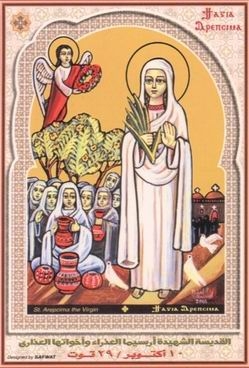
Although these maidens, apparently the protomartyrs of the Armenian church, are mentioned in the Roman Martyrology on this date as suffering under King Tiridates, nothing at all is known of their history or the circumstances of their passion. They are referred to in the legend of St Gregory the Enlightener, and may have been put to death during the persecution which preceded the baptism of Tiridates and his family by Gregory, but more likely later : their acta is a romance of the most barefaced kind.
These legends tell us that Rhipsime (Hrip'sime) was a maiden of noble birth, one of a community of consecrated virgins at Rome presided over by Gaiana. The Emperor Dioceltian, having made up his mind to marry, sent a painter around Rome to paint the portraits of all those ladies who seemed to him eligible, and he did his work with such thoroughness that he penetrated into the house of Gaiana and made likeness of some of her Christian maidens. When Diocletian examined the portraits his choice fell on Rhipsime, and she was informed of the honour that had befallen her. It was not at all to her liking, and Gaiana was so afraid of what the emperor might do that she summoned her charges at once from Rome, went aboard ship, and proceded to Alexandria. From thence they made their way through the Holy Land to Armenia, where they settled down at the royal capital, Varlashapat, and earned their living by weaving. The great beauty of Rhipsime soon attracted attention, but the noise of it apparently reached back to Rome before it came to the ears of King Tiridates, for Diocletian wrote asking him to kill Gaiana and Rhipsime back – unless he would like to keep her for himself. Tiridates therupon sent a deputation to fetch her to his palace with great magnificence, but when it arrived at the convent Rhipsime prayed for deliverance, and so fierce a thunderstorm at once broke out that the horses of courtiers and their riders were scattered in confusion. When Tiridates heard this and that the girl refused to come he ordered her to be brought by force, and that the girl refused to come he ordered her to be brought by force, and when she was led into his presence he was so attracted by her beauty that he at once tried to embrace her. Rhipsime not only resisted but threw the king ignominiously to the floor, so that in a rage he ordered her to prison. But she escaped and returrned to her companions during the night.
At morning when they found her gone the king sent soldiers afer her with orders that she was to die, and all the other maidens with her. St Rhipsime was roasted alive and torn limb from limb, and St Gaiana and the others to the others to the number of thirty-five likewise were brutally slain. St Maria,me was drragged to death from a bed of sickenss, but one, St Nino, escaped and became the apostle of Gorgia in the Caucasus. This massacre took place on October 5, on which date the martyrs are named the Armenian menology. A week later retribution overtook the brutal Tiridates who, as he was setting out to hunt, was turned into a wild boar. He was brought back to nature by St Gregory the Enlightener, who had been confined in a pit for fifteen years. Theses martyrs figured in the fabulous visioin of St Gregory at Etshmiadzin, and around the great church there are three smaller churches on the alleged site of the martyrdom of St Rhipsime, of St Gaiana and of the others.
[1] Butler's Lives of the Saints