St Paul the Simple[1]
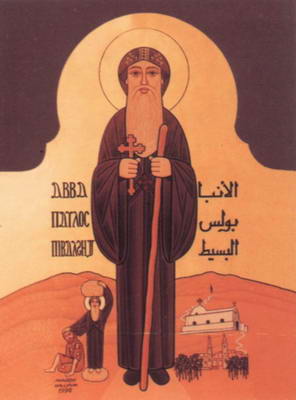
(cf II.xxxi) The Servant
of Christ, Hierax, as well as Cronius and several other brothers, told me
the story I am going to tell you about Paul the Simple. He was a peasant
farmer of transparently innocent and simple life, and he had taken a most
beautiful woman for a wife who nevertheless was of very lax morals. Led by
providence to an outcome which he was in fact half hoping for, he came back
from the fields unexpectedly one day, went inside, and found her and a man
together. When he saw her and the man she was having sex with he gave a
forthright and heartfelt laugh.
"Fine, fine," he said. "This means that she is no longer any responsibility
of mine. In Jesus' name I acknowledge her no longer. Go, take her with you,
and her children, for I am leaving to become a monk." Without saying
anything to anybody else he took an eight day journey to holy Antony and
knocked on his door.
"What do you want?" asked Antony when he came to the door.
"To become a monk," replied Paul.
"You must be at least sixty. You can't become a monk," said Antony. "Live in the town, work for your living, trusting in the grace of God. You would not be able to cope with all the trials of solitude."
"Whatever you told me to do I would do it," the old man replied.
"I have told you," said Antony. "You are old. You can't be a monk. Go away. Or if you do really want to be a monk go to a cenobium where there are many brothers to support you in your frailty. I am here all by myself, fasting for five days before eating." And with these words he tried to drive Paul away.
Refusing to admit him,
Antony shut the door and for three days did not go outside, not even to
answer the call of nature. But the old man stayed where he was.
On the fourth day he really had to go outside, but when he opened the door
and went out he saw Paul still there and said, "Go away, old man. Why do you
keep on bothering me? You can't stay here."
"I don't intend to stay anywhere else except here," said Paul.
Antony looked at him and saw that he had nothing with him to sustain life, no bread, no water or anything else, and he had now been fasting for four days.
"He is so unused to fasting he might die," thought Antony, "and I will be to blame." And so he took him in.
"If you can be obedient
and do what I tell you," said Antony, "you'll be all right."
"I will do whatever you say," Paul replied.
Antony in those days followed just as rigorous a way of life as he did when young. In order to test the Paul's mettle he said to him, "Stay here and pray, while I go in and fetch something for you to work with." He then went into his inner room and watched Paul through the window. For the rest of the week he stayed there without moving, even though scorched by the heat. At the end of the week he brought some palm branches which he had soaked in water.
"Take these and weave a rope as you see me doing," he said. The old man wove until the ninth hour, completing fifteen arms-lengths with great difficulty. Antony inspected what he had done and was not satisfied with it.
You've done that very
badly," he said. "Undo it and do it again." It was now the seventh day that
this elderly man had been fasting, but Antony was treating him severely like
this to see whether he would give up and abandon the life of a monk. But he
just took the branches and rewove them, and with great labour put right the
unevenness with which he done them at first. Antony saw that he had neither
grumbled, nor been downcast, nor turned aside, nor become resentful to the
slightest degree, and he began to feel sorry for him. And as the sun set he
said, "Well, little father, shall we break some bread together?"
"If you think that's right, abba," replied Paul, thus leaving the decision
to Antony without jumping up eagerly at the mention of food. Antony began to
change his mind.
"Get the table ready then," he said. And he did so. Antony put the bread on
the table, four six-ounce rolls. He put one to soak for himself (for they
were dry) and three for Paul. Antony sang a psalm which he knew, and when he
had repeated it twelve times he also said a prayer twelve times. This he did
in order to test Paul further. But the old man prayed too, as promptly and
eagerly as the great Antony himself. (I really think that he would rather
feed on scorpions than live falsely.) "Sit down," the great Antony said to
Paul after the twelve prayers, "but we won't eat until vespers. Wait till
the bread is eatable." The time for vespers came and Paul still had not
eaten, when Antony said, "Get up. We'll pray and then sleep." They left the
table and did so.
Half way through the night Antony woke Paul for prayers and went on with them right through to the ninth hour. But at last when vespers came and the table had been prepared and they had sung and prayed they sat down to eat. Antony ate one roll and did not pick up another one. The old man was eating more slowly and still had the roll which he had started. Antony waited till he had finished and said, "Come, little father, eat another roll."
"If you have another one, I will," said Paul, "but not if you won't."
"I've had quite sufficient for one who is a monk," said Antony.
"Since I want to be a monk," said Paul, "that's enough for me too, then."
And he got up and said
twelve prayers and sang twelve psalms. After the prayers they slept a little
for the first part of the night, then rose and sang psalms again till dawn.
He then sent him out to wander in the desert.
"Come back after three days," he said. This he did.
When some brothers came on a visit he paid close attention to Antony and did whatever Antony wanted. "See to the visitors' needs and keep silence," he said, "and don't eat anything till they have started on their journey back." At the end of the third week in which Paul had not eaten anything the brothers asked him why he kept silent, to which he replied nothing at all. "Why keep silent?" said Antony. "Speak to the brothers." So he spoke.
Once when Antony was
given a jar of honey he told Paul to break the jar. He did so and the honey
spilled. "Now scrape up the honey with this shell," he ordered, "but don't
get any dirt mixed up in it." Once he ordered him to draw water all day.
When his garment got a bit tattered, he told him to just get used to it.
In the end this man had grasped such firm hold on obedience by the divine
grace given him, that he was able to command the demons. When the great
Antony saw that this man had promptly carried out everything he had asked
him to do in the way he ordered his life, he said, "See if you can keep on
doing this day by day, brother, and stay with me."
"I don't know what else you can show me," said Paul. "I do whatever I see
you doing, quite easily and without any strain, the Lord being my helper."
On another day Antony admitted 'in the name of Jesus' that he had indeed become a monk. The great and blessed Antony had become convinced that the soul of this servant of Christ had become almost perfected in all things, even though he was somewhat simple. After a few months Antony was moved by the grace of God to build a cell for him three or four miles away from his own cell, and said to him, "See now, by the help of the grace of Christ you have become a monk. Now live by yourself, and even take on the demons." So a year after Paul the Most Simple came to live with him, he was highly experienced in a disciplined way of life and was found worthy to battle against the demons and against all kinds of diseases.
One day there was brought to Antony a young man vexed beyond measure by one of the most powerful and savage demons, who railed against heaven itself with curses and blasphemies. Antony had a look at the young man and said to those who had brought him, "This is not a task for me. I have not yet been given the grace to deal with this very powerful type of demon. Paul the Simple has the gift of dealing with this one."
The great Antony went to
Paul, that most excellent man, taking them all with him.
"Abba Paul," he said, "Cast out this demon from this person so that he may
return home cured and glorify God." "Why not you?" asked Paul. "It is not
for me," said Antony. "I have other concerns." And the great Antony left the
boy there and returned to his cell.
The unassuming old man stood up and poured out a strong prayer to challenge
the demon and said, "Abba Antony says, 'Depart from this man'" "I will not,
you disgusting, pompous old man," said the demon, with many curses and
blasphemies. Paul put on his sheepskin and belaboured him in the back,
crying, "'Go out,' abba Antony says."
The demon abused both
Paul and Antony with curses, saying, "You are disgusting old men, lazy and
greedy, never content to mind your own business. What have you got in common
with us? Why are you browbeating us?" "Either go now," said Paul, "or I will
call upon the power of Christ to bring destruction upon you." But this
unclean demon railed against Jesus also with curses and blasphemies "I am
not going," he shouted.
This made Paul get angry with the demon. He went outside. It was midday -
when the Egyptian heat bears comparison with the furnace of Babylon. The
holy old man stood up straight, like a statue, on top of a rock, and prayed,
"O Jesus Christ, you were crucified under Pontius Pilate, take note that I
will not come down from this rock, nor will I eat or drink even if I die,
until you hear me and cast out this demon from this man and liberate him
from the unclean spirit." And even as the simple and humble Paul was
praying, before he had even finished, the demon cried out, "I'm going, I'm
going, driven out by force, overcome by tyranny. I'm getting out of this man
and won't come back any more. It is the simplicity and humility of Paul
which has driven me out and I don't know where to go."
The moment he went he changed into an enormous dragon about seventy cubits long which crept off towards the Red Sea. Thus were fulfilled the words of Holy Scripture, 'The righteous man shows his faith by what he does' (Proverbs 12.17), and 'On whom shall I look, says the Lord, if not on him who is gentle and humble and trembles at my words?' (Isaiah 66.2). Although lesser (humiliores) demons can be cast out by the faith of men in authority (principales), it takes humble (humiles) men to be able to put to flight the demons of greatest power (principales). Such were the miracles of the humble Paul the Simple, and there were many others he did, even greater than these. He was known as Simple by all the brothers.
[1] Vitae Patrum Chapter XXVIII.