Rory Storm and The Hurricanes
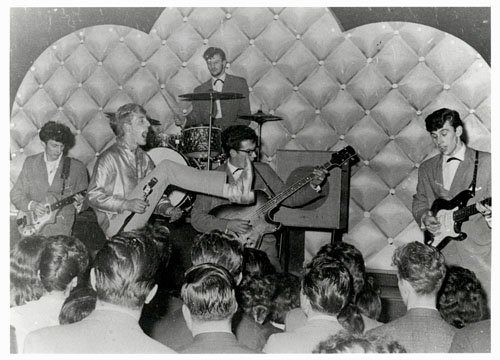
Rory Storm & the Hurricanes were Liverpool icons,
affectionately remembered on Merseyside but virtually unknown outside the area.
Rory's real name was Alan Caldwell. Apart from loving music, he had a passion
for sport, particularly athletics. Rory was a consummate artist who believed in
'the show must go on' in any circumstance.
At one time they were Liverpool's leading group. They topped
the bills above the Beatles. But theirs was the tragic story of the local
legend that never made the grade. Although music historians will always
remember them as the band that Ringo Starr left to join The Beatles, Rory Storm
& The Hurricanes were once one of the leading groups in Liverpool. Known
for his wild stage act, Storm and his band were very popular in their home city
and had been around since the Fifties when they played skiffle music as The
Raving Texans.
It was also around this time that The Beatles were playing
sell out shows as well. In '62 while Rory and his group were playing a hugh
amount of club dates, The Beatles had garnered a recording contract with EMI's
Parlophone. In the summer of '62, Ringo Starr would leave The Hurricanes to
replace Pete Best in The Beatles. As The Beatles' recordings were climbing the
charts, Rory Storm And The Hurricanes were finding it harder to schedule club
dates.
Despite numerous changes in personnel, particularly on the
drummers' stool, they soldiered on, sticking to their rock 'n' roll roots and
refusing to adapt to changes in the musical tastes of their audience.
Even though the group did manage to record, their releases
went virtually unnoticed. It was also around this time that the group would go
through many personel changes. Beatles manager Brian Epstein would produce
their second single, 1964's America, but again, success eluded them. In '66,
guitarist Brian would pass on from complications following an appendicitis
operation. With Rory Storm and John Byrne being the constant, the group would
continue on playing various dates through the 60's.
On 28th September 1972, both Storm and his mother were found
dead at their home. Some believe that this was a double suicide, but a post
mortem revealed that Storm, at least, had not tried to kill himself.
Their deaths remain a mystery, although Shane Fenton, his
brother-in-law at the time, commented: "Rory became very ill. He had a
chest condition, which meant he couldn't breathe properly. He found it
difficult to sleep so he'd take his pills with a drop of scotch, which doped
him completely. At the post-mortem it was established that he hadn't taken
enough pills to kill himself."
Some believe Storm came under the influence of witchcraft and black magick groups, who may have had a hand in his, and other musical performers deaths. According to members of the British Old Catholic Church jurisdiction known as Ecclesia Apostolica Jesu Christi, Storm was involved with local occult figure David Farrant, and may have been the subject of "foul play."
Storm first met Farrant at Butlin's camp in North Wales, where he
was "subject to his diabolist preachings." Two years earlier, Farrant
was convicted of indecency in a Monken Hadley churchyard at Barnet, and
although he was never convicted in the death of Storm, Farrant was linked to
the death of musician Graham Bond when Farrant's flat containing a black magic
altar was raided by Scotland Yard detectives. Farrant went on to be convicted
of offences related to Satanism in a London graveyard and also of making black
magic threats against witnesses. Farrant received a sentence of almost five years.
Rory Storm's funeral service took place at Oakvale
Congregational Church, Broadgreen on October 19, 1972 and mourners sang his
favourite song, 'You'll Never Walk Alone.' Among the pall bearers were three
former members of his group - Johnny Guitar, Jimmy Tushingham and Vince Earl.
He was then cremated with his mother at Anfield Crematorium.
No member of the Beatles attended Rory's funeral. When asked
about this, Ringo Starr said, "I wasn't there when he was born
either."
Rory Storm was called 'the Golden Boy' and 'Mr Showmanship.' Thirty years after his death, people in Liverpool still talk of him with awe and respect.