990521-061c
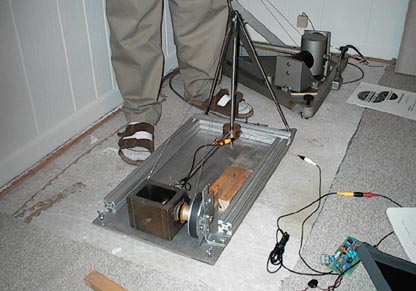
In the foreground is John Lahr's homemade horizontal seismometer. The concrete beneath is in a corner of the house resting on the ground.
990521-062c
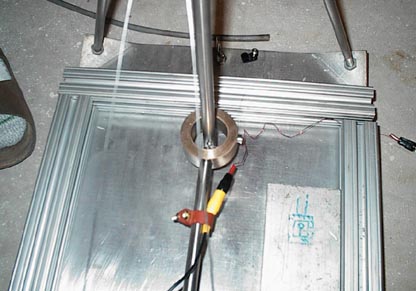
This is a view of John Lahr's horizontal boom/mast
pivot arrangement. Bascially a wire is inserted into the middle of
the boom end and locked in. From there, the wire goes through the
mast via a hole drilled in it. The wire continues on to and through
the shown brass ring, via a small hole, and is locked down by the wire
wrapping around the screw on the right hand side of the brass ring.
This is basically the same method as used in the Sprengnether horizontal
behind it in the lower photo. This method averts alot of friction
problems where knife edges etc., are involved.
990521-063c
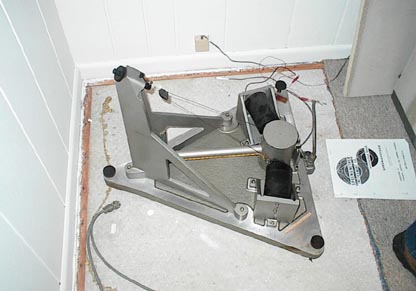
A view of a 1950's Sprengnether horizontal seismometer.
It contains two coils, one for damping and one for pickup.
990521-064c
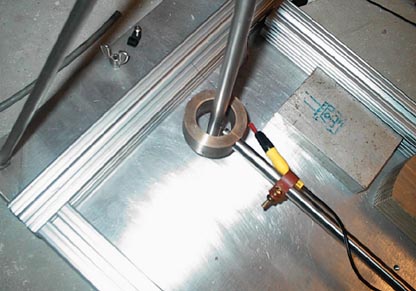
Another view of John Lahr's horizontal seismometer
and its boom/mast pivot. Only by very astute observation can one
make out the wire crossing between the mast and the inside back of the
brass ring. Johns variation of pivot arrangement is alot simpler
than the Sprengnether in comparison, and I would recommend this approach,
if possible. Very well done John.
990521-065c
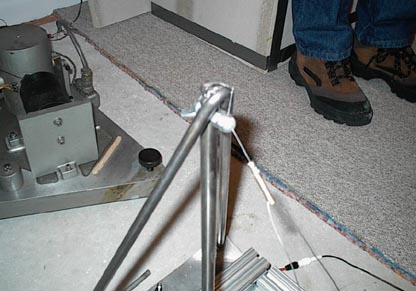
A view of John Lahr's mast and suspension wire pivot.
It is a combination of bending and welding for the frame. The 3 rods
contribute to the stability. The brass rod is a noteworthy approach
to supporting the wires associated with suspending the mass/boom.
990521-066c
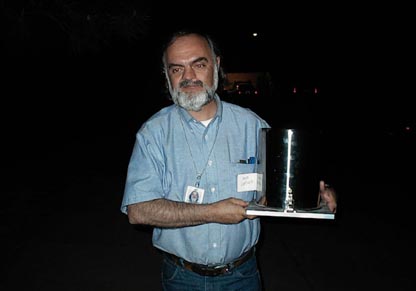
Here is David Latsch with his Sprengnether seismoscope.
Apparently David picked it up a gun auction which also contained a wide
variety of other material. The seismoscope appears in prime condition
and is certainly a part of history in strong motion instrumentation.