To Herauld the Lyste Myriad
List mastering beyond the double-elimination tournament
By Meradudd Cethin
(with thanks to Brand Glendower)
Introduction
– For many, both competitors and spectators alike, there is but one type of tournament, the double elimination tournament seen at Crown/Coronet lists. But to restrict ourselves to a single type of tournament, especially when there is such a rich tapestry to draw upon, is like sitting to a feast and only dining upon the same roast beast every time. This tract will endeavor to enrich the reader by briefly exploring several more popular forms of the list and give practical examples for their implemenation in our present middle ages.Historical basis and description of the Tournament – There are a few things which should be mentioned in the first before we go further. The ‘tournament’ which we in the Society celebrate has, in general, very few resemblances to it’s medieval inspiration. Until the 15th century, almost all tournaments were mass combat affairs, with ranks of knights on horse squaring off against each other. For obvious financial and safety reasons, the horse, the centerpiece of the knight, is absent. Without the horse, any competitions with the lance are, pardon the pun, pointless. Another significant difference is the time factor involved. The normal tournament lasted for at least 3 days, with the grand spectacles like the one described in King René’s book and the Field of the Cloth of Gold lasting for a fortnight.
Still, there are two forms of combat celebrated in period texts which can be brought forward with few changes – the Pas D’armes and what we refer to as the William Marshall tournament.
The ‘William Marshall’ tournament – Sometimes known as a ransom tourney, this style of tournament style pits combattants in single combat in (normally) a variety of formats. Each combattant brought something of value to the tournament as a prize for the victor (or victors). Early on, the prize was the armor and horse of the loser. Later, prizes varied from gilded helms, purses of silver and jewelry to fine cloth and even a fish.
Practical Application - The key aspects of this tournament style are the idea of multiple prizes for victors and multiple lists for different weapon styles. Either single-elimination or double-elimination formats will work here, but double elimination is probably preferred.
Sometimes a ‘point-system’ is used. The way that works is each entrant is given a ‘point’ (physical tokens like strips of cloth are easy to use here). The victor is given a point (or all the points ) of the loser. At the end of the list, the points are tallied and the victor of the list declared. An overall winner can also be declared this way. An interesting variation on this can be used when every entrant brings a prize. Each of entrants are given a choice of a prize from the largess, starting with the person with the most points getting first pick on down to the last entrant. That way, everyone who entered gets something for participating.
The Pas D’armes – The Pas D’armes is unique and different from the normal tournament, both in period and presently. A group (or company) of knights would issue forth an open challenge to all worthy opponents that they would be at <X> place for so many days and would enter into combat with all comers for the pleasure and honor of doing battle. When the challengers arrived to do battle on the field of honor, they would announce who they were, who they fought for and their intentions in answering the challenge. The whole spectacle was to not just show prowess in battle, but also chivalry, honor and the highest qualities of knightly behavior. There were no prizes given or special honors bestowed, for the purpose was not victory but rather the enrichment and enjoyment of the chivalric ideals.
Practical application- The key aspects of this type of tournament are the emphasis on the chivalric ideals and the invocation and greetings. The actual mechanisms of the tournament depend on the host, but they normally are fall into a number of set formats, at least two or three would be present:
Mélée – massed combat with equal sides. Fought with or without a barrier and either single elimination or resurrection style. When fought with resurrection, a time limit is imposed. When fought without, the mélée is called when both sides agree on a victor or no team member on one side remains. ‘Death from behind’, being a less than chivalrous method of combat, is forbidden.
Counted blows – single combat with the marshal or herald of the field counting the number of blows struck on each combattant. When the number of blows equals the pre-agreed upon limit, the duel is called in favor of the victor.
Barrier combat – single combat with polearms. Can be single elimination or counted blows. Blows below the waist are not counted in any event.
Frequently, the order of the list is chosen by the defending force and is chosen by the eloquence of the introduction. In any event, the list is most often free-form.
Also, tokens of notice are often given to individuals who have shown great honor on the field. These can be given by the defending company, by the sponsor of the tournament or by the ladies in the gallery.
One of the key factors to getting a Pas to work is to have a good voice herald as the herald of the field. It is his/her job to set the tone of the Pas, explain the rules of the Pas and to keep things going. To assist those who feel themselves oratory-challenged, having a few good voice heralds on the side to provide assistance with the introductions and to keep the ‘feel’ of the Pas is a good idea.
Non-historical tournament formats
There are a number of non-historical formats which can also be used with great effect to have variation from the standard double elimination tourneys.
Round-robin tournament – A Round-robin tournament is one in which every contestant fights every other contestant. These can be done with mixed weapons or with a single weapon style (or with multiple weapon styles, each having their own list). For purposes of this tract, let us concern ourselves with a single list. Please note that there are no bye’s in a round-robin tournament. If for some reason a combattant must leave the tourney, ALL of his bouts (fought or not) are scratched through and not counted.
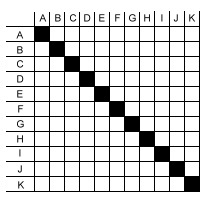
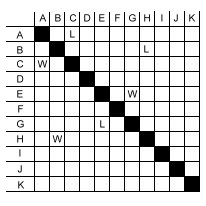
It is easiest to draw this list in a grid/graph fashion. Make a grid with as many columns as rows, numbering each column and row identically, and mark out the intersections of the same numberings as seen in the figure at right. The next thing to do is to choose which manner that the grid is to be read (columns or rows...we’ll use by rows). Next, randomly pair up each contestant (easiest is A-B, C-D, etc.) for the first round. As each bout is completed, mark off the appropriate boxes as victors and defeated (W’s and L’s, green and red markers, whatever...) For this demonstration, we’ll use W’s and L’s.
As can be seen, there have been three bouts fought so far. In one bout, fighter ‘C’ was victorious over fighter ‘A’. Fighter ‘H’ beat fighter ‘B’ and fighter ‘E’ won over fighter ‘G’. One continues the bouts running, ensuring that each contestant rests at least one fight between their bouts, until the entire grid is filled in. Then, go row by row and count the number of "W’s" for each fighter. Compare the tallies to find the victor. In the unlikely event of a tie, a ‘two out of three’ fight can settle the issue.
Bear Pit/King of the Hill - Like the William Marshall and Round-Robin tournaments, this style of tournament is based on points. After designating the number of ‘pits’ you will have, a list of fighters is created, with each fighter being assigned a designator (number, letter, whatever) and the fighters are assembled in a line. Each fighter who enters the pit is awarded a point. The fighter who wins the bout is awarded a point. If a fighter steps outside the boundaries of the pit (normally marked with chalk or roped off) for any reason, they automatically cede the bout. The loser of the bout goes to the back of the line of their own pit.
This is a timed list, with the winner being the fighter who has racked up the most points.
Atlantian Speed Tournament - Essentially a variant on the bear pit, it was designed for a LOT of fighters to be in a tournament at once. The big differences are multiple pits with rules against stalling and when a loser is declared, they go to the end of the next bear pit.
Warlord Tournament – I have read of two different versions of this tournament. The most common is a standard double elimination tournament with the prize being to serve as the ‘warlord’ or general of an army in an upcoming mélée.
The second is a single elimination tournament, with the loser joining the forces of the victor to fight in the next round. Thus, a field of 16 warriors becomes 8 teams of two squaring off in round 2. In round three, there are four teams of four, then two teams of eight in the final round.
Variations on a theme – There are a number of variations on both the ‘standard’ double elimination tournaments and the above-listed tournament styles. These include rotating weapon styles, retained wounds between bouts, random weapon styles, unusual victory conditions (only torso shots count, etc) and others.
In Closing - The tournament is the standard by which a fighter is measured and prowess in them is the mark of a knight. By using different tournament styles, even the ‘average’ event can be transformed into a spectacle which will be far more memorable than just some variant on the everyday. Thanks goes to Brand Glendower for assistance with some of the non-period tournament forms.