Period Legal Texts And Their Application In The Construction Of An Award Document In The SCA.
by Meradudd Cethin
Of all of the things within our Society, one of the more ahistorical and dearly loved traditions is that of the ‘award scroll’. In period, if you did something worthy of note or mention, most times the noble/potentate/king would say something nice in public, perhaps give you a neat bauble and perhaps even throw a feast in your honour. Only on the most significant of occasions would an individual be raised in status or rank. If that was to occur, there would be commonly a legal document stating this fact, both to honour the individual but also to prevent any false claims being made. In this article, we will examine the parts of a period legal document (with special attention paid to grants of arms and the ilk), the format and layout of a period legal document and how those items can be adapted to SCA usage.
Parts of a legal document
An important thing to recall with period documents of this sort is that they are legal instruments. As such, there is a set formula and wording which is precise beyond the obvious patter. This becomes evident as early as 600 AD in the Anglo-Saxon kingdoms of what is now England and carries through the end of period to this day. There are primarily four parts of a period legal document: the salutation, the exposition, the disposition and the attestation. We will examine each in turn with period examples and suggestions on how to apply them to our game.
The Salutation
Sometimes referred to as the intitulation or greeting, the salutation establishes who the document is coming from and who the audience is. Examples are as follows:
To all and singuler as well nobles and gentills as others to whome these presente shall come Robert Cooke Esquier alias Clarencieul principall herehault and kinge of armes of the Sowth East and weast parte of this realme of England from the river of Trent Sowthwards sendith greeting in oure Lord God everlasting. (Confirmation of arms to Henry Stanley, 1576)
To all true Christian people these present letteres hereing seeing or reading I, Roger Richmont, otherwise called Clarenceaux King of Arms of all the south parties of this reame of England send due recommendation and greeting in our lord god everlasting as it apparteigneth. (Confirmation of Arms to Peirs Peckham, 1494)
To all those who shall see or hear these present letters John Smert otherwise called Gartyer King of Arms of the English greeting and all humble recommendation. (grant of arms to John Alfrey, 1459)
Henry, by the grace of God king of England, lord of Ireland, duke of Normandy and Aquitaine, earl of Anjou to archbishops, bishops, abbots, priors, earls, barons, justices, sheriffs, reeves, ministers and all bailiffs and his faithful people – greeting. (charter to Shire of Huntington, 1252)
John, by the grace of God king of England, lord of
Ireland, duke of Normandy and Aquitaine and Earl of Anjou to his archbishops,
bishops, abbots, earls, barons, justices, sheriffs, reeves, ministers, and all
faithful servants, greeting. (1205
charter to Shire of Huntington, 1205)
In the name of the holy and indivisible Trinity. Frederick, by favour of the divine mercy, august emperor of the Romans. (The Gelnhausen Charter, 1180)
As
can be seen, it is but a pittance to create an appropriate salutation.
Bob and Fredicia, by rightful king and queen of the Outlands unto all our dukes, earls, counts, barons seneschals, reeves heralds and all faithful subjects: greetings.
To all nobles and gentles these present letters hearing seeing or reading do we, Fred and Roberta, alias baron and baroness of Al-Barran send greetings and all due recommendations as it appertaineth.
The Exposition
The
exposition is an explanation for the purpose of the letter and why we’re
bothering to talk to ALL of those folks mentioned above in the salutation. Charters don’t normally have such a section,
as the reason for the drawing up of a formal charter delineating boundaries,
fees and other items is commonly self-evident.
Whereas aunciently from the beginning the valiant and vertuous acte of worthie persons have ben comendid to the world with sondry monuments and remembrancs of their good deedes. Amongst the which the chiefest and most woorthe hath been the bearing of signes in shildes called armes which are evident demonstracons of prowes and valior
diversly distributed according to the quallities and woorthe of the persons which order as it was most prodently devised in the beginning to fhire and kindell the hartes of men to the imitacon of vertue and noblenes Even so hath the fame ben and yet is continually
observed to thend that such as have don comendable service to their Prince of Contry eather in warre or peace may bothe receave due honor in their lives and also dirve the fame successfuly unto the posteritie of ever. (Confirmation of arms to Henry Stanley, 1576)
Forsomuch as diverse and many persons of ther noble and gentle courage advance and style theymself to exercise good and virtuous acts with commendable manners and gentil concience with goddes grace they shal more the better atteigne unto the perfection of grete honour and nobelnesse. Among which persons as I am verily ascertaigned by ancient and worshipful persons oon there is in especial called Piers Peckham of the Cite of London which hath tenderly prayed and required me thesaid sign of armes to make good and the throrowe serch for the verray(true) armes of this predecessours. (confirmation of arms to Piers Peckham, 1494)
Equity requireth and reason ordains that men virtuous and of noble courage be rewarded for their merits by renown and that not only their persons in this mortal life so brief and transitory but after them those who shall issue and be procreated of their bodies may be in all places of great honour perpetually shining before others by certain signs and shows of honour and gentility. That is to say of blazon helmet and crest in order that by their example others may the more endeavour perseveringly to spend their days in feats of arms and other virtuous works to attain renown of ancient gentility in their line and posterity. (grant of arms to John Alfrey, 1459)
Since human memory is short and does not suffice for a crowd of things, the authority of those who preceded our age, the divine emperors and kings, has decreed that those things were to be written down which the progress of fleeting time generally removes from the knowledge of men. (The Gelnhausen Charter, 1180)
This
may seem a bit difficult to translate over to our game, but it is not overly
difficult. To wit:
Equity wills and reason orders that those who, by their merits and good renown, be rewarded not only in this mortal life so brief and transitory but also after them that those shall be of their bodies defended to be in all places of honour with other nobles and gentles accepted and taken by certain ensigns and demonstrations of honour and nobleness, that is to say arms, that by their examples others may the more be inspired to themselves to use their days in feats of arms and work virtuous to get the renown of ancient nobleness.
Forsomuch as diverse and many persons of their noble and gentle courage advance and style themselves to exercise good and noble acts with commendable manners and gentle concience to better attain unto the perfection of great honour and nobleness.
The Disposition
The
disposition is the section of the letter which explains the intent of the
author. Consider the exposition to be
the backstory, which explains why the action is going to happen and the
disposition is the action which is being taken. Thus, in a grant of arms, we see a disposition such as these.
And being required of henry stanley of sutton bonington in the cowntie of Nottingham
gentilman and of Anne his wife doughter of Richard Brasshow late of Bormy in the saide cowntie gent to make searche in the regesters and records of my office for the auncient armes of those two severall howses wherof they are defendid wheruppon I have made search accordingly and do finde that the saide Henry Standley may beare as his auncestors heretofore have don these armes and creast herafeter following That is to say golde thre egles legges rased gules on a chief indented asur thre staggs heade caboshed golde and to the creast wppon the healme on a wreath silver and asure an egles head golde wth thre pellatte and in his beake an egles foote rased gules mantled gules dobled silver, and also that the aforesaid anne wife to the saide henry stanley may also bear as her auncestors haretofore have don these armes herafter following Videgt silver to benlette (two bendlets) betwene two martlette sables as more plainly apperith depicted in the margent. The which severall armes and creast and every parte and parcell therof I, the saide Clarencieuly Kinge of Armes by power and aucthoritie unto my office armed and granted by letters patente under the greate seale of england do ratifie confirme and allow unto and for the saide henry stanley gent and anne his wife and to there posteritie with their due difference according to the law of armes and they the fame to use and enjoy forever without impediment let or interuption of any person or persons. (Confirmation of arms to Henry Stanley, 1576)
As whoi instance I have soo doon with al goodly diligence and have fonde that the righte armes of the said Piers and of his predecessours for beere sable, a cheveron gold between thre crosses botoney fitchy silver the crest a leopard hed sable pierced throrough his hed and eeres with suche three crosses as is sett in a wreath silver and sable mantelled goules lyned silver. as more plainly it appeareth in the margen above depicted. Which armes and crest I the said King of Armes testifiing the same ratifie and conferme unto the said Piers and to his posterite he and they to have to occupie and rejoice the same and them to be invested at their pleasure and to their honnour without any impediment or contradition of any person or personnes for eu more (evermore). (confirmation of arms to Piers Peckham, 1494)
And therefore I Gartier King of Arms abovesaid who not only by common renown but also by the report and testimony of other noble men worthy of credence am truly advertised and informed that John Alfrey has long persued feats of arms and as well in this as in other his affairs has borne himself valiantly and conducted himself honourably so that he has deserved well and is well worthy that henceforth perpetually and for ever he and his posterity may be in all places honourably admitted renowned counted numbered and received among the number and in the company of other ancient gentle and noble men. And for the remembrance of this his gentility I have devised ordained and assigned to the said John Alfrey for him and his heirs the blazon helmet and crest in the manner which follows. That is to say ung escu de six points de sable et dermyns a trois colz de signe dargent rasez membrez de gueulez et couronnez parmy chun dune couronne des enchaynez de mesmes es diz pointz de sable Et le tymbre sur le haulme deux colz de signe dargent acolans lun lautre ensemble pareillement couronnez et membres a une torse dargent de sable et de gueulez emnantelle de meismce double dargent ci comme la picture en la marge cy devant le demonstre to have and to hold for him and his said heirs and to invest them thereof for evermore. (Grant of Arms to John Alfrey, 1459)
This is, of course, the part where we get to find out exactly what our dear recipient is going to receive. Part of the crafting of the document comes from placing those specific words closest to the end as feasible, as the crowd normally erupts with cheer and, thus, obscures the herald’s words which follow the name of the accolade.
And, therefore, We, the aforesaid crown of the Outlands, not only by the common renown but also by the reports of those worthy to be taken of word and credence, have been plainly advised and informed that William Cooper is defended of an honor undefamed and has created such splendourous works of great art and artifice for the benefit for all to see so that said gentle is well worthy in all places of honor with our nobles and gentility to be accepted and taken by certain demonstrations of honor and nobility, that is to say, arms. And for remberance of these good works, We have been authorized, attributed, given and granted by our own hand, to hereby commend and induct said William Cooper into our most hallowed Order of the Argent Hart and grant unto said William Cooper arms to have and to hold and to use and enjoy for evermore.
Thus, we, the seid baron and baroness of Caer Galen by the power and auctorita by the kynges goode grace to us in that we shulde rewarde such dedes do we testifie ratifie and confirme the same that the seid William Cooper may henceforth have chalenge occupie and enjoye without any impedimend or empechement for euermore the rights duties and responsibilities which are appertaineth thereunto a companion of our Order of Saint William the Cooper.
Attestation
The
attestation is the section of the document which confirms the above exposition
and disposition as being accurate.
Further, it normally restates the issuing authority as well as the date
and even the place where the document was signed. Lastly, the document is signed (and sometimes sealed). In documents which predate a chancery, there
is a list of witnesses.
In witness thereof, I the saide Clarencieuly Kinge of armes have set hereunto my hand and seale of office in the xviiith day of March Anno Dom 1576 in the xiv yere of the raigne of oure souervaigne Lady quene Elizabeth. (Confirmation of arms to Henry Stanley, 1576)
In witnesse wherof I the said king of armes have sett to thies present the seal of myn armes of auctorite and signed the same with my hand the last day of Juyn in the yere of oure lord god a thousand foure hundreth foure score and fourten. And of our souverain lords reigne king henry the VIIth the VIth yere. (confirmation of arms to Piers Peckham, 1494)
In witness whereof I Gartier King of Arms above named have signed with my hand and sealed with my seal these present Made and given the first day of March in the year of grace one thousand four hundred and fifty nine. (Grant of Arms to John Alfrey, 1459)
As witnesses: <list of over a dozen people>. Given by our hand at Dover, the fifth day of March, in the 36th year of our reign. (Charter of Huntington, 1252)
As witnesses: George fitz Peter Earl of Wessex, The Earl William Marshal, The Earl, William Sarum, William Earl of Warrenn, William Earl of Arundel, Robert Constable of Chester, Saier de Quency, Simon de Patishill. Given by the hand of Hugh of Wells, Archdeacon of Wells, at Havering, the seventh day of August, in the seventh year of our reign. (Charter of Huntington, 1202)
We do confirm, therefore, this lawful donation and investiture of our royal majesty to the Cologne church and to our oft-mentioned prince the archbishop Philip, and to all his successors. And wishing this to remain valid for them unto all their posterity, we forbid by an imperial edict that any one, with rash daring, infringe it or in any way attempt to violate it; and we validly corroborate this our decree by the present privilege, signed by the golden seal of our Highness, the witnesses being written down who were present at this deed. They are as follows: etc. etc. (The Gelnhausen Charter, 1180)
As
one can see, there are many different ways to provide an attestation which
follows a period example. The most
difficult problem with the period examples is the use of yearly counting using
the reign. As we have reigns which last
only 6 months, there are a few ways of modifying this for our purposes. I shall demonstrate a few below.
In
confirmation of these things, we, the aforesaid Crown of the Outlands have set
our hand manual to these present letters.
Given on this, the feast of Saint Andrew in the year of Grace 2008.
And to
ensure that these things are made permanent, we have affixed our sign and seal
to these letters. Given on this 3rd
day of February in the reign of our lord soueraign king Bob and lady quene
Fredicia.
In witness
thereof, we do hereby sign and seal these letters by our own hand. Given at Caer Galen on the feast of St.
Kristina the Astonishing in the year of the Incarnation 2008.
As
can be noted, the A.S. year is not mentioned.
Also be reminded that Pope Gregory did not institute his papal bull to
reform the calendar until 1582 and the protestant half of Europe didn't accept
the reform until at least 1700. As
such, the statement “by the common reckoning of years” or “gregorian” shouldn't
be used.
Formatting and layout
A
few words about layout and formatting of period documents. In the first, they are almost always in
landscape format (as in I think I have 1 or 2 examples out of around 100 which
aren't). Secondly, one can quickly tell
that they are a single block of text without paragraph breaks or even
significant punctuation, as can be evidenced by the images below.
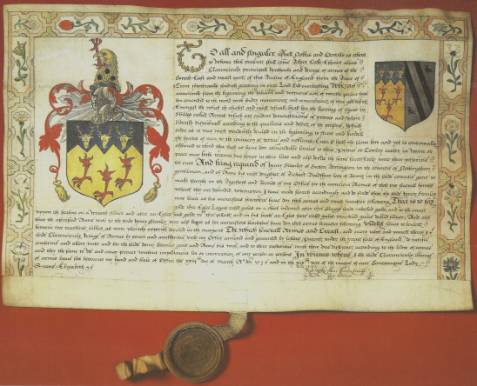
1576 confirmation of arms of Henry Stanley
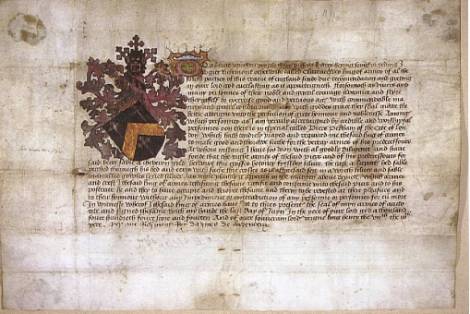
1494 confirmation of arms of Piers Peckham
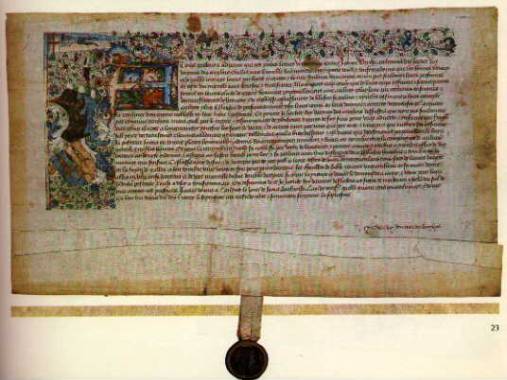
1492 Grant of arms
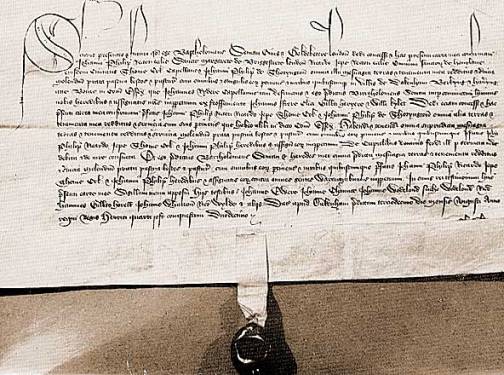
1411 charter of Dagenham
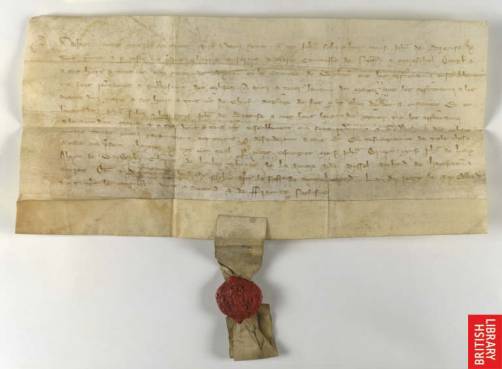
1348 Charter
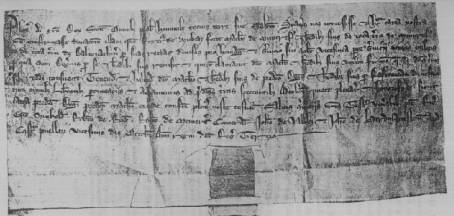
1247 charter
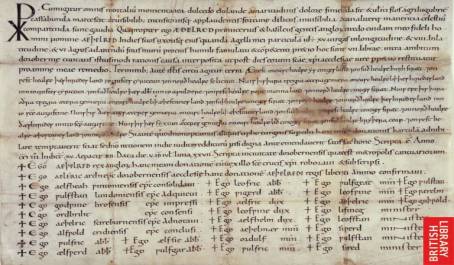
1003 grant
As one can also see, the amount of decoration or
illumination in most of the documents is very limited. It isn’t until the 15th century
do we see anything beyond the most basic of ornamentation and, perhaps, an
illuminated capital. It isn’t until the
Tudor period that the use of decoration spreads beyond the achievement of arms
and a capital to surround the text of the document. This leads back to the purpose of the documents, which is to
serve as a legal instrument.
Putting it all in an SCA
context
As we have seen, period texts are found in a
landscape format, use a block text format with minimal (if any) punctuation and
are, compared to most SCA documents, sparely illuminated if decorated at
all. Further, the text is broken into
four major sections, the salutation, exposition, disposition and
attestation. The following image and
text is a hybrid form, attempting to incorporate these forms into a document
which both the SCA and the submitter would find acceptable. Astute readers will note the similarity of
the text and illumination of the exemplar, which is the 1576 confirmation of
arms to Henry Stanley.
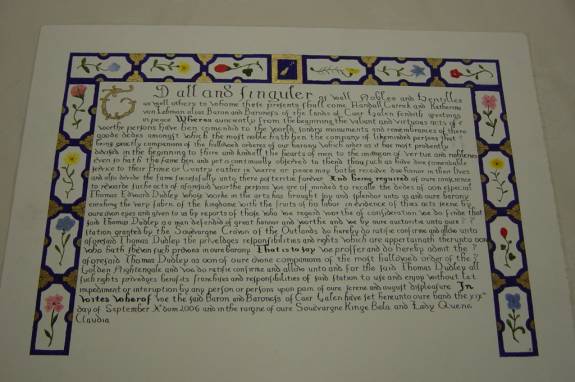
TO ALL AND SINGULAR as well nobles and gentilles as
others to whome these presents shall come Randall Carrick and Katherina von
Lehman alias Baron and Baroness of the lands of Caer Galen sendith greetings in
peace. WHERAS aunciently from the beginning the valiant and virtuous acts
of woorthe persons have ben comendid to the woorld sondry monuments and
remembrances of there good dedes. Amongst the which the most noble hath
ben the company of likeminded persions, that being exactly companions of the
hallowed orderes of our barony, which order as it has most prodently devised in
the beginning to fhire and kindell the hearts of men to the imitacon of vertue
and noblenes. Even so hath the fame ben and yet is continually observed to
thend thou such as have don comendable service to their Prince or Contry eather
in warre or peace may bothe receave due honor in their lives and also devide
the fame successfuly unto there posteritie forever. AND BEING REQUIRED of
oure conscience to rewarde suche acts of aforesaid woorthe persons we are of
minded to recalle the dedes of oon especial Thomas Edward Dudley whose worke in
the arts has brought joy and splendor unto us and oure barony enriching the
very fabric of the kingdome with the fruits of his labour. In evidence of
thies acts seene by oure own eyes and given to us by reports of those who we
consider woorthe of consideration we do finde that said Thomas Edward Dudley is
a man defendid of greate honnor and woorthe and we by our auctoritie unto oure
station granted by the Souevargne Crown of the Outlands do ratifie confirme and
allow unto aforesaid Thomas Edward Dudley the priveldge, responsibility and
rights which are appertainath therunto one who has shewn such prowes in oure
barony. THAT IS TO SAY we proffer and do hereby admit the aforesaid Thomas
Edward Dudley as oon of oure own companions of the most hallowed Order of the
Golden Nightengale and we do confirm, ratify, prepend and in all other ways let
it be known that from this hour forth he shall enjoy all such rights,
priveldges, franchises, benifits and responsibilities of said station, and that
no shall, by any means hinder him in those same rights, priveldges, franchises,
benifits and responsibilities upon pain of our serene and august
displeasure. IN WITNES WHEROF we the said Baron and Baroness of Caer
Galen have set hereunto oure hand the 19th day of September A.D. 2006 and
in the raigne of oure Souevargne Kinge Bela and Lady Quene Claudia.
Sources consulted
Adhemar de Villarquemada, Towards a More Period Text, KWHS Proceedings, 2004 Vol. 2.
British
Antiques Dealers' Association Yearbook, 1998/9
British
Library online collection. http://www.bl.uk/
(accessed 22 Jan 08)
Henderson,
Ernest F., Select Historical Documents of the Middle Ages London :
George Bell and Sons, 1896. http://www.yale.edu/lawweb/avalon/medieval/gelnhaus.htm (accessed 22
Jan 08)
‘Fifteenth
Century English Patents of Arms,’ http://verysleepy.itgo.com/grants.htm (accessed 23 Jan 08)
Littledale, Willoughby A. Harleian Society Publications Volumes 76-77: A Collection of
Miscellaneous Grants London: J. Whitehead & Son, 1925.
Miller, Sean (ed).
Anglo-Saxon Charters vol IX: Charters of the New Minster, Winchester. Oxford: Oxford University Press, 2001.
Tillitson, Diane. “Medieval Writing: Letters Patent”, http://medievalwriting.50megs.com/word/patent.htm (accessed 22 Jan 08)
Woodcock,
Thomas and John Martin Robinson, The Oxford Guide to Heraldry Oxford:
Oxford University Press, 2001.