
|
|
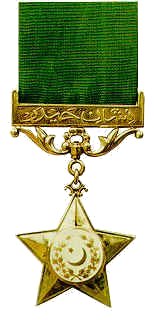 |
Mohammed Hussain Janjua (1949 - 1971) 22 yrs, Sowar, 20 Lancers Nishan-e-Haider (1971) Pakistan by Nasir M. Khan Background During the 1971 War, India Attacked East Pakistan on 21st November 1971. The General Headquarters in Rawalpindi launched an attack on India from the western front (West Pakistan) on 3rd December 1971. The primary purpose of the attack was to force India on transferring their military strength in East Pakistan to the West, easing pressure on the East. Before the transfer, it was expected that the West Pakistani forces would gather enough territory to negotiate with India after the war for areas in the East. It was also expected that if the Western front attack was successful, it would cause India to pull out of the war due to severe loss of territory. While the Pakistani attack commenced in the localities of Azad Kashmir, Chamb, Sulemanki, the area inclusive and surrounding Shakargarh (Pakistan), was to be defended. In this sector, the locations which had to be defended were 1) area between the Bein and Degh Rivers, 2) Shakargarh Town 3) area between Bein and Ravi Rivers 4) Zafarwal Town 5) Sialkot Town 6) Narowal Town 7) Jassar Town 8) Marala Headworks 9) Raya Town. During a defensive posture, the army in this area was supposed to facilitate the launch of the Army Reserves, a 5 Division strong section of the Pakistan Army which was commanded by Lt. Gen. Tikka Khan. In order to defend the area described as 1) above, the army raised a force consisting primarily of tanks (2 battalions/ units) and 800 foot soldiers (1 unit). This force was called the "Changez Force". 20 Lancers was one of the tank regiments of this force. Muhammed Hussain Janjua was a tank and light vehicle (Jeep) driver in 20 Lancers. Main Achievement Sowar Muhammed Hussein Janjua was not supposed to drive tanks in the 1971 war. His main task was to provide ammunition to the tanks during battle. The tank ammunition, consisting of shells for the tanks main gun, was to be provided through a Jeep when there was a lull in the battle field from the Indian side. On 3rd December 1971, Muhammed Hussein was called on to duty in an area opposite the Indian villages of Kathua and Samba where intense artillery shelling was taking place from the Indian side. The Pakistani tanks in this area had finished their main gun ammunition and were sitting ducks if the Indians were to launch an armour (tank) or even an infantry (foot soldier) attack. The Pakistani tanks were carrying the forward observation officers of the artillery (officers who provide the artillery guns with the exact positions of the enemy deployments) and hence had to stay in front even if there was no attack from the Indian side. Chances of an Indian attack were imminent since their troop deployment on the other side of the border was heavy. The ammunition Jeep, loaded with tank ammunition was waiting for a lull in Indian Artillery fire. The Pakistani tanks, helpless, were thinking of retreating their positions, perhaps to get cover from the Indian artillery fire and get their ammunition replenished. The lull was not coming. It was in these circumstances that the ammunition Jeep, driven by Muhammed Hussain Janjua, started advancing towards the tanks, amidst heavy shelling. Knowing what the jeep was carrying, as it is the logical assumption, the Indian artillery fire was directed at the jeep as well, but the sheer skill and speed of the driver prevented any damage. Some of the tanks were replenished, while for the others Hussain had to make further trips. Due to this display of dauntless courage by the driver in supplying the tank shells, and possibly due to shortage of manpower and vehicles, Hussain was given another task of replenishing ammunition to the Pakistani infantry's forward trenches. Getting as close to the trenches as he could in the vehicle, Hussain then transferred the ammunition to the trenches on foot, still amidst heavy shelling. There was however, no battle in this area on either 3rd or 4th of December 1971. On the 4th, the Indian artillery fire was not intense either and ammunition supply could be carried out in the more conventional manner i.e. during the lull periods. During this period, two layers of landmines were deployed in that area, one behind the other. 20 Lancers of the Changez Force were to delay the enemy along the first minefield, while the other tank regiment, 33 Cavalry, was to delay the enemy along the second minefield. At 1900 hrs on the 5th of December, the Indian forces launched an attack on the Changez Force with their infantry and tanks, along with intense shelling by their artillery. This attack was successful and the Changez force was made to retreat between the two minefields. It was under these circumstances that Muhammed Hussain volunteered to fight as an infantry soldier. The 20 Lancers Commanding Officer, Lt. Col. Tufail Muhammed was reluctant to grant the request due to two reasons. Firstly, Muhammed Hussain was a courageous and skillful driver who was very important for ammunition supply, primarily to the armour. Secondly, he was not trained for infantry battle. However, he succumbed to the vehement insistence of the driver who guaranteed him that the ammunition supply routine would not be affected, and that he would perform the dual role in the battle. He was provided with a sten gun, and was to be used as an ordinary sepoy. The commanding officer had done this more or less to appease the driver, and he was still expecting Hussain to provide the primary services as the driver of the ammunition supply jeep. This stance of the of the commanding officer was proven incorrect on the 9th of December at the small village of Harrar Khurd. An Indian platoon (37 men) had successfully broken through the Pakistani defences and had entrenched it's position. Muhammed Hussain was the first one to spot the Indian infiltration. With a handful of men, the Indian trenches were attacked. Muhammed Hussain showed exemplary gallantry in facing the regular Indian infantry, and they were made to retreat after suffering heavy casualties in this skirmish. The defensive position of Changez force had to be strengthened around the Cho drain, the area close to which was not protected by a minefield. Hence on the 10th of December 1971, 20 Lancers was placed in this area. There was a temporary stand off at the Cho drain as due to the geographical nature of the place, neither of the armies could see each other. There was heavy armour build up on both sides, balanced in number. The Indians had an advantage over the Paksitanis in infantry though, and they moved it forward towards the Harrar Khurd village for the second time. Faced with armour build up across the Cho drain on one side, and the Infantry build up near the Harrar Khurd village on the other side, 20 Lancers of the Pakistan army was in a fix. The Pakistan artillery in the area could not perform proper shelling of the Indian occupied land across the Cho drain due to the lack of information, and the shelling that it performed was not causing any damage either. The Pakistani armour was also not sure of whether the Indian Infantry at the Harrar Khurd side should be indulged, or should be the Cho drain area should be defended against a possible infiltration from the Indian armour. It was generally considered that India would be launching an attack from both directions simultaneously. It was then that Hussain, on his own initiative, crossed the drain and crawled upto the forward trenches of the Indian force. He saw the deployment of the Indian armour and realized that they were getting ready to attack the Pakistanis across the drain. While reporting back to his 2IC, Major Ammanullah, Hussain described the enemy intention and deployment. The Major, on the information provided by Hussain about the areas where indian armour and troop deployment was most scarce, launched a pre-emptive attack. The Indians were not ready for the attack when it came their way; 16 tanks were destroyed/ fatally damaged only on the information provided by Hussain. Such was the impact of the information provided by the driver in this successful attack that, while the battle was going on, Major Ammanullah contacted the commanding officer, Lt. Col. Tufail Muhammed, and asked him to recommend Muhammed Hussain for the highest gallantry award. The shocked commanding officer ordered his 2IC to concentrate on the battle and not the recommendations for gallantry awards. The Pakistani artillery, on the other hand, launched a pre-emptive shelling episode on the Indian Infantry at the Harrar Khurd village area. This attack was partially successful as a small number of Indian Tanks, accompaying the foot soldiers at Harrar Khurd, were able to infiltrate the Paksitani ranks. The main task of these tanks was to knock out the Pakistani Artillery, as they were wreaking havoc on the Indian Infantry. Muhammed Hussain did not stop his informer role here either. He would go forward to see the enemy tank location and run back to the nearest artillery recoilless gun to achieve a fire in that direction. It was in one of these back and forth movements, that a machine gunner on an Indian tank opened fire on Hussain. The bullets burst through his chest and he died immediately. Thus came to an end a chapter of gallantry where an ordinary Jeep driver from the armour corp had taken the initiative, and had displayed courage in situations for which he was neither trained for, nor had any experience with. Further developments Nearly all of the discussions about this act of gallantry end here. Most of the Pakistani books written in either English or Urdu refer to the Cho drain/ Harrar Khurd battle as being the final one in the area and Muhammed Hussain Janjua playing a major part in Pakistan's success. There is of course, no doubt about this fact. However, the accurate history, no matter how difficult to digest, has to be mentioned as there is no point in ignoring it. It is summarized below. The Cho drain/ Harrar Khurd battle was only a small attack by the Indians relative to what was to come later. In the overall Shakargarh sector, they defeated the Pakistan army in every battle, except two, in other areas after the Cho drain/ Harrar Khurd battle. One of the battles won after the Cho drain/ Harrar Khurd episode was the successful defence of Shakargarh town on 14th/ 15th December 1971. The main Indian attack came on the 15th/ 16th December. This successful attack managed to capture the area forming a triangle between the villages of Barapind, Jarpal and Ghazipur. There were two counter attacks launched by Pakistan to reclaim these areas, but only Barapind was reclaimed after a catastrophic battle in which the Paksitani casualties were extremely severe, much higher than the Indians. A unit, 35FF, was called in from Quetta at night was thrust into a counter attack in the morning to recapture the Jarpal and Ghazipur areas. Deprived of sleep and rest and not having any idea about the location in which they were fighting the battle, 35FF suffered huge casualties, including a number of commanding officers. Another unit, 13 Lancers (not 20 Lancers described above) was made to counter attack without any tank support. It too suffered major casualties in an unsuccessful counter attack. The threat of an Indian attack thus increased in this area. They were left virtually unchalleged area, with nearly all of the Paksitani forces in a wounded state. However, when they marched forward to capture further Pakistan territory, the PAF, which surprisingly had not been participating in this area, attacked them from the air and made them retreat. The retreat however could not be carried into Indian territory and Pakistan ended up losing 534 villages and 350 square miles worth of land in the Shakargarh sector. A large number of people had to vacate their houses in the captured villages and come inside the areas occupied by Pakistan. The worst part of the Shakargarh sector battles was the fact that apart from the Cho drain/ Harrar Khurd battle, in no area was there any significant superiority enjoyed by the Indians over Pakistan. The Changez force was however, more or less successful in this area in it's own operations. However, no advantage was taken by the Army high command in these areas to capitalize on the successes of the Changez force. The army high command was thus duly criticized in the Hamood-ur-Rehman commission Report of 1974. The Army reserve formation division, 17 Division, was not utilized in this sector in any aggressive formation due to the inability of the regular troops to create any solid foundation for their launch. The reserves had to take defensive positions in order to protect the area that was originally held up by regular troops. The Shakargarh sector in 1971 was undoubtedly, one of the worst chapters in the history of Pakistan warfare, following short of only the Longewala battle in 1971 and the Indian attack on Quaid Post, Siachen in 1987. |
|||||||||
| ||||||||||
| ||||||||||
|
| ||||||||||
|
|