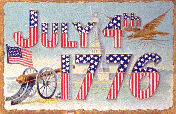
The Fourth of July soon became the main patriotic holiday of the entire
country. Veterans of the Revolutionary War made a tradition of gathering
on the Fourth to remember their victory. In towns and cities, the American
flag flew; shops displayed red, white, and blue decorations; and people
marched in parades that were followed by public readings of the Declaration
of Independence. In 1941, Congress declared July 4 a federal legal holiday.
The 13 Colonies were
Connecticut
Delaware
Georgia
Maryland
Massachusetts Bay
New Hampshire
 New Jersey
New York
North Carolina
Pennsylvania
Rhode Island
South Carolina
Virginia

In America, there are several symbols that represent our freedom. Our
flag is probably our most important symbol. Here is a look at what they
mean and the history.
Betsy Ross and Our Flag
The first flag representing the United
States was sanctioned by George Washington using colors from The British
Kings Colours. It was called the Grand Union flag. Soon, it was decided
that a new flag was needed to represent America, and it was decided to
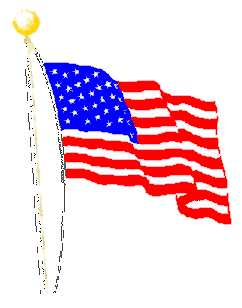
be red, white, and blue, with stars and stripes representing the colonies.
It is said that George Washington, Robert Morris, and George Ross (Betsy
Ross's late husbands uncle) came to Ross's home and asked her to sew the
new flag. Originally, George Washington had wanted 6-pointed stars on
the flag, but Betsy Ross demonstrated how to cut a 5-pointed star in a
single snip, and the committee was so impressed that they allowed Betsy
Ross to sew our new American flag, using the 5-pointed star.
OUR FLAG
On June 14, 1777, at Philadelphia,
the Marine Committee of the Second Continental Congress offered the resolution
which resulted in the adoption of the Flag of the United States. As new
states were admitted it became evident that the number of stripes in the
flag would have to be limited. Congress ordered that after July 4, 1818,
the flag should have thirteen stripes, symbolizing the thirteen original
states, that the union would have twenty stars, and that a new star should
be added on the July 4th following admission of a new state. The permanent
arrangement of the stars is not designated, and no star is specifically
identified with any state. Since 1912, following the admission of a new
state, the new design has been announced by executive order. The original
resolution read: "Resolved: that the flag of the United States be made
of thirteen stripes, alternate red and white; that the union be thirteen
stars, white in a blue field, representing a new constellation."
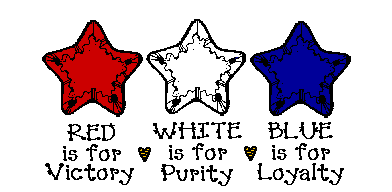
According to the Department of State, red stands for hardiness and courage,
white is the symbol of purity and innocence, and blue is the color of
vigilance, perseverance, and justice.
The Pledge of Alligiance
I pledge alligiance to the flag
of the United States of America
and to the Republic for which it stands.
One nation under God,
indivisible,
with liberty and justice for all.
History of the Pledge of Allegiance
The original Pledge of Allegiance was written by Francis Bellamy. It was
first given wide publicity through the official program of the National
Public Schools Celebration of Columbus Day which was printed in The Youth's
Companion of September 8, 1892, and at the same time sent out in leaflet
form to schools throughout the country. School children first recited
the Pledge of Allegiance this way:
"I pledge allegiance to my Flag and to the Republic for which it stands
one Nation indivisible, with Liberty and Justice for all."
"The flag of the United States" replaced the words "my Flag" in 1923
because some foreign-born people might have in mind the flag of the
country of their birth instead of the United States flag. A year later,
"of America" was added after "United States."
No form of the Pledge received official recognition by Congress until
June 22, 1942, when the Pledge was formally included in the U.S. Flag
Code. The official name of The Pledge of Allegiance was adopted in 1945.
The last change in language came on Flag Day 1954, when Congress passed
a law, which added the words "under God" after "one nation."
Originally, the pledge was said with the right hand in the so-called
"Bellamy Salute," with the right hand resting first outward from the
chest, then the arm extending out from the body. Once Hitler came to
power in Europe, some Americans were concerned that this position of
the arm and hand resembled the Nazi or Fascist salute. In 1942 Congress
also established the current practice of rendering the pledge with the
right hand over the heart.
The Flag Code specifies that any future changes to the pledge would
have to be with the consent of the President.
(The above article
on the history of the Pledge of Allegiance was written by American
Legion)
AMERICA
The song "America" is sung across
America as one of the National Anthems. It was written by Reverand Samuel
Francis Smith in 1832. It was first used at a children's fourth of July
picnic in Boston. Lowell Mason discovered the tune in a collection of
German melodies and recommended it to Rev. Smith. The music to "America"
is the same as that of the British national anthem, "God Save the Queen."
It is said that Henry Carey put the melody into its present form.
Words are:
My country, 'tis of thee,
Sweet land of liberty,
Of thee I sing;
Land where my fathers died.
Land of the Pilgrims' pride,
From every mountainside
Let Freedon ring.
My native country, thee
Land of the noble free--
Thy name I love;
I love thy rocks and rills,
Thy woods and templed hills;
My heart with rapture thrills
Like that above.
AMERICA THE BEAUTIFUL
FUN FACT
"America The Beautiful" was written as a
poem by Wellesley College professor Katherine Lee Bates in the year 1893.
After riding to the top of Colorado's Pike Peak whe was inspired by the
"spacious skies" and "purple mountain majesties". Her poem was later set
to music.
National Anthem
Read about "The Star Spangled Banner by clicking National Anthem
above.

The Liberty Bell
The Liberty Bell represents America's freedom.
The Liberty Bell is located at the Liberty Bell Pavilion on Market Street
between 5th and 6th Streets in Philadelphia, Pennsylvania. It was cast
in London and was made of 70% copper, 25% tin, and small amounts of lead,
zinc, arsenic, gold and silver. Written on the bell are the words, "Proclaim
liberty throughout all the land unto all the inhabitants thereof". The
Liberty Bell cracked the first time it was rung. It was repaired in 1846,
and cracked again. The bell has not been rung since.
FUN FACT
Every 4th of July the Liberty Bell is tapped - not actually rung.
The Eagle
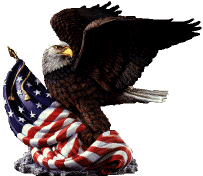
In 1787, the newly formed United
States adopted as its emblem a bald Eagle with wings that are outspread.
The Eagle is shown with a shield on its breast, an olive branch in one
foot, and a sheaf of arrows in the other foot. When the Eagle is placed
on the American coat-of-arms it carries a scroll in its beak bearing the
Latin words E Pluribus Unum, meaning one out of many.
FUN FACT
The first Eagle on an American coin appeared on a Massachusetts penny
in 1776.
The Declaration of Independence
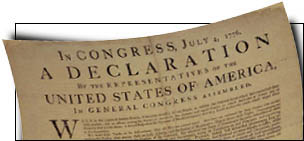
The Declaration of Independence
is a document written by our Founding Fathers declaring America's independence.
A committee of five men, Thomas Jefferson, John Adams, Benjamin Franklin,
Roger Sherman, and Robert R. Livingston were appointed to write the document.The
first draft of the Declaration was written by Jefferson, in seclusion.
He spent several days writing it. John Adams was the first person to revise
the document, followed by Benjamin Franklin, and finally by the full Congressional
Committee. It was altered a total of 47 times before independence was
declared. Independence was declared on July 2, 1776, and 39 more revisions
to the document followed. John Hancock was the first signer of the Declaration
of Independence, on July 4, 1776. The Declaration of Independence is on
display at the National Archives.
President Jefferson wrote
in the Declaration of Independence:
"We hold these truths to be self-evident;
that all men are created equal..."
"Resolved, That these United Colonies are,
and of right ought to be, free and
independent States, that they are absolved
from all allegiance to the British Crown,
and that all political connection between
them and the State of Great Britain is, and
other to be, totally dissolved."
Thomas Jefferson, was the 3rd President
of the United States of America,
from 1801 to 1809. Congress had appointed
5 men to prepare this proclamation, and
Jefferson was the greatest contributor of
the words contained in the document, and
described the Declaration of Independence
as
"An expression of the American mind."
Thomas Jefferson
It was a declaration of independence for the
colonies of the 13 States, in America,
from Great Britian and was adopted on
July 4, 1776 by the Second Continental Congress,
when John Hancock, who was the President of
the Congress, accepted and signed it.
All the men who signed the document,
knew that they had placed themselves
in grave danger, but were willing to risk
their live for what they believed.
Jefferson used many of the ideas from John Locke
who was an English Philosopher who argued against
the philosopy that human beings were born with
certain ideas. He believed that the mind was
blank and only through experience, a person would
begin to enter ideas. He was totally against the
devine right of kings and argued that governments
depended on the consent of the governed. The main
ideas brought forth were that all men were created
equal; that man had natural rights which were
granted by God; that government could only have
so much power in the lives of the people,
and could only be governed by the agreement
of the people; and the right of the people to
rebel against a government which wanted
to impose dictatorship or tyrany to its people.
Thomas Jefferson was born in 1743 and died
in 1826. His picture is on the $20 dollar bill,
the $2 dollar bill and the nickle. He is considered
to have been one of our greatest Presidents.
He wrote these words on his own gravestone:
"Here was buried Thomas Jefferson, author of
the Declaration of Independence, of the statute
of Virgina for religious freedom, and father
of the University of Virginia."
When the Declaration of Independence was declared,
John Adams wrote this historic letter to his wife:
"I am apt to believe that this day will be celebrated
by succeeding generations as the great anniversary
festival. It ought to be commemorated as the day of
deliverance, by solemn acts of devotion
to God Almighty. It ought to be solemized
with pomp and parade, with shows, games, sports,
guns, bells, bonfires, and illuminations, from one
end of this continent to the other, from this time
forward forevermore."
FUN FACT
One lucky Philadelphian purchased a $4.00 picture at a flea market.
What they found behind the picture was an original 1776 printing of
the Declaration of Independence. It was sold to TV producer Norman Lear
for 8.1 million.
STATUE OF LIBERTY

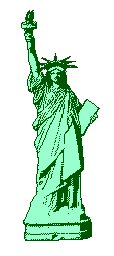
The large copper statue that stands on Liberty Island
in New York Harbor is a rememberance of our Nations FREEDOM
France gave the statue to America in 1884 as a symbol of friendship
and of the liberty that citizens enjoy under a free form of government.
The statues proper name is Liberty Enlightening the World.
The statue represents a proud woman, dressed in a loose robe that
falls in graceful folds to the top of the pedestal on which the statue
stands. The right arm holds a great torch raised high in the air. The
left arm grasps a tablet bearing the date of the Declaration of Independence.
A crown with huge spikes, like sun rays, rest on her head. At her feet
is a broken shackle, which symbolizes the overthrow of tyranny.




CLICK HERE to watch a great show of
F I R E W O R K S
Continue to Page on America's National
Anthem
"The Star Spangled Banner"
Links to Information on the United States Flag
CONTINUE
TO OUR FLAG HISTORY

A wonderful Name the President game.
The Gettysburg Address
Thirteen United States of America
Declaration of Independence
The Constitution of
United States of America
The Men Who Signed the
Declaration of Independence
Have you ever wondered what happened
to the 56 men who signed the Declaration of Independence?
Five signers were captured by the British as traitors and tortured
before they died.
Twelve had their homes ransacked and burned.
Two lost their sons serving in the Revolutionary Army, another had two
sons captured.
Nine of the 56 fought and died from wounds or hardships of the Revolutionary
War.
They signed and they pledged their lives, their fortunes, and their
sacred honor.
What kind of men were they?
Twenty-four were lawyers and jurists. Eleven were merchants, nine
were farmers and large plantation owners; men of means, well educated.
But they signed the Declaration of Independence knowing full well that
the penalty would be death if they were captured.
Carter Braxton of Virginia, a wealthy planter and trader, saw his
ships swept from the seas by the British Navy. He sold his home and
properties to pay his debts, and died in rags.
Thomas McKeam was so hounded by the British that he was forced to move
his family almost constantly. He served in the Congress without pay,
and his family was kept in hiding. His possessions were taken from him,
and poverty was his reward.
Vandals or soldiers looted the properties of Dillery, Hall, Clymer,
Walton, Gwinnett, Heyward, Ruttledge, and Middleton.
At the battle of Yorktown, Thomas Nelson, Jr., noted that the British
General Cornwallis had taken over the Nelson home for his headquarters.
He quietly urged General George Washington to open fire. The home was
destroyed, and Nelson died bankrupt.
Francis Lewis had his home and properties destroyed. The enemy jailed
his wife, and she died within a few months.
John Hart was driven from his wife's bedside as she was dying. Their
13 children fled for their lives. His fields and his gristmill were
laid to waste. For more than a year, he lived in forests and caves,
returning home to find his wife dead and his children vanished. A few
weeks later, he died from exhaustion and a broken heart.
Norris and Livingston suffered similar fates.
Such were the stories and sacrifices of the American Revolution. These
were not wild-eyed, rabble-rousing ruffians. They were soft-spoken men
of means and education. They had security, but they valued liberty more.
Standing talk straight, and unwavering, they pledged: "For the support
of this declaration, with firm reliance on the protection of the divine
providence, we mutually pledge to each other, our lives, our fortunes,
and our sacred honor."
They gave you and me a free and independent America. The history books
never told you a lot about what happened in the Revolutionary War. We
didn't fight just the British. We were British subjects at that time
and we fought our own government!
Some of us take these liberties so much for granted, but we shouldn't.
So, take a few minutes while enjoying your 4th of July Holiday and
silently thank these patriots. It's not much to ask for the price they
paid. Remember: Freedom is never free!
Those who signed were:
JOHN HANCOCK
President of the Continental Congress
1775-1777
NEW HAMPSHIRE
Josiah Bartlett
William Whipple
Matthew Thornton
MASSACHUSETTS BAY
Samuel Adams
John Adams
Robert Treat Paine
Elbridge Gerry
RHODE ISLAND
Stephan Hopkins
William Ellery
CONNECTICUT
Roger Sherman
Samuel Huntington
William Williams
Oliver Wolcott
NEW YORK
William Floyd
Philip Livingston
Francis Lewis
Lewis Morris
NEW JERSEY
Richard Stockton
John Witherspoon
Francis Hopkinson
John Hart
Abraham Clark
DELAWARE
Caesar Rodney
George Read
Thomas M'Kean
MARYLAND
Samuel Chase
William Paca
Thomas Stone
Charles Carrol of Carrollton
VIRGINIA
George Wythe
Richard Henry Lee
Thomas Jefferson
Benjamin Harrison
Thomas Nelson, Jr.
Francis Lightfoot Lee
Carter Braxton
PENNSYLVANIA
Rober Morris
Benjamin Rush
Benjamin Franklin
John Morton
George Clymer
James Smith
George Taylor
James Wilson
George Ross
NORTH CAROLINA
William Hooper
Joseph Hewes
John Penn
SOUTH CAROLINA
Edward Rutledge
Thomas Heyward, Jr.
Thomas Lynch, Jr.
Arthur Middleton
GEORGIA
Button Gwinnett
Lyman Hall
George Walton
I hope you will show your support by please sending this to as many
people as you can. It's time we get the word out that patriotism is
NOT a sin, and the Fourth of July has more to it than beer, picnics,
and baseball games.






 The city was celebrating
the first anniversary of the founding of the United States.
The city was celebrating
the first anniversary of the founding of the United States.