Far Away Places
 Washington State Vacation - Nov. 6 to 9, '99
Just be patient. Let your machine download the stuff. Thanks.
<1>
This is suppose to be a nice and beautiful morning, but I guess the camera just can't capture all that glorious beauty. This was taken along Route 7 - a typical northwestern countryside. Portion of this road reminded me of the place where Rambo was escorted out of the town ....
<2>
(Left) Taken near Nisqually Entrance (Southwest) of Mt. Rainier National Park. (Left) and so is this one.
<3>
And another, taken near the southwest entrance of the park ...
<4>
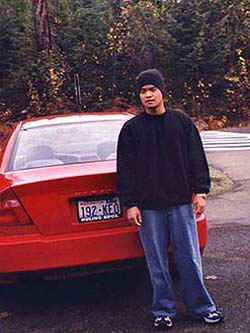
Here's a pose with our rented "de Lorrean" ... pretty nice car ...
<5>
A short stop at Christine Falls just to pose for these pictures ....
<6>
This happy guy was caught by the camera at the height of his excitement somewhere pass Christine Falls inside the Mt Rainier National Park.
<7>
Here's a mountain wonderland of dense forest, dazzling wildflowers, tremendous snowfields, and rugged glaciers. Enjoy the fresh smell of trees and soil, the soothing - and sometimes deafening - sound of falling water, and the refreshing cold breezes of the glaciers.
This is complex landscape, but the explaination of its origins are simplicity itself: fire and ice. The mountain is a volcano born of fire and built up above the surrounding country by repeated eruptions and successive flow of lava. It is a relatively young volcano, only about one million years old.
<8>
By contrast the mountains of the Cascades Range that Mount Rainier looks down upon are at least 12 million years old, created by the folding, buckling, and uplifting of the Earth's surface. Mount Rainier is not an isolated volcano, for from Lassen Peak in California to Mount Garibaldi in British Columbia and entire line of volcanoes defines the north-south march of the Cascades. The peaks dominate the skyline, ever a reminder that they are only dormant and may at anytime, like Lassen Peak in 1914-21 and Mount St. Helens in 1980, erupt in fury and rage at the fragile world built by humans.
One of the unexpected side benefits of these eruptions has been the deposition of ash and pomice layers that are rich in nutrients and support the abundance of wildflowers throughout the mountainous Pacific Northwest.
<9>
Even as volcanic forces were building up this land, the slow, inevitable power of glacial ice began to shape and form it. Glacier came from the snow that does not melt from year to year - it accumulates to greater and greater depths. The weight of the snow presses the air out, packs it tight, and compresses it into ice. Gravity pulls the ice down the mountainside, both scouring and smoothing the bedrock as it goes.
<10>
Freezing and thawing break rocks from the adjacent stones and they fall onto the glacier surface. More debris is picked up by the passing ice. This is an inexorable process that continues today and will after the mountain in the tomorrows to come. Yes, the process is simple, but it deals in forces that are beyond the control, and perhaps comprehension, of humans. Come, take a look at this mountain yourself, it may be gone in a million years ....
<11>
Here's the only native of Mt Rainier that entertained and welcomed us ... We were sorry however, we brought no junk food to feed it.
<12>
Another one of those happy poses ... at the Jackson Visitors' Center.
<13>
These were taken along Route 503 as we go closer the Mt St Helen. Along this route, especially on the portion close to the volcano, one can figure out the awesome power of nature as evidenced by the devastations it had created all around about a decade ago.
<14>
Taken at Hoffstadt Bluffs Visitor Center in Mt St Helen National Volcanic Monument.
<15>
And here's a shot from the Washington State Capitol in Olympia.
<16>
Well, that's me, in front of Washington obelisk at the State Capitol.
That's all folks ....!
Click HERE to visit "Ibajay"