 |
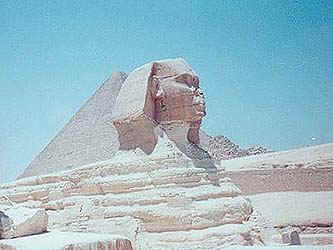 |
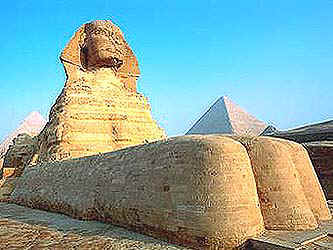
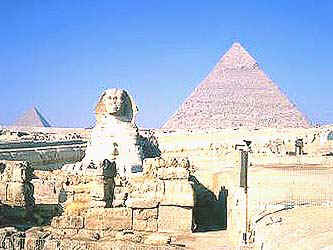
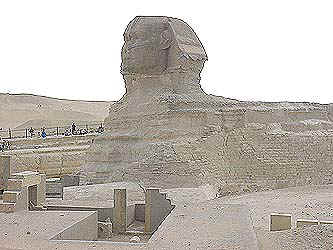
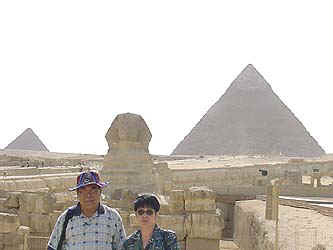
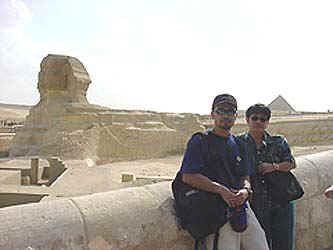
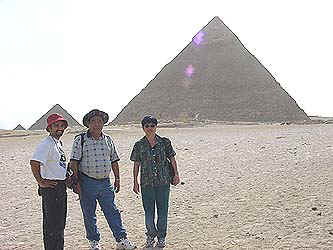
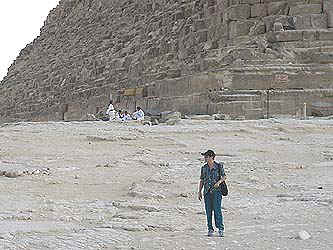
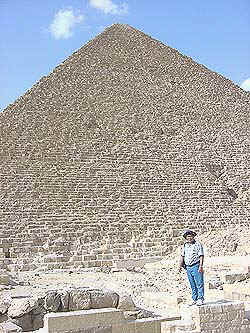
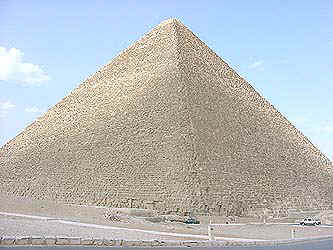
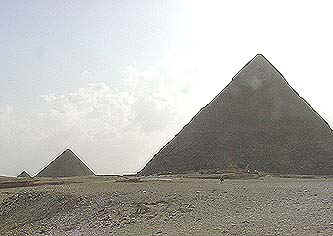
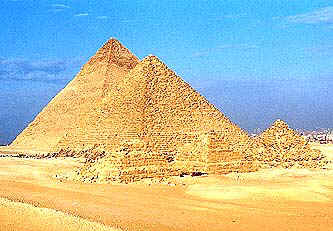
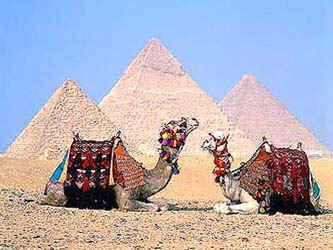
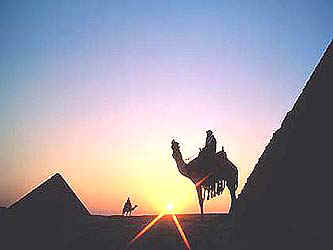
These pictures where taken in and around Giza�s general area.
Originally, the pyramids of Giza may have been gleaming for it were covered with polished white limestone casing. Unfortunately, builders around Cairo successively stripped these outer coverings to build their palaces and mosques exposing the softer core to the elements. Today, the pyramids should have look as it was originally had it not been for such vandalism.
Still, the questions of: �What were it for?� and �How were it built?� prevail. It must have been built for kings - the pharaohs - by tens of thousands of workers, is the usual acceptable notion. This notion however is constantly being challenged � from the highly unlikely to weird, wild and wacky theories are constantly being propounded. The meticulous and precise carvings, the placement of stones, the significance of the structures� astronomical dimensions could be evidence that the structures may have been constructed by angels, or by the devils or by visitors from the outer space. Yes, it may sounds funny theories, but a visit in the Giza Plateau and a gaze at these structures, one could easily see why people believes these structures are unearthly.
It was neither an obsession with death, nor a fear of it that led the Egyptians to build such incredible mausoleums as the pyramids: it was their belief in eternal life and their desire to be one with the cosmos. A pharaoh was a son of a god, and the sole received of the ka (life force), that emanated from the god. The pharaoh in turn conducted this vital force to his people, so in life and death he was worship as god.
A pyramid is a sanctum for the preservation of the ka, and the apex of a much larger funerary complex that provided a place of worship for his loyal subjects. It also provided a visible reminder of the absolute and eternal power of the gods and their universe.
Several structures can be found in the Giza Plateau such as the queens� pyramids, the cemeteries, the Chephren� & Mycerinus� Mortuary Temples, the Tomb of Khenthaw etc, but only four major ones shall be describe here in a little detail.
King Khufu, who is also known by the greek name "Cheops," was the father of pyramid building at Giza. He ruled from 2551 - 2528 B.C. and was the son of King Sneferu and Queen Hetpeheres.
Khafre, who was the son of Khufu, was also known as Rakhaef or Chephren. He ruled from 2520 - 2494 B.C. and is responsible for the second largest pyramid complex at Giza, which includes the Sphinx, a Mortuary Temple, and a Valley Temple. The most distinctive feature of Khafre's Pyramid is the topmost layer of smooth stones that are the only remaining casing stones on a Giza Pyramid.
Dates Built: c. 2558-2532 B.C. Khafre may be best known for his statues, and most famous among them is, of course, the Sphinx. Mark Lehner and Zahi Hawass write of Khafre: "He was, after all, perhaps the greatest maker of statues of the Pyramid Age. There are emplacements in his pyramid temples for 58 statues, including four colossal sphinxes, each more than 26 feet long, two flanking each door of his Valley Temple; two colossal statues, possibly of baboons, in tall niches inside the entrances of the Valley Temple; 23 life-size statues of the pharaoh in the Valley Temple (fragments of several have been found with his name inscribed on them); at least seven large statues of him in the inner chambers of his Mortuary Temple; 12 colossal Khafre statues around the courtyard of his Mortuary Temple; and ten more huge statues in the Sphinx Temple."
Menkaure, also known as Mycerinus, ruled from 2490 - 2472 B.C.. He was king of the smallest of the three pyramids at Giza, and is believed to be Khufu's grandson.
Dates Built: undeterminedThe Sphinx, which embodies the body of a lion and the head of a pharaoh, is believed to be the head of Khafre and his guardian spirit for his entire burial complex. Carved from the natural limestone of Giza, the sphinx has disintegrated over the years, entire pieces dropping off to the desert floor below. It is not known to have chambers inside, like those found in the pyramids at Giza.
Dates Built: undetermined|
|
|
 |
 |
 |
 |
 |
 |
 |
 |
 |
 |
 |
 |

