Our Visit to the Pyramids of Dahshur
Luxor, Egypt - April/May 2001
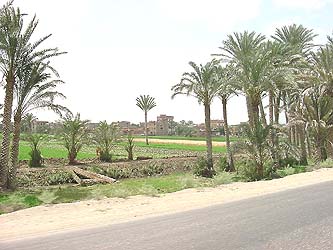
These pictures where taken in and around Dahshur�s general area.
Some facts about The Pyramids of Dahshur
Dahshur is situated some 45 km south of Giza. It is about 4 km long desert field with 3 pyramids of the 4th and the 12th dynasties. It used to be an off-limit military zone until 1996. As of today, the place have not find enough tourist market yet, as that of Giza and Saqqara, so the place can be yours and few other folks to enjoy.
Originally there were 11 pyramids in the area of which, 4 remain intact today. Two of these intact ones were build in the Middle Kingdom on which an oddly shaped one, the Pyramid of Amenemhet III, is worth seeing. It is also known as The Black Pyramid. It used to be some 104 sq m by 81 m high, made of mudbricks and lined with limestone.
Due to pilferage, the structure has now collapsed. It contains a maze of corridors and rooms to deceive tomb robbers. Thieves however, have penetrated some burial chambers, yet in 1993 few more precious funerary artifacts were found.
The two other remaining pyramids in this area are The Red and The Bent Pyramids. Both were built by Sneferu (2575-2551 BC), father of Cheops and founder of the 4th Dynasty. He too is thought to have built the third pyramid at Meidum. Why did Sneferu had 3 pyramids is a mystery.
The Red Pyramid is the world�s oldest true pyramid. Named so for the red graffiti scribbled on its outer surfaces. It is the only pyramid in Dahshur that is open for visitors at this time. Its entrance is at the north side, some 35 meter off the ground. A passageway of about 65 meters long leads to three chambers, the first two of which has some 15 meter high tapered ceilings and the third is some steps above the 2nd chamber. Cracks are now showing on its walls.
About a kilometer and a half, south of The Red Pyramid is The Bent Pyramid. The Bent Pyramid was built out of limestone. Its outer surfaces are polished with Turah limestones. Its rhomboidal form has puzzled Egyptologists for centuries. For some reason at about halfway its height, the slope changed from 54.31 to 43.21 degrees. There are several reasons been advanced why:
1. that the architects of Sneferu may have figured that the structure may collapse (as what happened to that in Meidum) if the slope were to be maintained
2. that by changing the slope, it may speed up the construction and,
3. that it may have been purposely done as evidence by the design of entrances thus: the northern entrance is just about 12 meters above the ground leading to upper chamber and (on the western side) is just about the ground level, leading to lower chamber.
<1>
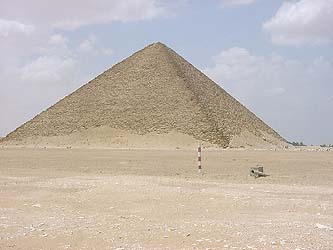 | 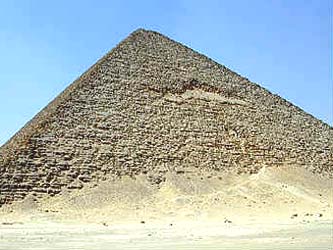 |
Shown above are the pictures of the Red Pyramid.
<2>
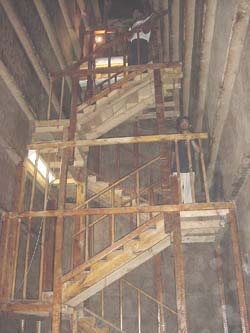 |
Here's a stairway leading to the 3rd chamber in the Red Pyramid.
<3>
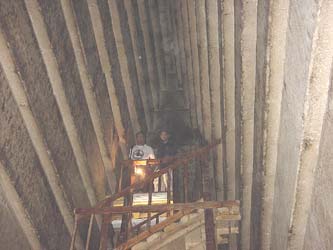 |
This is in the 2nd chamber. Note how the ceiling was tapered. Reminds me of those I saw in Central America done by the Mayan.
<4>
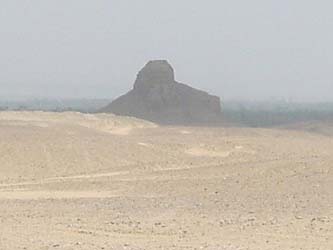 | 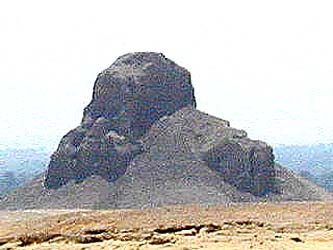 |
Here's a couple of pictures of the Black Pyramid of Amenemhet III.
<5>
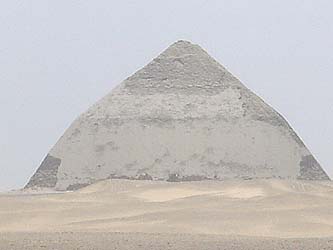 | 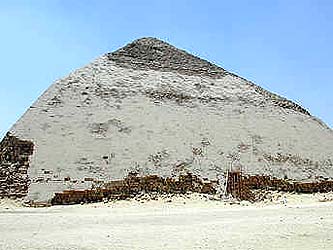 |
... and the Bent Pyramid.
<6>
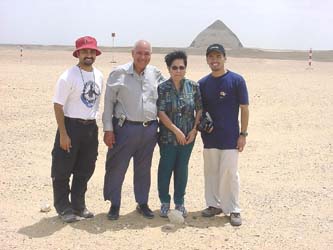 |
Here's my wife, My son on her right, my son's buddy Bobby and our driver/guide, Abdullah, with the Bent Pyramid behind. Sorry for me ... am always behind the camera.
<7>
 |