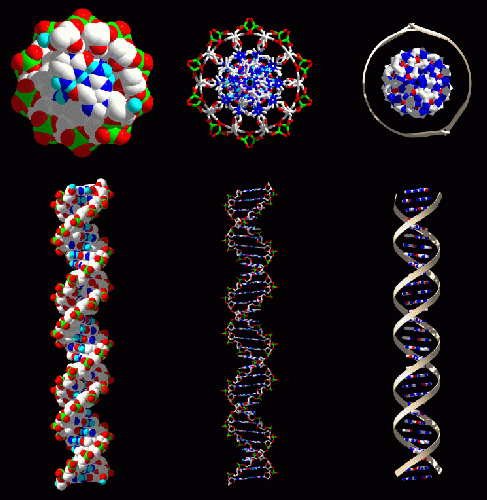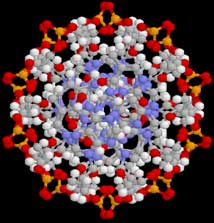
The picture of DNA |
In these days everyone can hear that the scientists have found the map of the human genes;absolutely, they heve found the the map of DNA. But, what is DNA? Does it belong to non-living things or is it a kind of ladder? Simple man can not know this. In my lecture I want to explain the importance of the DNA in our lives, its functions and structures, and its replication.
First of all, why is it so important that chromosomes be passed on from parent cell to daughter cells? Chromosoms are formed of genes, the segments of DNA that are the units of inheritance. Genes control the development of traits, such as hair color, blood type, skin color,and eye color. Genes commonly are said to be "on" chromosomes.The genes are linked on the chromosomes much like beads on a string.
|
Since genes are the segments of DNA, it is the chemical DNA that controls the development of traits and cellular activities. Experiments with bacteria that cause pneumonia have provided evidence that DNA is the material of heredity. Some of these bacteria have outer coats and are harmless. The presence or absence of the coat and the ability or lack of ability cause disease are inherited characteristics.
The ability to make the coat can be transferred from disease-causing bacteria to the harmless ones by transferring DNA from other cells. The harmless bacteria then develop coats and the ability to cause disease. The offspring of these changed bacteria also have coats and cause disease. From all of this information about bacterias show us that DNA is a kind of structure that carry and keep their genes or genetic materials to give or share their characteristic proporties to each other.
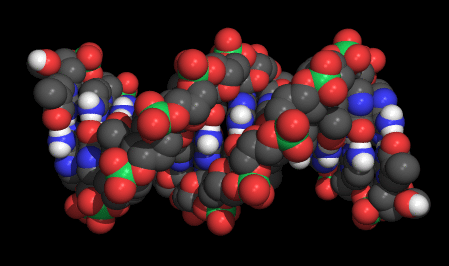
Interesting photo from DNA |
|
Then what I mean with saying "the structure of DNA". This is the second information that I said in introduction. The knowledge that DNA is the hereditary material led many scientist to study the structure of DNA. In 1953 an American biologist, James WATSON, and British biophysicist, Francis CRICK, propsed a model of tructure of DNA.
|
| DNA is very large molecule, but it is based on a very simple kind of chemicals. It is composed by nucleotids (NOO klee uh tidz). Each nucleotids includes five-carbon sugar called deoxyribose (dee ahk suh RI bohs), and a nitrogenous (ni TRAHJ uh nuhs) base. Nucleotids are joined by bonds between phospate group of one nucleotide and the sugar of the next nucleotide. The phosphate of the second nucleotides bounded to the sugar of the third nucleotide, and it continues like this. All in all, a long chain of nucleotides is formed.
|
| The nitrogenous bases extend out from the sugars of the phosphate-sugar chain.Four bases exist in DNA: these are adenine (AD uh neen), cythosine (SI tuh seen), guanine (GWAH neen), and thymine ( THI meen). However these bases are not conbined each other, instead they have a specific bases. Adenine (A) always bonds to tyhmine (T). Cythosine (C) always bonds to guanine (G). All of these compose a DNA molecule which two chains of nucleotides joined by weak hydogen bonds. The chains of nucleotides spiral around a common center. The spiral shape of the molecule is a double helix. To picture the shape of a double helix, illustrate a flexible ladder that can be twisted. The sides of ladder represent the bounded sugars and phosphates of the nucleotides. The rungs of the ladder represent the bounded pairs of bases.
|
| Now we all have the information about the DNA and its sequances.However, how about the DNA replication? And this is the last part of my lecture. Form previous information we can say that the pairing of bases in the complementary chains of nucleotides is the basis of DNA replication. Chromosomes in DNA are duplicated during interphase, before cell divisions begins. As a result of mitosis, the daughter cells recieve identical copies of the genetic material of the parent cell. Daughter cells formed during meiosis (mayoz bolunme) recieve copies of half of the genetic material of the parent cell. The process in which a DNA molecule makes a copies of itself is called DNA replication.
|