
"Take all the remarkable people in history, Rattle them off to a popular tune."
|
"Take all the remarkable people in history, Rattle them off to a popular tune." |
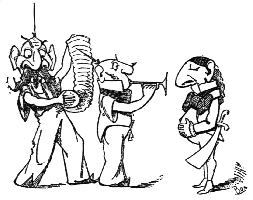 |
1870: Gilbert's play The Princess with its subtitle 'A Whimsical Allegory, Being a Respectful Perversion of Mr. Tennyson's Poem' is produced at the Olympic Theatre on January 8th. The work contains 'borrowed' music from Hervé and Offenbach.
|
Historic Note: The story of The Princess tells of three men who disguise themselves as women to access an all woman's university. The original production had the part of Hilarion played by a woman, Maria Simpson. His brothers played their characters en travesti which were the rule in burlesque. The play ran until April, went on tour, and then lay dormant until it was revived as Princess Ida. |
|
-Extract- HILARION: Here lives the porter, Cyril. I'll be bound
He's quite as learned as the rest of them,
Half Newton and half Bacon! Here he comes. Enter GOBBO from lodgeCYRIL: Half Bacon? No,--all Bacon I should say! GOBBO Now then, what is it? HILARION: I'm a royal prince;
These gentlemen are followers of mine;
We hold King Gama's letters, charging you
To bear us safely to the Council Hall,
In which the Princess Ida holds her state.GOBBO: Ho! ho! ho! ho! HILARION: How now?--you mock at us? (Draws sword.) GOBBO: Mock you? Why, bless your heart and soul alive,
No man may place his foot within those walls;
It's death to disobey our Princess, sir! FLORIAN: It's double death to disobey your king! (draws.) CYRIL: It's treble death to disobey ourselves! (draws.) GOBBO: But, sirs, I am the only man alive
Who ever enters! FLORIAN: You? GOBBO: Yes! Once a year
I am led through their ranks that they may see
What sort of thing's a man! "See here!" she cries.
"See--this is what you lose in losing man!
This is a courtly knight--well born, well formed!"
(I'm comely, sirs; but, bless you, I'm no knight!)
"Look, girls," she cries, "this is a courtly knight--
A type of all that's beautiful in man!"
(aloud) And then they make me gibber, squeak, and mow;
Then, with much deference and mock courtesy,
They bow me to my duty at the gate!FLORIAN: Are there no males whatever in those walls? GOBBO: None, gentlemen, excepting letter mails!
And they are driven (as males often are
In other large communities)--by women!
If you'll believe me, gentlemen, I swear,
She's so confoundedly particular,
She'll scarcely suffer Dr. Watts's hymns;
And all the animals she owns are "hers"!
The ladies rise at cockcrow every morn--HILARION: Oh, then they have male poultry! GOBBO: Not at all.
(confidentially.) The crowing's done by an accomplished hen!
To check out the complete 'Princess' click here
|
|
-Extract- GENTLEMAN IN BLACK: I have the power of transferring your soul into his
body for one calendar month--at the end of the month your soul
reverts to its original tabernacle. What do you say? Shall I do
it?
BARON OTTO YON SCHLACHENSTEIN: For one month only(?)
GENTLE: Only for one month. This is the thirteenth August,
1584, on the thirteenth September your souls will revert to their
proper bodies.
BARON: Agreed. Go it.
GENTLE: Very good. Behold--I go it!
Recitative
Otto's body, grim and droll,
Shrine young Hans's simple soul;
Otto's soul, of moral shoddy,
Occupy young Hans's body! [He makes passes, and flashes fire. Hans immediately assumes the ferocious demeanour of the Baron --the Baron assumes the loutish demeanour of Hans. N.B.--For the sake of convenience, Hans�s body with the Baron's soul will be distinguished as the "False Hans," the Baron's body with Hans's soul as the "Real Hans."]
GENTLE: There, it's done! How do you like it?
FALSE HANS: Potz-tausend himmel Sackerment noch emmal! This
is a tight fit!
REAL HANS (chuckles as Hans did--looking in mirror): What an
ugly brute I am!
FALSE HANS (indignantly): Potz-tausend! What do you wean by
that? You're a devilish good-looking fellow, sir. Look at me!
here's a sight! And I've got to go about like this for a month--
and in these clothes, too! Potz-tausend himmel Sackerment noch
emmal! [Pulls at cloth of his coat.]
REAL HANS: I say, baron, don't do that--that's my best
doublet, and it won't stand trifling with.To check out the complete 'Gentlemen In Black' click here
|
|
Historic Note: This could have very well worked out as being the very first Gilbert and Sullivan operetta. German Reed had hoped Sullivan would set the music and had written to ask him. Sullivan stipulated a higher price than the gallery could afford so Reed wrote the music himself. |
|
-Extract- KING PHANOR: That palace is enchanted. Every one
Who enters there is bound to speak the truth--
The simple, unadulterated truth.
To every question that is put to him
He must return the unaffected truth.
And, strange to say, while publishing the truth
He's no idea that he is doing so;
And while he lets innumerable cats
Out of unnumbered bags, he quite believes
That all the while he's tightening the strings
That keep them from a too censorious world.
What do you say to that?QUEEN ALTEMIRE (Amazed):Say? Would the world
Were one such palace, Phanor!KING PHANOR:If it were,
At least we all should meet on equal terms;
But to be taken from a world in which
That influence don't exist, and to be placed
Inside a fairy palace where it does
(Accompanied, moreover, by one's wife),
Might take one at a disadvantage!QUEEN ALTEMIRE: Well,
I am prepared to undergo the test
If you'll accompany me.KING PHANOR:No, no, no!
You are a worthy woman, Altemire,
But, Altemire, you have your faults!QUEEN ALTEMIRE: My lord,
I am a woman!KING PHANOR:Yes, exactly so!
If you were not a woman, Altemire,
Or, being one, were some one else's wife,
I'd take you there tomorrow!
To check out the complete 'Palace of Truth' click here
|
|
Historic Note: Financially Gilbert did very well with The Palace of Truth. He was paid 4 guineas a night till February, 1871 and 2 guineas thereafter. On tour Gilbert asked 3 guineas a night. |
 |
|
Historic Note: Pygmalion and Galatea was so popular that other Pygmalions were rushed to the stage. In January, 1872, Ganymede and Galatea opened at the Gaiety. This was a comic version of von Suppé's Die Schöne Galatea, with Sullivan's brother, Frederic, in the cast. In March, William Brough's Pygmalion; or, The Statue Fair was revived and in May a visiting French company produced Victor Massé's Galathée. |
 |

|
|
Historic Note: Thespis was a hasty piece of work, for Gilbert was simultaneously engaged on two other plays. It was, however, still moderately successful and was withdrawn only at the end of the pantomine season, outlasting a number of other special productions. Thespis was a classical extravaganza written to serve the great stars of the Gaiety, who at the time included J.L Toole, Nellie Farren (who appeared in tights as Mercury) and the Payne Brothers - the most famous Harlequin and Clown of their day. |
|
Historic Note: Crystal Palace, famous exhibition hall designed by Sir Joseph Paxton for the Great Exhibition of 1851 in London, England. Because of its great size and its innovative use of glass and iron in prefabricated units, it was a milestone in the development of modern architecture. After the exhibition closed, the prefabricated building was dismantled and then reconstructed at Sydenham in south London. The Crystal Palace was destroyed by fire in 1936. "Crystal Palace," Microsoft® Encarta® Online Encyclopedia 2000 |
 |
|
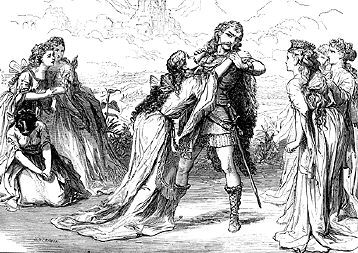
Historic Note: Althought Charity was a failure in England it was produced with great style at the Fifth Avenue Theatre in New York. It had a run of forty-two nights which was a good run for America. This gave Gilbert no pleasure for the producer added characters and revised the text without asking permission. The American court wouldn't issue an injunction either. |
 |
| Continue on to 1875 | To the Operas |