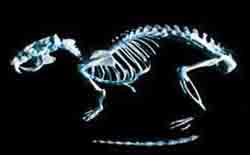
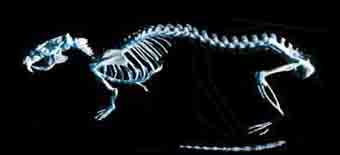
Proposal for gene overexpression on transgenic mice with skeletal overgrowth.
(The images are indicative of the normal and mutant animal )
Purposeful mutations on mice as an artistic process
And the painter too is, as I conceive, just such another -- a creator of
appearances, is he not?
Of course.
But then I suppose you will say that what he creates is untrue. And yet there
is a sense in which the painter also creates a bed?
Yes, he said, but not a real bed. [597a]
Then if he does not make that which exists he cannot make true existence, but
only some semblance of existence; and if any one were to say
that the work of the maker of the bed, or of any other workman, has real existence,
he could hardly be supposed to be speaking the truth.
[598b]
Which is the art of painting designed to be -- an imitation of things as they
are, or
as they appear -- of appearance or of reality?
-Of appearance.
Plato, Republic 39 (595a-602b)
Transgenic art, a term proposed by E.Kac , is based "on the use of genetic engineering
techniques to transfer synthetic genes to an organism or to transfer natural
genetic material from one species into another, to create unique living beings".
The artist, , will study the gene over-expression that cause skeletal overgrowth
on transgenic mice. The aim is to get mutant animals with extended skeletal
system as a model for a superhuman anatomy.
Is Nature, in the end, becoming the artificial product of humanity, which
will be a tautology to civilization?
Organisms created
in a lab display inherent restrictions compared to those in "natural" environments
with more intense antagonism. From the idea of "unchanging", "fixed" species
to evolving organisms and now to "population thinking organisms", morphology
always reveals the laws behind forms. At the end, selection will classify all
new variants, urging each alternate to face discrimination. The genetic program
of organisms is a computing system as well as the center for performing certain
behaviors. At the same time genes will be our highest form of reflection with
the environment. It is rather premature but not pointless to speculate that
genetic data may include us in the role of a decisive designer; from humans
to Meta-, Super-humans or the Afterman, species evolve into one another. By
artistic means, the aestheticizing of evolution is the ultimate product of modernism;
either inside or outside nature, the natural body may now acquire the individual
consciousness of each regenerative organ or tissue, thus becoming a body in
excess, a body that reappears after postmodernism, retaining its functional
and consciencial anatomical unity-perpetually evolving in new organizational
levels.
Proposal for gene overexpression on transgenic mice with skeletal overgrowth.
(The images are indicative of the normal and mutant animal )

