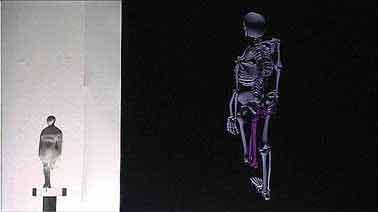
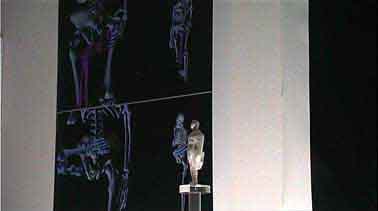
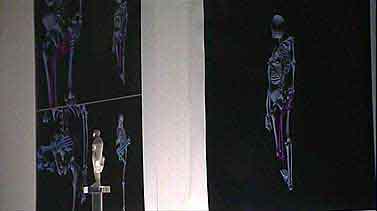
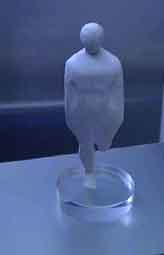
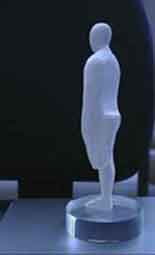
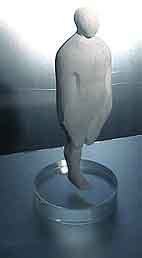
Sculpture model of a man standing, assuming a physically impossible position. [Height 20,8 cm, width 6,95cm, depth 3,95, aluminium cast, 2000].
Superhuman
What may be 'natural' to humans is difficult to say, and the term may well
be meaningless. The human genotype clearly has a very broad norm of reaction
with respect to most behaviours: any of a great many phenotypes may develop,
depending on the circumstances.
Douglas J. Futuyma
As mentioned before, Nietzsche used the term Superhuman to define a certain human "type" that would evolve through science and power. Paul Rabinow, in his text "Artificiality and Enlightenment: From Sociology to Biosociality", says that Foucault identified the modern form of power as bio-technico-power. Following, in an article about Foucault, which is entitled "On the Death of Man and Superhuman", Deleuze supported three forms for the man. The last form that comes by the name "surhomme" presents man as an imperfect and opaque being, who moves towards an unlimited end. [The term " afterman" is proposed by P.Rabinow over DeleuzeÕs term "surhomme"]. [6]
At the end, Eugene Thacker refered to the "regenerative body" which, like reptiles, regenerates whatever is damaged Ð"not the whole body, but rather the body parts or those sections articulated through anatomical and physiological science, as well as molecular genetics, which operate within the body according to certain variants." [7]
Paul Rabinow Ôs term "afterman" portrays the central attribute of "new body": transparency. In contemporary high-speed evolution practices that take place in the labs, the body still remains imperfect, while DNA engineering turns it into a diaphanous field of transformations. In this way, bio-transparency serves as the ideal path to bodily reformations and to another conjunction of the arts with science. It would be of primal interest to investigate what kind of artistic practices should be used for this arrangement.
The bio-technical approach seems to have some serious implications: On a social-political level it redefines all values. The bio-industrial approach often considers life as a product that resides beyond the procedures of socio-political control.
in technical terms, the bio-technical approach transforms human physiology into an area of genetic interaction (with unpredictable outcomes).
Artistically, gene
expression is possibly becoming our essential interface with the environment.
Art is now an interaction between genes and the environment. At the level of
criticism, the issue of "fabricated organism" claims to serve as the answer
to the virtualization and the subsequent loss of the body, as outlined by postmodernism.
As far as the third issue is concerned, we could observe the following:
Given that the body has already been open to extensions, it now becomes a field
for transformations. These changes will be derived from our inner body, the
genetic code, producing unpredictable forms. The aim would be to change the
genetic data in a way that a hybridist form of the human being will be produced
[9]. When genetic change comes deliberately, it may be argued that evolution
uses its own product, humans, as an organ for future mutations. The natural
selection could determine whether humans or human artifacts would survive in
the process of evolution.
As it has already been argued, Nature has always been an undefined term. It
is now more appropriate to say that if humans are part of nature, nature chooses
all potential evolutions; or even further, if the last border is our selves,
constructing our artifact successors will be the main issue of the future. [10]
Will a hypothetical Superhuman, as an artistic product, be able to manifest an acceleration in the evolutionary process?
Main issues that may emerge:
a. Development of specific spatial navigation strategies. (At the time that a new limp or organ is produced, requires the development of specific spatial navigation strategies, which is rather difficult to assume).
b. Study of the epigenetic processes. (How genes interact with the environment).
c. Competitive interactions between humans and Superhumans.
d. Extra limps "normally" acquire more independent genetic control, which makes genes interactions more unpredictable.
e. Will purposeful mutations lead to the humanised automaton or the dehumanised organism?
Sculpture
model of a man standing, assuming a physically impossible position. [Height
20,8 cm, width 6,95cm, depth 3,95, aluminium cast, 2000].
Links:
http://www.humancloning.org./
http://www.talkorigins.org/faqs/origin.html
http://cwis.usc.edu/dept/biomed/bme490.981/artificial_skin.htm
http://www.aec.at/lifescience/indexv4.html
http://www.newscientist.com/ns/981003/superhumans.html
http://www.ess.ucla.edu/huge/Biochips.html
http://www.biota.org/org/vision.html
http://prophecyclub.com/jan99/16.html
http://www.nih.gov/nigms/news/features/artificial_skin.html
http://cwis.usc.edu/dept/biomed/bme490.981/artificial_skin.htm
http://www.vegan-straight-edge.org.uk/taxonomy.htm
http://www.robotbooks.com/artificial-muscles.htm
http://www.ai.mit.edu/
Calvin H.William, " How Brains think", Univ.of Washington, chapt 8,
"Prospects for a Superhuman Intelligence". [http://faculty.washington.edu/wcalvin/bk8/bk8ch8.htm]
http://www.hedweb.com/nickb/superintelligence.htm
http://www.cs.usu.edu/~degaris/papers/journal.html
References and Notes
1 Stuart A. Kauffman, The origins of Order, (N.York : Oxford University Press,
1993), page 10.
2 Douglas J. Futuyma, "Evolutionary Biology", third edition, Sinauer
Associates, Massachusetts, 1998, pages 24 and 651.
3 Íüçóéò : intellect, mind, perception, interpretation.
4 C.Langton, "Artificial Life" (Cambridge, MIT Press, 1997)
5 Douglas J. Futuyma. ibid, page 742.
6 Paul Rabinow , in his article "Artificiality and Enlightenment: From
Sociology to Biosociality", refers to Gilles DeleuzeÕs book "On the
Death of Man and Superhuman", which presents "Man as a distinctive
being, who is both the subject and the object of its understanding, but an understanding
that is never complete because of its very structure."
7 Eugene Thacker, "The Thickness of Tissue Engineering: Biopolitics, Biotech,
and the Regenerative Body.", Ars Electronica, Lifescience, Springel Wien
New York, Austria 1999, page 184. Also Ars electronica public discussion, September
1999.
8 Paul Rabinow, "Artificiality and Enlightenment : From Sociobiology to
Biosociality ", Incorporations, edited by Jonathan Crary and Sanford Kwiner,
Zone 6, Zone Books, , N.York, (1992), page 234.
9 The hypothesis that humans are "machines, puts humans and machines in
a juxtaposition. Within western philosophy machines are often presented as "slaves",
potential antagonists to the human race. Hugo de Garis claims that robots will
conflict with the humans when their intelligence will approach ours.
10 Douglas J. Futuyma. page 743, Some behavious, such as wearing navel rings
or composing symphonies, are rare or "abnormal" (i.e., very different
from the average), but not "unnatural", for human nature is our behavioral
norm of reaction, which includes enerything that people do.It makes no sense
to judge a behavior as moral or immoral, ethical or unethical, on the basis
of whether or not it is "natural".
11 Consciousness: if every level of life has its own consciousness, then Superhuman
has a superior one. (Experiences a superior consciousness)
According to Bryan Kolb and Ian Q.Whishaw, consciousness is not thought to be
a unitary process. A human at different ages of life is not thought to be equally
conscious at each age. Animals vary in their degree of consciousness while simple
animals as ants, experience little consciousness and more complex animals such
as cats or dogs, display more consciousness. Since the nervous system is designed
to move the body through space, it is likely to argue that an extended anatomy
will affect consciousness. As the writers conclude: "Since there is growing
evidence that the various systems of the brain can interact and ' look what
the others are doing', it is becoming increasingly possible to imagine how complex
thought processes can be equated with consciousness and how 'self-consciousness'
is possible. (p. 484-485)12 Ed. Kac,"Transgenic Art",Symposium, Ars
Electronica Lifescience, (Austria : SpringerWienNewYork, 1999), (p.296).
Bibliography
Charles Darwin, Origin of Species, Introduction.
Socratis Gikas-Iason Evangelou, Presocratic Philosophers, Savalas publications,
Athens 1995.
Facing the Future, Ars Electronica, published by Timothy Druckrey,(Cambridge
: The MIT Press, 1999)
John Wood, Ôhe virtual Embodied, (London : Routledge books,1998)
Ars Electronica Center, Lifescience, (Austria : SpringerWienNewYork, 1999)
Mark Taylor , "HIDING", Chicago Press, 1997
Incorporations, edited by Jonathan Crary and Sanford Kwiner, Zone 6, Zone Books,
, N.York, (1992)
Fragments for a History of the Human Body, part 1, edited by Michael Feher,
ZONE 1990, N.York.
Gary William Flake, The Computational Beauty of Nature, (Massachussetts: A Bradford
Book, the MIT Press, 1998)
Bryan Kolb and Ian Q.Whishaw, Fundamentals of Human Neuropsychology, University
of Lethbridge, ( W.H. Freeman and Company, N.York, 1995 )
T.W.Sadler, "LangmanÕs Medical Embryology, sixth edition, Williams &
Wilkins, Maryland, USA,1990
George Gessert, " A History of Art Involving DNA", Ars Electronica,
Lifescience, Springel Wien New York, Austria 1999.
Bob Johnstone, "Japan's Friendly Robots", MIT'S Technology Review,
May-June 1999
, page 64, (1999)
Genetics, Vol. 96, Issue 18, 10278-10283, August 31, 1999.
Hans Moravec, "Mind Children: The Future of Robot and Human Intelligence.
Harvard University Press, Cambridge, Massachusetts, 1988.
Friedrich Nietzsche. Thus Spoke Zarathustra. Trans. Walter Kaufmann. New York:
Penguin Books, 1981.
Friedrich Nietzsche. Ecce homo. (Walter Kaufmann, Trans.). New York: Vintage
Books, 1967.
Friedrich Nietzsche. The Will to Power. Trans. and Ed. Walter Kaufmann and R.J.
Hollingdale. NY: Vintage, 1967.
Vilem Flusser, "Curie's Children," Art Forum Vol. 26, No. 7 (1988)
and Vol. 27, No. 2 (1988).
G. Gessert, "A Brief History of Art Involving DNA," Art Papers (Sept./Oct.
1996).
G. Gessert, "Notes on Genetic Art," Leonardo Vol 26, No. 3 (1993).
Theory of the Artificial, Virtual replications and the Revenge of Reality, Massimo
Negrotti, Intellect Books, England,1999
Lee Silver, Remaking Eden, Princeton University, 1997.
Steven Levy, Artificial Life, Vintage Books, N.York, [see chapter "The
Strong Claim", pages 311-348].
Gilles Deleuze, Nietzche and Philosophy, trans. Hugh Tomlinson, New York : Columbia
University Press, 1983.

