
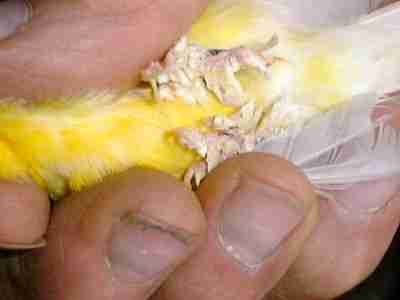
 this
budgie has a bad case of scaly foot.
this
budgie has a bad case of scaly foot.scaly face
Scaly-face or Mycosis of the
Beak:
This first shows up as a spotty, greyish-white film on the upper mandible,
starting at the corners of the beak and spreading sometimes to the ceres, the
rims of the eyes, the legs, and the vent. Possible cause: This disorder is
caused by the tiny burrowing mite Cnemidocoptes pilae, which is present in
passive form from nestling days and months or even years later can seriously
affect a bird weakened by stress or other negative influences. The mite burrows
into the horny tissue of the beak or into the epidermis and feeds on skin
particles and lymph. Sieve-like tunnels destroy the skin, and the horny growths
that appear are the bird's defense mechanism. The greyish film that shows up
first can harden like scales and form welts and protrusions. In the initial
stages this disorder bothers a parakeet very little, and it rarely spreads to
other birds. Often the hardened growths fall off by themselves and they are not
necessarily followed by other symptoms
what to do
Since Mycosis of the beak usually
affects parakeets with temporarily weakened resistance, the birds general state
of health should be watched. Give the highest quality food and add a
multivitamin solution to the drinking water. Greens (vegetables) are recommended
for the birds health also. The visible film and growths should be gently dabbed
with an antidote, but never with an oily contact insecticide, which could enter
the circulatory system through the skin and be fatal. Many veterinarians
recommend special ointments. In minor cases balsam of Peru, Parrafin Oil,
mineral oil or baby oil or Benzyl Benzoate or Dettol disinfectant may be
effective. Dab the effected spots with a Q-tip three times a day for three days,
then twice a day every other day for up to 3 weeks. Make sure that none of the
medication gets near the eyes, nostrils or mouth. If the feet are effected,
promptly remove the band if possible, because the legs tend to swell, causing
the band to cut off circulation. This disease is also contagious to other birds
in the nest or aviary. Some say the oils is the best remedy but we use Dettol
with good success if caught early. The oil should soften the scaly part which
may fall off and then a good disinfectant like Dettol can be used.
Cure or Prevention:
A cure for a severe mite problem is IVERTMECTIN available at most vets or some
pet supply stores. Dettol disnfectant can be used for mild cases of mites on the
legs and cere and for disinfecting cage utensils. Some oils such as mineral oil
or baby oil can also be used as the oil willl kill the mites and soften the
skin. In time the dry crusty area will come off.
The only way to prevent mites from re-occurring if they do, is to disinfect the
entire cage, food utensils, toys, etc. If more than one bird is present you must
treat them all even if only one seems affected. Some pet shops carry items you
can hang in the cage that is supposed to get rid of mites but we have never
tried these and doubt their effectiveness. Dettol is a good disinfectant to
clean the cage and dishes. Perches and toys should be boiled or soaked in bleach
and rinsed clean with fresh water and let dry before placing back in cage.
scaly leg
Scaly leg is caused by mites and the skin protrusions and large scales are the end result. The skin growth is usually from a prolonged or after affect of the mites even after they may have disappeared. The protrusions may be caused by the mites damaging the circulation of the leg causing the abnormal skin growth. You may only seed dry flaky scales on the skin or tiny red spots where the mites are burrowing into the fleshy skin. The scales are the residue of the mites burrowing. Long tassel-like projections are found growing from the foot of infected canaries. In the budgie, rough pale-colored crusts are seen on the feet, as well as on the face.
treatment?
Treatment for scaly leg is the same as scaly face above. You can use Dettol disinfectant, mineral oil, baby oil, Ivermectin or an acaricide (mite control) purchased from a vet or pet store.
this
budgie has a bad case of scaly foot.