Magical Minerals - January Lesson
Welcome to your first lesson in Magical Minerals! Rocks and minerals are all around you. If you walk along a river bank or go hiking in the mountains, you'll be sure to see them. Look closely at the stones in an old building or the pieces of gravel on a pathway. This month, we will be learning about minerals - the "building blocks" of rocks.
Introduction
What are Minerals?
Minerals are made up of the elements in the periodic table. (Don't worry if you haven't learned about the periodic table. You won't need to know about it for this course). Different combinations of elements give substances different properties. But what makes something a mineral?
There are four criteria that must be satisfied for something to be called a mineral:
1. It must be Naturally Occurring. That means it exists in nature, and is not made by humans. For example, the ice in a glacier IS a mineral, because it is formed by natural processes, but the ice in your freezer is NOT a mineral, because it is formed by the artificially cooled air inside the freezer. Today, many minerals can be made synthetically by industrial processes, but these are not technically called minerals because they were not formed in the natural world.
2. It must be Solid. Liquids and gases cannot be called minerals, even if they have the same chemical composition as a mineral. For example, solid water (ice) in a glacier is classified as a mineral, but liquid water is not a mineral.
3. Its composition can be expressed by a specific chemical formula (although the composition can vary within certain limits)
4. It has a crystal structure. What this means is that the elements that make up the mineral are arranged in a regular way. Sometimes, this crystal structure is obvious, such as a large crystal of quartz. Other times, you have to look at the substance under a microscope to be able to see the crystal structure. Some materials satisfy #1-#3, but do not have a crystal structure. One example is volcanic glass (obsidian). This material is naturally occurring, solid, and can have a definite composition, but it has no crystal structure, so it is not technically a mineral. Some minerals can have the same composition, but different crystal structures. Diamond and graphite are both made entirely of the element carbon. In diamond, the carbon atoms are arranged in a 3-dimensional network, whereas in graphite they are arranged in sheets. The crystal structure greatly influences the properties. Diamond is clear, colourless (if pure), and very hard. Graphite is grey, opaque, and very soft.
How do we identify minerals?
Colour: Colour is actually not a very good identifier, since many minerals contain impurities. For example quartz when pure is clear, but it can also be purple, pink, yellow, black, milky-white, red, or green, depending on the impurities it has.
Streak: Streak refers to the colour of the powder produced when a piece of the mineral is scratched over a rough tile. This property tends to be more consistent that the actual colour. One dramatic example is the mineral hematite. You will often see it in rock and gem shops. It is a shiny greyish-black mineral when polished, but its streak is red in colour. (However, polished specimens may have a glaze over them, so you might not see this until the glaze has been scratched away).
Crystal Shape/Cleavage: The shape of the crystals can help in identifying minerals. Also, the mineral may preferentially break along one or more "cleavage" planes. The number and orientation of these planes is fixed for a given mineral.
Hardness: Hardness description in minerals is based on the "Mohs scale of hardness".
1. Talc
2. Gypsum
3. Calcite
4. Fluorite
5. Apatite
6. Orthoclase
7. Quartz
8. Topaz
9. Corundum
10. Diamond
In the list above are ten minerals. Diamond is the hardest, while talc is the softest. A mineral with a higher number will scratch a mineral with a lower number (for example, topaz will scratch quartz). For example, if your unknown mineral will scratch Fluorite but not apatite, you can assign it a hardness of 4.5. However, in practice, no one would carry these minerals around with them. Instead, we can use common items we are likely to have with us (a fingernail is about 2 on the scale, a penny about 3, a knife 5, window glass is 5.5 etc.)
There are other methods used to identify specific minerals, such as magnetic properties, specific gravity (density), iridescence, fluorescence, reaction with various chemicals, magnetic properties, and the appearance of a thin slice of a mineral under polarized light.
Magical Minerals of the Month: Quartz and Diamond
Quartz
Physical Properties:
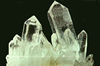
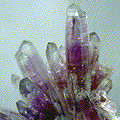
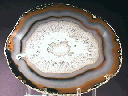
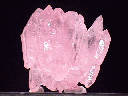
Quartz is made up of the elements Silicon and Oxygen, arranged with four oxygen atoms in a tetrahedal, or triangular-pyramid shape, with a silicon atom in the centre. Some of the oxygen atoms are shared between two adjacent silicon atoms, so the overall chemical formula is SiO2. Quartz is a very common mineral, and can exist in many different shapes and colours. The photos above show crystalline pure quartz, amethyst (containing iron as an impurity, giving it the purple colour), chalcedony or agate (the crystals are microscopic), and rose quartz (trace amounts of titanium gives the pinkish colour). There are many other varieties as well, including smoky quartz, citrine, milky quartz, tiger's eye, onyx, and carnelian.
Magical Properties:
Since quartz is such a common mineral, it has many attributed magical properties in many different cultures. Generally, the properties assigned to the quartz depend on what colour it is (ie. amethyst would have different properties from rose quartz). To the ancient Japanese, quartz represented perfection, and they believed that quartz formed from the breath of a white dragon. In aboriginal cultures in North America and Australia, quartz played an essential role in rain rituals. In modern times, quartz is often used in new-age healing practices, with different varieties of quartz being used to treat different ailments. It is also said to amplify energies and facilitate meditation.
Diamond
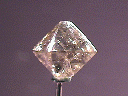
Physical Properties:
Diamond is the hardest known substance. It consists entirely of the element carbon (C), arranged in a three-dimensional network. Diamond is very rare, and was formed during violent prehistoric eruptions where material from below the earth's crust was ejected onto the surface. The rock in which diamond is found is called kimberlite. The largest rough diamond ever found is the "Cullinan" diamond from South Africa, weighing 3106 carats (621 grams or 1.36 pounds). Only about 25% of diamonds produced are gem quality, and most of those are very small. And don't believe everything you hear... diamonds aren't forever. They are only stable at very high temperatures and pressures. At the earth's surface, they will gradually decay to graphite (although for your average sized diamond ring, this would take several billion years!)
When talking about cut diamonds, there are four considerations when determining a diamond's value, known as the 4 C's. "Cut" refers to the shape that a diamond is cut into. Rough, or uncut diamonds are actually quite dull, it is only once they are cut that they become so brilliant. If the diamond is poorly cut, it will be less valuable than one that is well cut. Shown below are different cuts of diamonds.
Round: Radiant:
 Princess:
 Pear:
Pear:
Oval: Marquise:
 Heart:
 Emerald:
"Clarity" refers to how clear the diamond is. If there are flaws within the diamond crystal, it will not be as brilliant, so the value will be less. "Carat" refers to the weight of a diamond. One carat = 200mg. (For the non-metrics, 142 carats = 1oz.) Obviously, the bigger the diamond, the more valuable it is. Finally, "Colour" is also important. Most diamonds have a slight yellowish tint. The most desireable diamonds are totally colourless. Increasing amounts of yellow will decrease the value of the diamond, to a point. Very yellow diamonds (or diamonds of other colours, such as green or blue) are quite rare, and are therefore also very expensive.
Magical Properties
The word diamond comes from the Greek word "adamas" meaning invincible. Diamonds are often associated with strength, purity, and love in many different cultures. Ancient Romans believed diamonds brought the wearer courage in battle. Ancient Jewish priests would hold a diamond before an accused person. If the stone became dull or darkened, the person was guilty. If it glowed brightly, they were considered innocent. In Hindu culture, it was believed that diamonds were created when lightning struck rocks.
The Real World: Rocks and Minerals you see and use every day
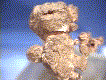 Copper (Cu) Take a look at the cords connecting any electrical device, such as a desk lamp or computer, to the power source. Inside the plastic covering, the wires are most likely made of copper. Same with the wiring inside your house (if you're a Muggle-born). Another common place you'll find copper is in pennies and other low-denomination coins. Although they used to be made from copper, they are now made of a mixture of metals, including copper and zinc. Pennies actually contain more zinc than copper. (This may depend on what country you're in).
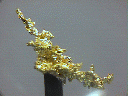 Gold (Au) You may have some gold jewellery, or you may have had a tooth replaced with a gold crown. Most of the world's gold sits around as gold bars in big vaults and is used in international trade. One of the reasons that gold is so valuable is that it is resistant to corrosion, but by itself gold is very soft. When people talk about "karats" of gold, it refers to the purity (This is different from carats of diamonds, which refers to the weight). 24K gold is 100% gold. Because it is so soft, it's not very good for making jewellery, because it would quickly get scratched and bent out of shape. In order to make it stronger, it is mixed with other metals, such as silver. This improves the strength, but also makes it more prone to becoming tarnished. Common gold purities used in jewellery are 10K, 14K and 18K.
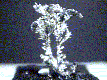 Silver (Ag) Silver is used in photography, cutlery, electronics, and jewellery.
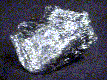 Graphite (C) The "lead" in your pencil is not really lead at all - it is graphite. In fact, the word "graphite" comes from the Greek word meaning "to write". Most of the graphite used today is produced synthetically, so is not technically a mineral.
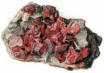 Realgar (AsS) You may not have heard of this mineral, but it produces the brilliant white light you see in fireworks. (Other minerals produce different colours, such as green or red, but most of these chemicals are produced synthetically).
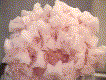 Halite (NaCl) This is one of the few edible minerals! It is more commonly known as table salt.
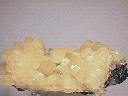 Calcite/Marble (CaCO3)Calcite and similar minerals are used to make cement for concrete. Marble is the name for a metamorphic rock made up of calcite, and is used in building stone and as an ornamental stone.
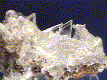 Gypsum (CaSO4) Gypsum is used to make drywall (wallboard) and plaster of paris.
 Kaolinite (Al2Si2O5(OH)4) Kaolinite is a clay mineral. It is white in colour, and is often used in making dishware. "Clay" is usually made up of several different minerals, and is used for everything from bricks, tiles, and pipes, to pottery.
Quartz (SiO2) Imagine yourself on a beautiful white sandy beach. Now look carefully at the grains of sand. They are most likely made of the mineral quartz. If the beach is made up of brown or grey sand, there are likely other minerals present in addition to quartz. Quartz also has some interesting electrical properties when pressure is applied to it, so you can find it in watches and radios. (It can vibrate at a fixed frequency when an alternating current is applied).
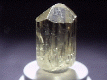 Apatite (Ca5(PO4)3(OH)) This is the material that makes up your bones and teeth. Although not technically a mineral, since it is produced by a living organism, it is otherwise identical to the apatite that you would see in rocks.
Proceed to Assignment
Return to Homepage